Research Areas

Cognitive AI & Neurorobotics
Keywords
Neuro-Cognition / Artificial Intelligence / Machine Learning / Human-Centered AI / Neurorobotics
Description
As a bridge between humans and technology, the triad of cognition, artificial intelligence (AI), and (neuro-)robotics is becoming increasingly central, as these future technologies transform human–machine interaction. These three areas encompass a wide range of methods. A particular strength of research at TU Chemnitz lies not only in machine learning methods but also in neurocognition and the development of intelligent systems modeled on the human brain.
Research in this focus area aims to enhance the efficiency and quality of hybrid human–machine societies by enabling machines to acquire higher cognitive capabilities or robots to develop self-representation and agency.
Contacts
Prof. Dr. Fred Hamker – Chair of Artificial Intelligence
Prof. Dr. Florian Röhrbein – Chair of Neurorobotics
Prof. Dr. Dr. Marco Ragni – Chair of Predictive Behavioral Analysis
Transport & Mobility
Keywords
Driver Assistance Systems / Automated Driving / Interaction of Different Road Users / User State Monitoring / Innovative Mobility Concepts
Description
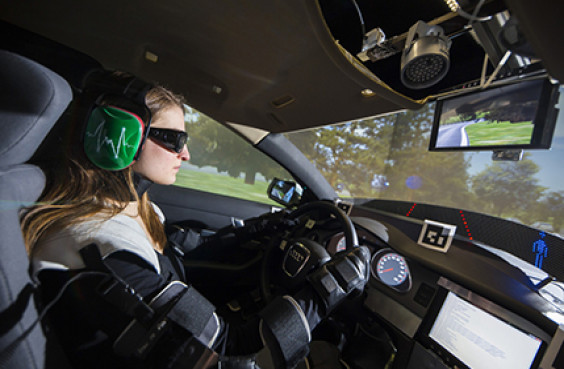
Research on human–technology interaction in the field of transport and mobility covers a wide range of topics. Within the framework of human-centered design and evaluation of driver assistance systems, the study of anticipatory interaction between different road users, and the consideration of the requirements and needs of passengers in highly automated vehicles, future users are involved early in system development to make transport and mobility safer, more efficient, and more comfortable.
Factors such as system trust and technology acceptance, as well as user characteristics such as age, driving experience, and other personality traits, along with algorithmic real-time monitoring of user state, play a central role.
Another research focus is the design and evaluation of innovative, sustainable, and multimodal mobility concepts in urban and rural transformation areas. New virtual reality-based participation formats are tested, and existing instruments for participatory transport planning are further developed.
Contacts
Prof. Dr. Angelika Bullinger-Hoffmann – Chair of Work Science and Innovation Management
Prof. Dr. Stefan Brandenburg – Chair of Cognitive Psychology and Human Factors
Prof. Dr. Klaus Mößner – Chair of Communications Engineering
Prof. Dr. Stephan Odenwald – Chair of Sports Equipment Technology
Human Factors
Keywords
Interaction Design / User Experience (UX) / Ergonomics / Accessibility / Acceptance
Description
Human Factors focuses on human actors in their complex interactions with technologies, products, and environments. Depending on the research question, individuals, groups, and societal organizations are considered. Based on the diverse requirements of people, Human Factors research designs or modifies complex systems across various domains to meet human needs.
One domain is transport, e.g., redesigning traffic rules and infrastructure to support the use of (partially) automated vehicles, or designing automated driving behaviors to address the question of how humans want automation to operate. Another domain is production, for instance, developing AI-assisted human–robot workstations that are intuitive, inclusive, and supportive of learning, while also ensuring modern occupational health and safety standards.
In summary, Human Factors research aims to (re)design systems optimized for safety, efficiency, comfort, and user satisfaction. Various aspects are considered, including ergonomics and physical workload, cognitive demand, personnel selection and training, accessibility, and user acceptance. Human Factors is therefore a highly interdisciplinary field, benefiting from contributions in sociology, psychology, computer science, and mechanical engineering.
Contacts
Prof. Dr. Lewis Chuang – Chair of Human and Technology
Prof. Dr. Stefan Brandenburg – Chair of Cognitive Psychology and Human Factors
Prof. Dr. Angelika Bullinger-Hoffmann – Chair of Work Science and Innovation Management

Ethics & Law
Keywords
Intelligent Systems / Robotics / Artificial Intelligence / Data Economy / Ethics / Trust and Responsibility / Legal Frameworks / Standardization
Description
Beyond general guidelines, research at the human–technology interface touches on two essential ethical dimensions: responsibility toward the individuals directly involved in research and the potential long-term impacts on society. The Ethics & Law focus examines human–technology relationships particularly from the perspective of societal frameworks shaped by our values. These values are reflected not only on an ethical-moral level, guiding behavior and decisions, but also within our legal system, where constitutionally guaranteed protections and rights define individual and collective well-being, including corresponding duties, responsibilities, and liabilities.
We investigate how new technologies affect this carefully balanced system of values and how society and law should respond. This involves both the theoretical grounding of technical and socio-technical systems to design them in a value-oriented and regulatory-compliant manner, as well as addressing current, concrete questions at the interface of research, development, innovation, technology, and law.
Contacts
Prof. Dr. Dagmar Gesmann-Nuissl – Chair of Private Law and Intellectual Property Law
Prof. Dr. Alexandra Bendixen – Chair of Structure and Function of Cognitive Systems
Prof. Dr. Anja Strobel – Chair of Personality Psychology and Assessment

Sensing & Cognition
Keywords
Sensing / Cognition / Psychology / Perception / Behavior
Description
At TU Chemnitz, researchers investigate human and machine perception, cognition, and behavior through cognitive science experiments, field studies, sensor development, immersive simulations, and neurocognitive modeling inspired by the brain. The development of new sensors and the study of sensor systems and multimodal (human) perception is conducted across faculties, spanning fundamental research to diverse applications. A particular focus is on realistic, complex scenarios, such as intelligent sensing in human–technology interaction, perception and understanding of everyday scenes, and changes in sensing, cognition, and motor skills across the lifespan. Interdisciplinary degree programs such as Sensing and Cognitive Psychology (B.Sc., M.Sc.), Human Factors (M.Sc.), and Neurorobotics (M.Sc.) at TU Chemnitz introduce students to this research and prepare them for careers in these forward-looking fields.
Contacts
Prof. Dr. Alexandra Bendixen – Chair of Structure and Function of Cognitive Systems
Prof. Dr. Wolfgang Einhäuser-Treyer – Chair of Physics of Cognition
Prof. Dr. Olfa Kanoun – Chair of Measurement and Sensor Technology
Prof. Dr. Ulrich Schwarz – Chair of Experimental Sensing
Virtual & Augmented Humans
Keywords
Human–Technology Interaction / Digital Simulation / Virtual Human Models / Augmented Humans
Description
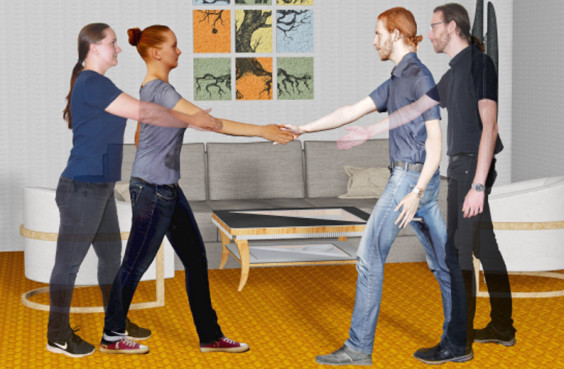
Digital simulations using virtual human models are often employed to optimize the coordination between humans and technology. The importance of a human model increases significantly with the number of human characteristics that can be integrated into it. Central aspects of our work include realistic visual representation of the human body, synthesis of human movements and speech, and behavioral modeling that incorporates cognition and emotion.
The increasing integration of the human body with technical devices (e.g., implants, prosthetics) introduces new challenges in human–technology interaction. Digital human models must therefore be extended to include the possibility of technical body augmentations. For simulating interaction with and between augmented humans, psychological and sociological studies are necessary to understand how such augmentations affect self- and social perception as well as social interactions.
This research focus cooperates closely with the Interdisciplinary Competence Center Virtual Humans at TU Chemnitz.
Contacts
Prof. Dr. Guido Brunnett – Chair of Computer Graphics and Visualization
Prof. Dr. Bertolt Meyer – Chair of Work, Organizational, and Economic Psychology
Prof. Dr. Maximilian Eibl – Chair of Media Informatics
Prof. Dr. Dr. Marco Ragni – Chair of Predictive Behavioral Analysis

Digital Media and Communication
Keywords
Digital Platforms / Societal Change / Social Networks / User-Centered Communication
Description
How do people exchange information with each other through digital media? Multiple disciplines—including communication and media studies, linguistics and semiotics, digital humanities, political science, and sociology—focus on digital media as a subject of research. The Digital Media and Communication research area examines the impacts, opportunities, and challenges of digital technologies on communication in social, professional, and cultural contexts.
The research explores how digital platforms, social networks, and innovative media formats enable new forms of exchange and collaboration. Analytical activities are diverse and highly dynamic due to their close connection with technological development processes. The field is strongly interdisciplinary, combining perspectives from communication and media studies, computer science, psychology, semiotics, media linguistics, sociology, and design to develop a comprehensive understanding of digital transformation.
Key topics include challenges in digital communication, changes in societal communication, teaching and learning with digital tools, the significance of manual actions and gestures in robotics, workplace design, and product development, as well as the broader societal impacts of technological innovation.
Contacts
Prof. Dr. Veronika Karnowski – Chair of Media Communication
Prof. Dr. Ellen Fricke – Chair of German Linguistics, Semiotics, and Multimodal Communication
Prof. Dr. Marco Ragni – Chair of Predictive Analysis
Prof. Dr. Lewis Chuang – Chair of Human and Technology

Technology Reflection and Implications
Keywords
Societal Change / Technology Acceptance
Description
New technological developments shape our daily lives and permeate nearly all areas of society. Evaluating these developments from both historical and societal perspectives is therefore increasingly important. In addition to examining the potential of technological innovations to influence social, cultural, and economic processes, Technology Reflection focuses on the interaction between technical systems and societal change.
Interdisciplinary approaches help critically assess technological transformations and develop sustainable solutions. The growing technologization of society inevitably raises questions about technology acceptance, public perceptions of science and technology, and the underlying expectations and concerns. A central research question concerns the role of language and communication in technologically shaped discourses.
Linking adaptive technologies with socially relevant topics enables reflection on technological innovations, their applications, and their effects on society.
Contacts
Prof. Dr. Lewis Chuang – Chair of Human and Technology
Prof. Dr. Ellen Fricke – Chair of German Linguistics, Semiotics, and Multimodal Communication