TU Chemnitz Successfully Concludes International DAAD Project „WeSPICE" in Sfax
TU Chemnitz Completes Collaborative Project Funded by the German Academic Exchange Service with ENET'COM and Industrial Partner Dräxlmaier Group
-

Successful completion of the three-year ‘WeSPICE’ cooperation project at the École Nationale d'Electronique et de Télécommunications de Sfaxan in Tunisia. Image (from left to right): Prof. Achraf Mtibaa (project coordinator, Tunisia), Ali Hammami (Group Quality Manager, Dräxelmaier Group), Prof. Chokri Abdelmoulah (Director of the National School of Electronics and Telecommunications of Sfax, Tunisia), Prof. Dr. Olfa Kanoun (Chair of Measurement and Sensor Technology at Chemnitz University of Technology). Photo: Chair of Measurement and Sensor Technology -

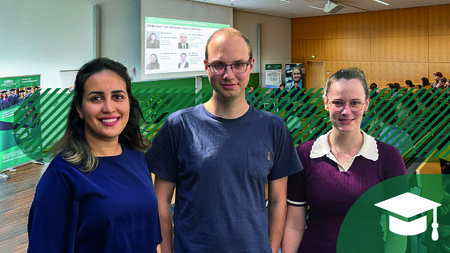
The discussion panel ‘Strengthening Tunisian-German Collaboration in Education, Research, and Industry: Towards Sustainability and Long-Term Partnerships’ was moderated by Prof. Dr. Olfa Kanoun (2nd from right) and Assoc. Prof. Achraf Mtibaa (2nd from left) during the final week. Photo: Chair of Measurement and Sensor Technology -

The three-year cooperation project ‘WeSPICE’ consisted of an international exchange of students and staff from Chemnitz University of Technology and the State University of Tunisia and included student-oriented events and further training courses for specialists at ASPICE. Photo: Chair of Measurement and Sensor Technology -

The staff of the Chair of Measurement and Sensor Technology at Chemnitz University of Technology (from left to right) Dr Thomas Keutel, Dr Christian Viehweger and Prof. Dr Olfa Kanoun took part in the ASPICE training course. Photo: Chair of Measurement and Sensor Technology
From December 1 to 4, 2025, the final week of the three-year collaborative project „WeSPICE" took place at the Tunisian university École Nationale d'Electronique et de Télécommunications de Sfax (ENET'COM). The project was funded by the German Academic Exchange Service (DAAD) as part of the Ta'ziz Partnership Program. The following staff members from the Chair of Measurement and Sensor Technology at Chemnitz University of Technology were involved in the project: Prof. Dr. Olfa Kanoun (Chair holder), Dr. Thomas Keutel (Project Manager Impedance Spectroscopy), Dr. Christian Viehweger (Working Group Leader and Project Manager Energy-Autonomous Sensor Systems), Dr. Rim Barioul (Working Group Leader Smart Wearables), Dr. Hiba Hellara (Project Manager Smart Wearables), and Mohamed Dhia Ayadi (Project Leader Micro- and Nanosensors (Nanogenerators)). The project was officially concluded with all participating organizations on December 4, 2025, in a ceremonial closing event attended by representatives from TU Chemnitz and the German Embassy in Tunis, as well as the Director of the DAAD Country Office.
Cross-Border Professional Development and Student Orientation
TU Chemnitz and ENET'COM in Sfax have worked closely in recent years with the Dräxlmaier Group, headquartered in Vilsbiburg, Lower Bavaria. The globally renowned premium vehicle manufacturer develops and produces wiring systems, electrical and electronic components, battery systems, and high-quality interiors for premium automotive manufacturers such as BMW and Porsche.
The project pursued three central thematic priorities with a special focus on knowledge transfer, participatory network building, and sustainable dialogue between academia, industry, and society:
- Professional development in ASPICE (Automotive SPICE): A total of 17 professionals were qualified, including seven instructors who will directly incorporate their knowledge into university teaching in the future, thereby ensuring sustainable knowledge transfer from industry to academia.
- Building an interdisciplinary network: A network of 25 partners from industry and society was established. Together with these non-university actors, „Improvements of Engineering Education Addressing Industry and Research Needs" were discussed from the perspectives of instructors and students. These participatory dialogue spaces enabled knowledge exchange between academia and practice and contributed to the needs-oriented development of engineering education.
- Student-oriented events: Over 360 students participated in a total of 32 participatory events including hackathons, soft skills seminars, women's empowerment workshops, job fairs, and green economy workshops. These formats strengthened the dialogue between universities, industry, and civil society and created sustainable bridges between academic education and professional practice.
ASPICE is an internationally recognized process model for evaluating and improving development processes in the automotive industry. Manufacturers and suppliers worldwide use it to ensure the quality, safety, and efficiency of software and system development. The project's final week was framed by a job fair and a workshop on integrating ASPICE into academic teaching. This made the international collaboration between research, industry, and education clearly visible and strengthened once again. „The parallel qualification of instructors and the practice-oriented offerings for students represent a sustainable contribution to strengthening international cooperation and training future professionals," emphasizes Prof. Dr. Olfa Kanoun, project leader on the German side.
Background: The WeSPICE Project
The collaborative project „We Establish Sustainable Program to Improve Commitment to Employability" (WE-SPICE)" was funded from 2023 to 2025 by the German Academic Exchange Service (DAAD) as part of the Ta'ziz Partnership Program with approximately 300,000 euros from the German Federal Foreign Office.
Background: Ta'ziz Partnership Program
The Ta'ziz Partnership Program, funded by the German Academic Exchange Service (DAAD) with resources from the Federal Foreign Office, promotes cooperation between German universities and partner institutions in the MENA region (Middle East and North Africa). The Arabic term „Ta'ziz" means „strengthening" or „consolidation" and clarifies the program's objective. In times of social and political change, universities and non-university actors are to be supported in order to promote reforms, scientific cooperation, and civil society participation.
For further information, contact Prof. Dr. Olfa Kanoun, Chair of Measurement and Sensor Technology
Anne Eichhorn
09.01.2026