Tribological evaluation of coatings/applications
Investigation of remedial measures for fretting wear or sliding/friction wear
1 General description
Experimental model investigations to evaluate resistance to fretting wear or sliding/friction wear (including abrasive and erosive wear) are carried out, among others, with our test rig for the standardized determination of static friction coefficients. For this purpose, the contact surface pair to be tested is subjected to oscillating relative motion under normal force loading. The relative displacement amplitude can be set between 0.01 mm and 10 mm depending on the frequency. For measurement of small slip distances, relative displacement measurement using a laser extensometer is used.
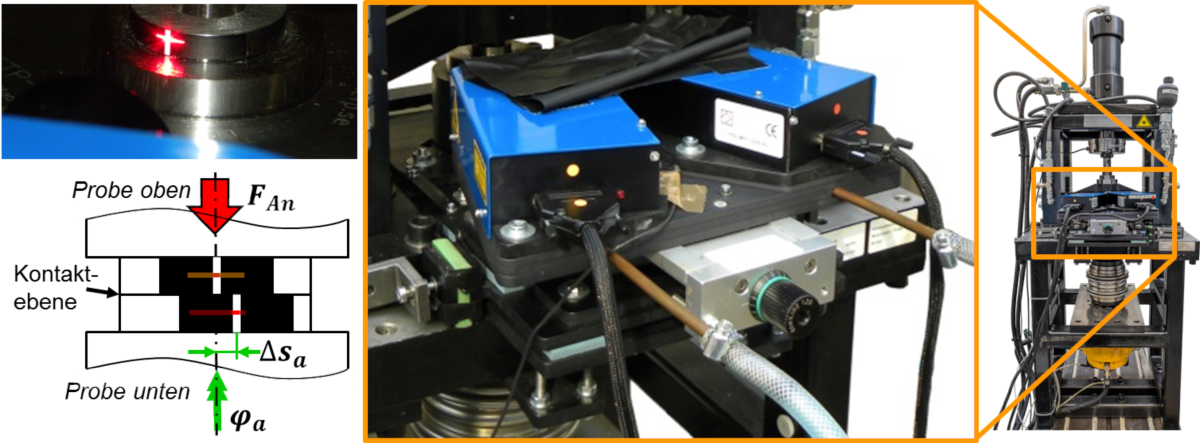
With beginning surface destruction, the friction coefficient in the contact area generally increases. By integrating the dissipated work during a load cycle and accumulating it over the test time, the durability of a remedial measure against fretting wear or sliding/friction wear can be evaluated.
2 Specimens
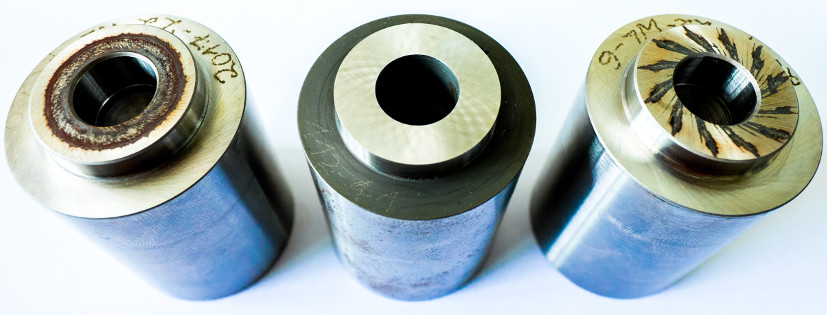
The geometries of the specimens are optimized for uniform distribution of surface pressure in the contact area. The planar annular contact on the standardized friction coefficient test rig with torsional loading, with inner diameter (Di = 15 mm) and outer diameter (Da = 30 mm), results in a nominal contact area AnomT ≈ 530 mm².
3 Results
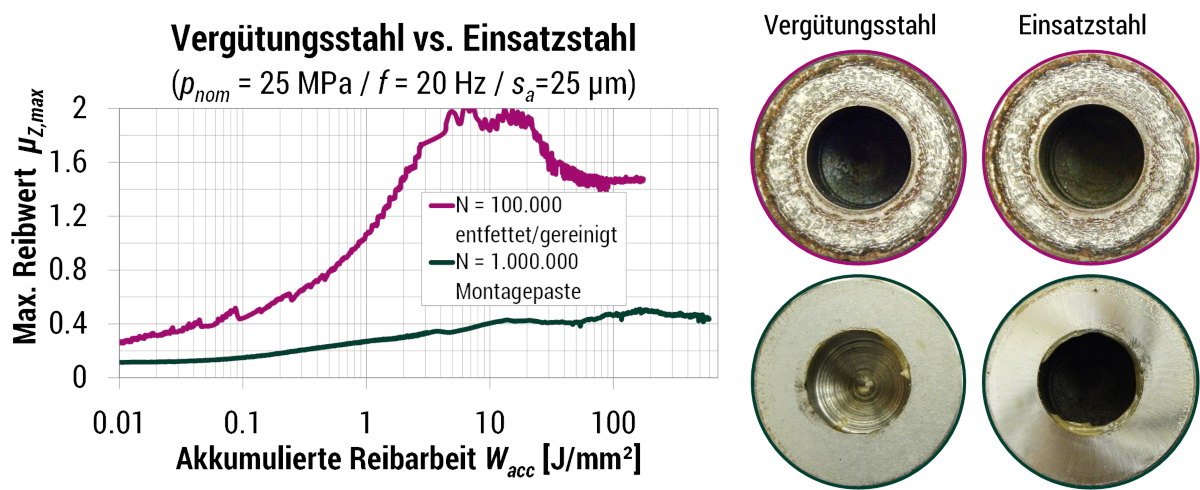
Based on friction coefficient curves over the specific accumulated friction work, the time of surface damage can be determined at significant increases. In combination with surface examination using reflected-light microscopy or, for example, laser scanning using a confocal microscope, individual wear forms in the contact surfaces can also be identified.
4 Test rigs
5 Contact

| Prof. Dr. sc. ETH Alexander Hasse | |
| Head of the professorship and director of IKAT, Head of the specialist Research Groups "Tribology" and "Shaft-Hub-Connections" | |
| Email: | alexander.hasse@… |
| Phone: | +49 371 531 36105 |
| Room: | C21.323 (alt: 2/A323) |
| Office hours: | by arrangement |
| 116 publications | |