Design and layout of compliant mechanisms
Synthesis and analysis methods for compliant mechanisms
General description
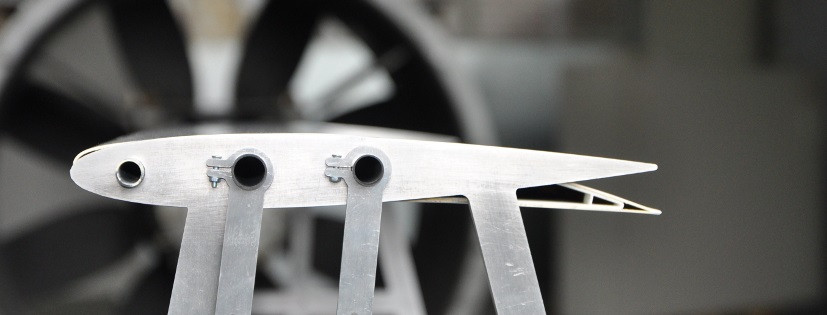
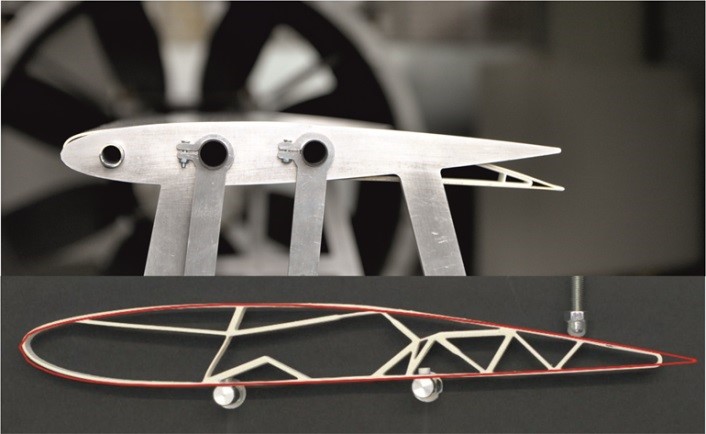
Compliant mechanisms can be used as an alternative to conventional mechanisms in many application areas. Desired movements are realized through the elastic deformation of the material rather than through the sliding and rolling of elements. This brings several advantages, such as the reduction of individual parts, monolithic component design, freedom from friction, wear and backlash, low sensitivity to dirt and increased cleanliness, reduced maintenance effort, arbitrary scalability, increased precision, and a favorable ratio of load capacity to mass.
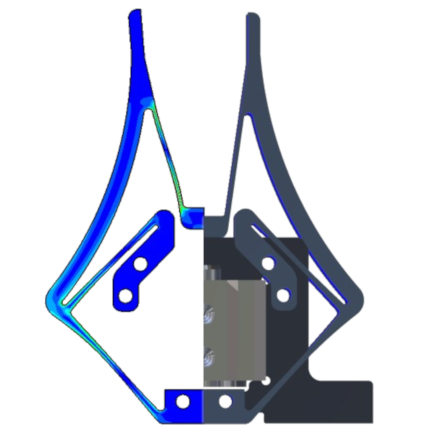
At the Professorship MP, the optimization-based design process for compliant mechanisms represents an important research area. With this expertise, we offer the complete product development process for compliant systems as a service, from design through the concept phase to detailed construction. Application possibilities range from the design of individually adapted flexure hinges for coupling with conventional components, flexure actuators, compliant designs for the substitution of classical components, mechanisms for load transfer, and shape-adaptive systems.
Contact

| Prof. Dr. sc. ETH Alexander Hasse | |
| Head of the professorship and director of IKAT, Head of the specialist Research Groups "Tribology" and "Shaft-Hub-Connections" | |
| Email: | alexander.hasse@… |
| Phone: | +49 371 531 36105 |
| Room: | C21.323 (alt: 2/A323) |
| Office hours: | by arrangement |
| 116 publications | |