
You don’t just want to calculate machines.
You want to develop products?
Then study with us in the Master’s programme “Sustainable Textile Technologies and Outdoor Equipment”.
What we offer
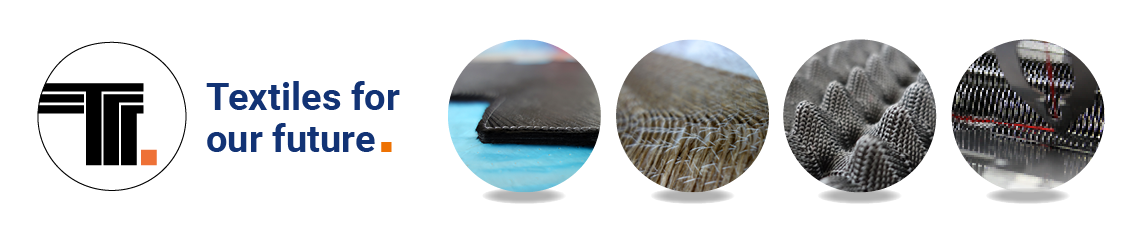
- High-tech, not just textiles: Carbon, composites, smart textiles and technical fibres.
- From material to product: Develop, manufacture, test and optimise.
- Experience lightweight engineering: Technologies for sports, mobility, medicine and industry.
- Engineer sustainability: Natural fibres, recycling and circular economy.
- Digital manufacturing: Automation, sensors, image processing and AI.
- Industry instead of the ivory tower: Real projects, machines, companies and research.
Why should you study with us?
1. You develop real high-tech products – not just fabrics.
Today, textile technologies can be found in carbon-fibre components, sports equipment, vehicles, medical products, outdoor equipment, buildings and industrial lightweight structures.
At the Chair of Textile Technologies, the spectrum ranges from conventional textiles to high-performance fibres made of carbon and metallic materials.
2. You can combine mechanical engineering with lightweight engineering and composites.
During the Bachelor’s programme in Mechanical Engineering, you can specialise in areas such as lightweight engineering.
Later, you can specifically expand this expertise towards textile composite materials and composites.
3. We don’t just calculate – you can actually build things.
Teaching includes practical work with textile manufacturing processes and machinery.
This includes, for example, knitting machines, nonwoven technologies, Dry Fiber Placement and the production of textile reinforcement structures.
4. You work on materials that make vehicles and products lighter and more efficient.
Composites and textile reinforcement structures are among the Chair’s main research areas.
This is where solutions for components that combine high mechanical performance with low weight are developed.
5. Outdoor and sports become engineering topics.
If you are interested in bikes, winter sports, outdoor products or technical sports equipment, you can combine these interests with an engineering degree.
Sports and outdoor textiles are a dedicated research area at the Chair, and Outdoor Equipment is explicitly part of the Master’s programme.
6. Sustainability means engineering – not just theory.
You work with natural fibres, recycled fibres, circular economy concepts, energy and water consumption, emissions and sustainable manufacturing processes.
The goal is not simply to discuss sustainability, but to develop better materials and processes.
7. AI, digitalisation and automation are part of modern textile engineering.
The curriculum covers Industry 4.0, sensors, image processing, data exchange, digital production chains and artificial intelligence in textile engineering.
If textile engineering makes you think only of old looms, you may need to reconsider what modern textile technology actually means.
8. You learn about the entire development chain.
From fibres and yarns to textile structures, manufacturing processes, finished products and recycling, the entire value chain is considered.
This means that you do not learn just one individual process – you understand how technical products are actually created.
9. You work close to research and industry.
Practical projects, close cooperation with industry partners and an extensive network are important elements of studying at the Chair.
Courses also address real industrial challenges with contributions from company representatives, and company excursions provide additional insights into industrial practice.
10. Chemnitz is an excellent location for textile and lightweight engineering.
The Chair cooperates with institutions including STFI, Cetex, TITV and the University of Applied Sciences Zwickau (WHZ) and is therefore located within a strong regional textile and lightweight engineering environment.
This is relevant for internships, Bachelor’s and Master’s theses, research projects and contacts with potential future employers.
11. You don’t have to choose a narrow specialisation at the beginning of your studies.
The Bachelor’s programme in Mechanical Engineering first provides you with a broad foundation in engineering.
Within the programme, you can then choose between areas such as design, production, materials, mechanics, lightweight engineering and automotive engineering.
12. After your Bachelor’s degree, there is a clear path to a specialised high-tech Master’s programme.
The Bachelor’s degree in Mechanical Engineering at TU Chemnitz explicitly fulfils the admission requirements for the Master’s programme “Sustainable Textile Technologies and Outdoor Equipment”.
In the Master’s programme, you can then focus, for example, on composites or on sustainable textiles and outdoor equipment.
13. You can build a distinctive combination of skills.
The combination of mechanical engineering, materials, textile technology, lightweight engineering, sustainability, manufacturing and digitalisation gives you a more specialised profile than a purely general mechanical engineering background.
This interdisciplinary expertise is particularly relevant for product development and industrial research.


