Fighting Cancer Before It Develops: TU Chemnitz Secures Its First ERC Synergy Grant
The European Research Council awards €10.6 million to the international research project ECLIPSE – Scientists from Chemnitz, Manchester and Oxford aim to develop programmable microrobots capable of detecting and selectively treating the earliest precancerous lesions
-

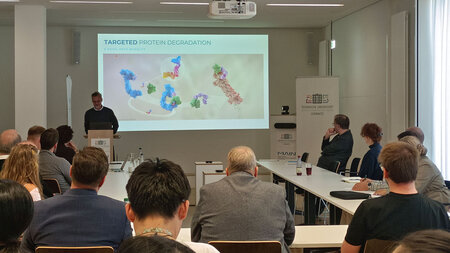
ECLIPSE team on eclipse day: From left to right Christine Schmidt (University of Manchester), Vineeth Bandari (TU Chemnitz), Richard Edmondson (University of Manchester), Oliver G. Schmidt (TU Chemnitz), Benjamin Davis (University of Oxford). Photo: Alexander Walker, Pembroke College Oxford -

“We aim to develop microrobots that can autonomously recognize biological signals, process this information and respond directly.” Prof. Dr. Oliver G. Schmidt, Head of the Professorship of Material Systems for Nanoelectronics and Scientific Director of the MAIN Research Center at TU Chemnitz, is the "Coordinating Principle Investigator" of ECLIPSE -
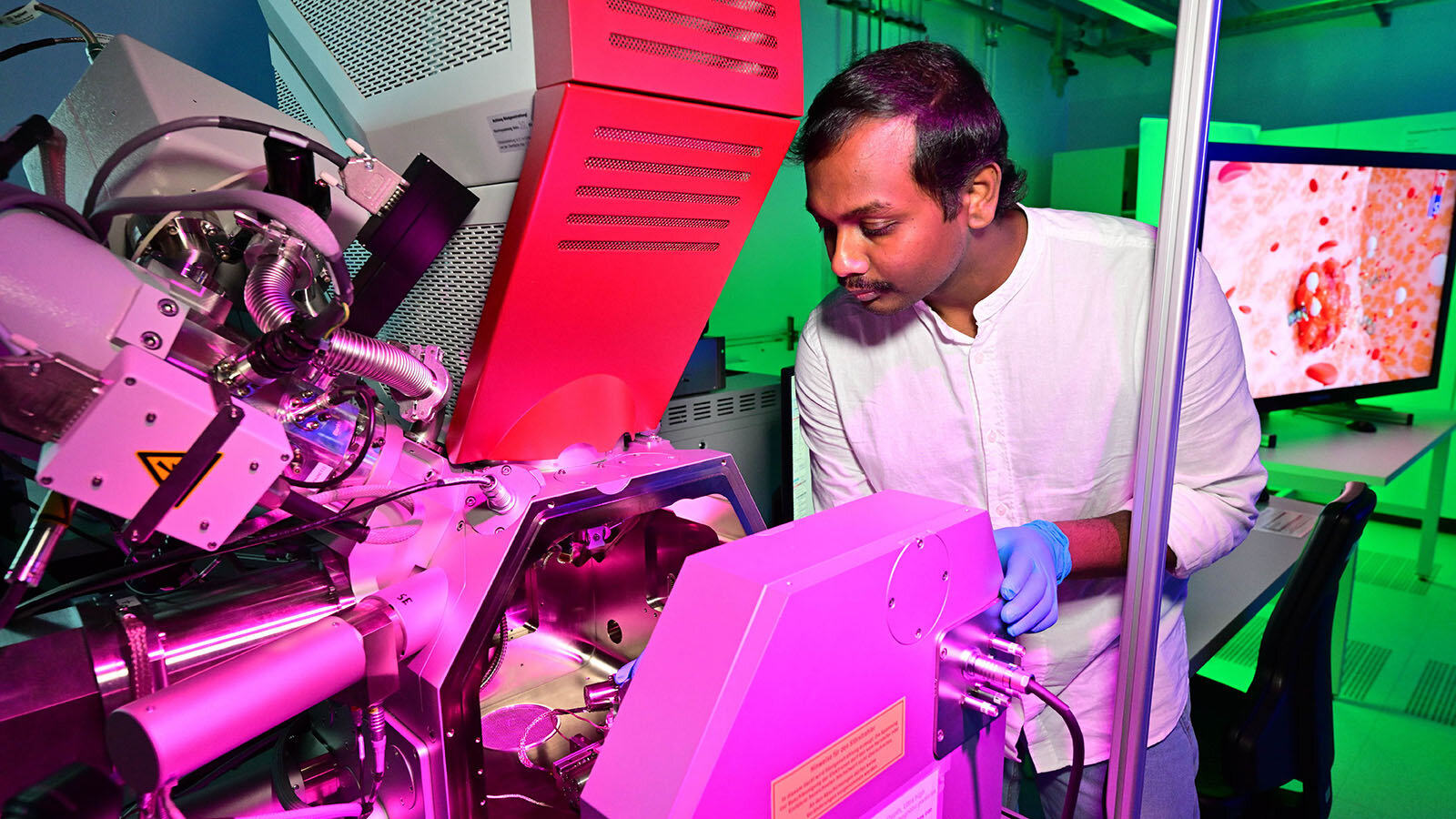
Dr. Vineeth Bandari, Technology Innovation Manager of the Professorship of Material Systems for Nanoelectronics at TU Chemnitz, serves as the Scientific Coordinator for ECLIPSE -

The European Research Council ERC, set up by the European Union in 2007, is the premier European funding organisation for excellent frontier research.
What if cancer could be treated before a malignant tumor even develops? This vision lies at the heart of the international research project ECLIPSE, which has been awarded approximately €10.6 million in funding over six years by the European Research Council (ERC). It is the first ERC Synergy Grant awarded to Chemnitz University of Technology (TU Chemnitz), marking an outstanding achievement for the university and its internationally recognized research.
Coordinated by Prof. Dr. Oliver G. Schmidt, Head of the Professorship of Material Systems for Nanoelectronics and Scientific Director of the MAIN Research Center at TU Chemnitz, four internationally leading scientists from Germany and the United Kingdom aim to develop a fundamentally new strategy for the early detection and treatment of cancer. At the center of their approach are tiny, programmable microrobots designed to autonomously detect molecular signs of the earliest pathological changes inside the body and initiate targeted therapeutic interventions directly at the site where cancer may develop.
The project is entitled Early Cancer Lesion Interception via Programmable Sensor-Equipped Morphobots (ECLIPSE). Alongside Prof. Oliver G. Schmidt, the research team includes cancer researcher Dr. Christine Schmidt and gynecological oncologist Prof. Richard Edmondson from the University of Manchester, as well as chemist Prof. Benjamin Davis from the University of Oxford.
A Paradigm Shift in Cancer Medicine
Most current approaches to early cancer detection aim to identify tumors as soon as possible after they have developed. ECLIPSE pursues a fundamentally different strategy: detecting and treating pathological changes before they progress into invasive cancer.
As its first application, the research team is focusing on a particularly aggressive form of ovarian cancer known as high-grade serous ovarian carcinoma. This disease is often diagnosed only after the cancer has already spread. However, recent scientific findings indicate that many of these tumors originate not in the ovary itself, but in the fallopian tube. There, microscopic precancerous lesions may develop over several years before the disease progresses.
This window of opportunity offers a largely unexplored possibility for cancer prevention. The challenge is that these early lesions are located deep inside the narrow and delicate fallopian tube, making them virtually inaccessible to conventional diagnostic techniques.
This is precisely where ECLIPSE comes in.
“Our vision is to treat cancer not only after a tumor has developed, but to identify and selectively eliminate the earliest pathological changes,” explains Schmidt. “To achieve this, we aim to develop microrobots that can autonomously recognize biological signals, process this information and respond directly. This would represent a fundamental paradigm shift in cancer medicine.”
Intelligent Microrobots as New Medical Tools
The proposed microrobots, known as morphobots, will be smaller than one millimeter and designed to navigate through narrow anatomical structures. Unlike conventional magnetically controlled microswimmers, they will integrate a wide range of functionalities. These include miniaturized sensors for detecting disease-specific molecules, electronic circuits for processing sensor signals, systems for energy harvesting and storage, and actuators that enable the robots to change their shape and selectively release therapeutic agents.
The microrobots will be navigated through the fallopian tube using magnetic fields. Ultrasound will contribute both to their energy supply and to monitoring their position and movement. In addition, artificial intelligence methods will be developed to track their location and behavior using ultrasound images.
A particular challenge is that individual molecular signals do not always provide unambiguous evidence of a precancerous lesion. The morphobots will therefore be designed to recognize multiple biological markers simultaneously and respond only when a specific combination of disease-related signals is detected.
“We do not simply want to build smaller robots,” emphasizes Schmidt. “Our goal is to create a new generation of microscopic machines capable of sensing their environment and responding with targeted actions. Achieving this requires us to combine electronics, chemistry, materials science and medicine in entirely new ways.”
Four Scientists – One Shared Vision
The defining feature of an ERC Synergy Grant is the close collaboration of outstanding researchers whose complementary expertise enables them to pursue a common scientific objective. ECLIPSE brings together four Principal Investigators from three universities, each contributing essential expertise.
Prof. Dr. Oliver G. Schmidt (TU Chemnitz) contributes his internationally recognized expertise in microrobotics, microelectronics and the three-dimensional self-assembly of functional materials. His team will develop the morphobots and integrate their electronic, sensing and mechanical functionalities into microscopic systems. He will also coordinate the overall project.
Dr. Christine Schmidt (University of Manchester) investigates the earliest molecular changes involved in the development of ovarian cancer. Her team will work to identify characteristic biomarkers that can be detected in the fallopian tube at very early stages of disease and serve as molecular targets for the microrobots.
Prof. Benjamin Davis (University of Oxford) is an expert in chemical biology and protein chemistry. His team will develop tailored molecular recognition systems capable of combining multiple disease-related signals. These systems are intended to enable the microrobots to distinguish between healthy and pathologically altered tissues with high selectivity.
Prof. Richard Edmondson (University of Manchester) contributes his expertise in gynecological oncology and clinical cancer research. His team will investigate how the novel microrobots can be used safely in biological tissues and what requirements must be met before eventual applications in humans can be considered.
The four research areas are closely interdependent: cancer biology identifies the molecular targets, chemistry enables their selective recognition, microrobotics integrates these functions into mobile technical systems, and medicine evaluates their effectiveness and safety.
“None of us could realize this vision alone,” explains Schmidt. “Only by closely combining our different scientific strengths can we explore an entirely new form of medical intervention. This is precisely what the ERC Synergy Grant scheme was designed to enable.”
From Fundamental Research to Medical Applications
Over the next six years, the researchers will first systematically investigate the molecular signatures of the earliest precancerous lesions. Based on these findings, they will develop novel biosensors and integrate them into the morphobots.
The systems will then undergo step-by-step evaluation in biological models. Planned investigations include animal models and human tissue studied outside the body. Particular emphasis will be placed on precise navigation, reliable detection of pathological changes, targeted drug release and biological compatibility.
In the longer term, the technology could pave the way for new minimally invasive approaches capable of treating precancerous lesions directly at their site of origin. The underlying concepts may eventually also become relevant to other diseases in which pathological changes develop in regions of the body that are difficult to access.
"An Outstanding Achievement for TU Chemnitz"
ERC Synergy Grants are among Europe's most prestigious and substantial research funding schemes. They support particularly ambitious scientific projects whose objectives can only be achieved through the close collaboration of several outstanding researchers.
"Securing an ERC Synergy Grant for the first time—the most significant and highest-funded grant category within the most prestigious funding program at the European level—is an absolutely outstanding achievement for TU Chemnitz," says its President, Prof. Dr. Gerd Strohmeier. "It serves as an impressive proof of the university’s excellence at the highest international level in the field of miniaturized, functionally integrated microsystems and microrobotics. I would like to extend my warmest congratulations to our colleague Oliver G. Schmidt, his team, and our partners in Oxford and Manchester on this magnificent accomplishment."
“For us, this ERC Synergy Grant represents exceptional scientific recognition as well as a major responsibility,” says Schmidt. “It gives us the opportunity to pursue a visionary research idea together with our partners in Manchester and Oxford over the next six years, going far beyond what individual research groups could achieve. I am particularly pleased that TU Chemnitz will take on the scientific coordination of this project.”
Background: ERC Synergy Grants
The European Research Council (ERC) supports ambitious fundamental research projects through its ERC Synergy Grants, bringing together two to four Principal Investigators whose combined expertise enables them to address scientific challenges beyond the reach of individual researchers. In 2026, the ERC reviewed 957 project applications from all over Europe and approved 48 of them. The total budget for this year´s ERC Synergy Grants is €500 Mio.
Project: ECLIPSE – Early Cancer Lesion Interception via Programmable Sensor-Equipped Morphobots
Funding: €10.6 Mio
Duration: 72 months
Coordinator: Chemnitz University of Technology (TU Chemnitz)
Participating universities: Chemnitz University of Technology, University of Manchester, University of Oxford
Principal Investigators: Prof. Oliver G. Schmidt, Dr. Christine Schmidt, Prof. Richard Edmondson, Prof. Benjamin Davis
Detlef Gürtler
12.11.2026