Using Artificial Intelligence to Predict Road Safety Risks and Prevent Accidents
TU Chemnitz is a partner in the European research project ROAD4SAFE, which is developing new approaches to proactive road safety. The project receives a funding of 5 million Euro
-

Graphic: Dr. Josephine Halama, generated by AI -
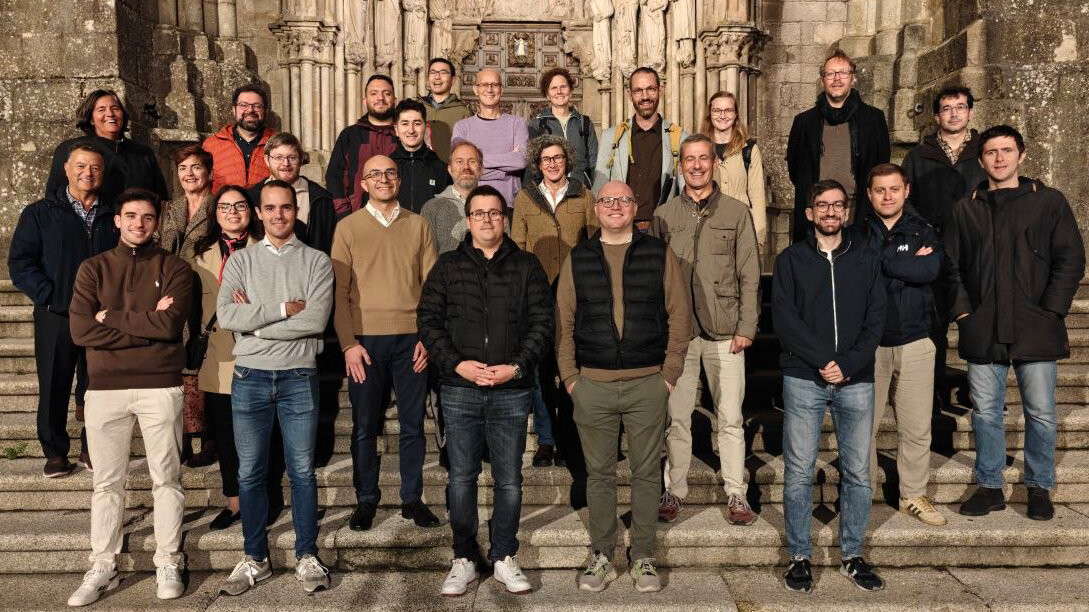
The international ROAD4SAFE project consortium at the project kick-off meeting. Representing TU Chemnitz are Prof. Dr. Dagmar Gesmann-Nuissl (third row, first from left), Prof. Dr. Stefan Brandenburg (third row, second from right), Dr. Stefanie Meyer (third row, third from right) and Bettina Kämpfe (fourth row, fourth from left). Photo: Ana Sánchez Rodríguez
How can road accidents be prevented before they happen? This is the question addressed by the European research project ROAD4SAFE, which successfully launched in October 2026 with a kick-off meeting in Vigo, Spain. With total funding of €5 million under the European Union's Horizon Europe research programme, the project brings together universities, road operators, technology organisations and industry partners from across Europe and beyond. Chemnitz University of Technology (TU Chemnitz) plays a key role in the project through its Chair of Cognitive Psychology and Human Factors (Prof. Dr. Stefan Brandenburg) and its Chair of Private Law and Intellectual Property Rights (Prof. Dr. Dagmar Gesmann-Nuissl). Both chairs contribute their expertise in psychology and law to the development of new AI-based solutions for improving road safety.
Identifying risks proactively and in real time instead of analysing accidents after they occur
Until now, many road safety measures could only be implemented after accidents had already happened. ROAD4SAFE takes a fundamentally different approach: using Artificial Intelligence (AI) and data from various sources, potential hazards are to be identified at an early stage, helping to prevent accidents proactively. This involves combining and analysing information from connected vehicles, road infrastructure sensors, traffic and environmental conditions, as well as historical accident data, in real time. Based on these data, an intelligent decision-support system will be developed to predict potential risks and help drivers and other relevant stakeholders take appropriate preventive action.
Humans, ethics and law as the foundation for trustworthy AI
At the beginning of the project, the two TU Chemnitz chairs, together with their international project partners, will develop a framework addressing the ethical, legal and technical requirements of the new AI systems. The aim is to align technological capabilities with people's needs and the practical requirements of real-world applications.
As part of the project, the Chair of Cognitive Psychology and Human Factors will also focus on the design and evaluation of the human-machine interface (HMI). The aim is to present the information provided by the system in a clear and understandable way, enabling drivers to respond appropriately and potentially avoid accidents. The chair will also contribute to the scientific evaluation of pilot studies and examine the ethical and human-centred application of the technologies being developed.
The Chair of Private Law and Intellectual Property Rights will investigate the legal requirements governing the use of the AI systems. This includes, in particular, examining how data from different sources can be combined, processed and used to predict road safety risks in compliance with applicable legal requirements.
In this way, TU Chemnitz is making an important contribution to ensuring that AI-based road safety systems are not only technically effective, but also legally compliant, trustworthy and suitable for practical everyday use.
Contributing to the European goal of “Vision Zero”
The AI solutions developed within ROAD4SAFE are intended to help identify and predict road safety risks proactively and prevent accidents. At the same time, the project supports the European “Vision Zero” ambition of reducing the number of road fatalities and serious injuries to zero. TU Chemnitz's involvement in ROAD4SAFE further demonstrates the university's research strength in shaping safe, responsible and future-oriented mobility.
Further information is available here. For further information about the project, please contact Prof. Dr. Stefan Brandenburg, Chair of General Psychology and Human Factors, phone +49 371 531-31312, email stefan.brandenburg@psychologie.tu-chemnitz.de, or Prof. Dr. Dagmar Gesmann-Nuissl, Chair of Private Law and Intellectual Property Rights, phone +49 371 531-39233, email dagmar.gesmann@wirtschaft.tu-chemnitz.de.
Mario Steinebach
13.11.2026