How Should Automated Vehicles Interact with Pedestrians?
Joint studies by TU Chemnitz and TU Berlin investigate how vehicle mode, speed, and braking behaviour influence interactions with an automated shuttle
-
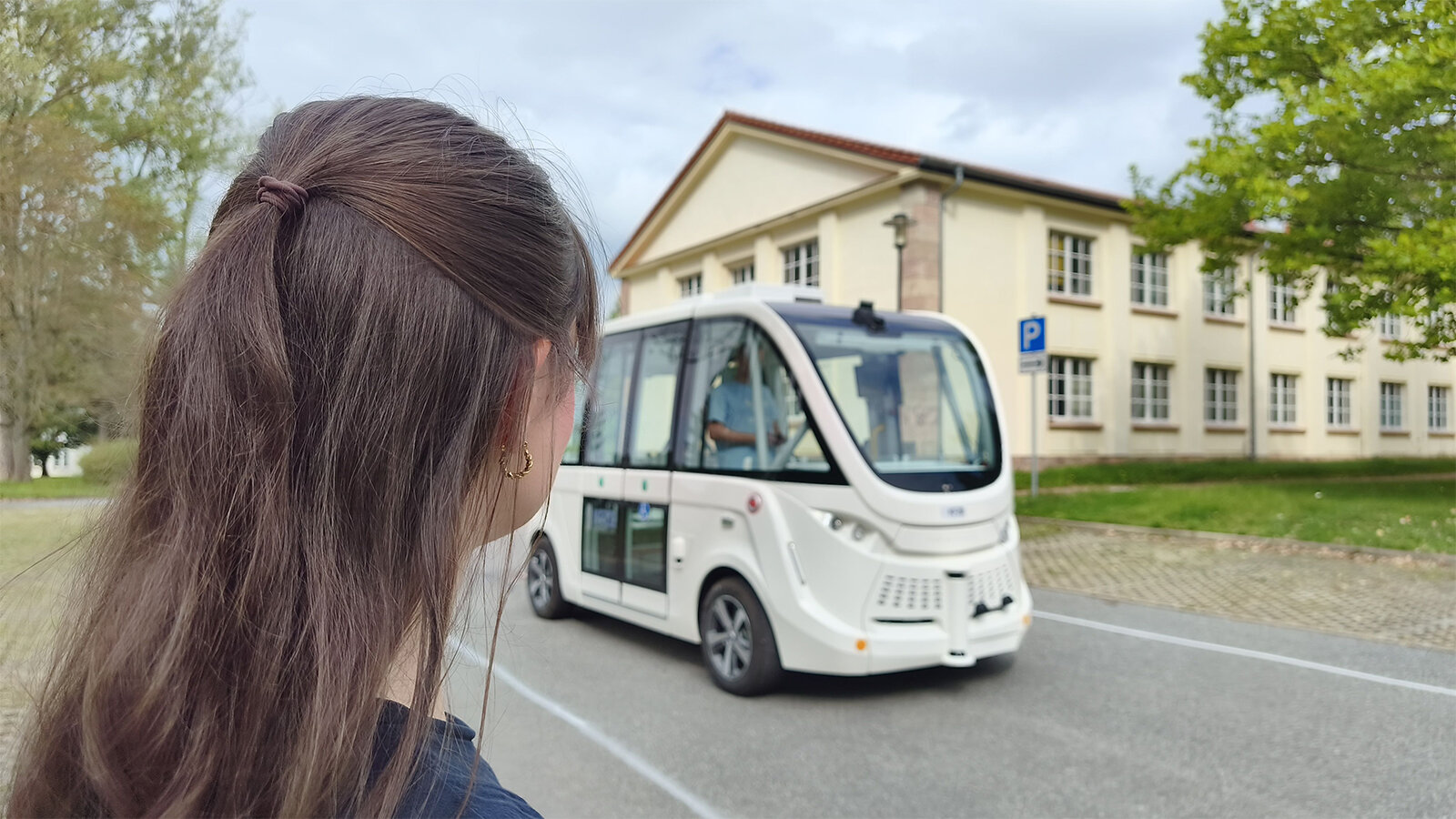
Test scenarios for research: In July and August 2026, several studies were conducted on the campus Erfenschlager Straße 73 of Chemnitz University of Technology, focusing on interactions between pedestrians and an automated shuttle. Photo: Dr. Josephine Halama
How do pedestrians react when they encounter an automated vehicle on the street? Does the interaction feel safe and comfortable, and does it make a difference whether the vehicle is operating autonomously, is driven by a human, or is teleoperated from a remote location? How should an automated vehicle brake when yielding to a pedestrian? Researchers from Chemnitz University of Technology and Technische Universität Berlin investigated these questions in July and August 2026 using an automated shuttle on the campus Erfenschlager Straße 73 in Chemnitz.
The studies were conducted by the Chair of Cognitive Psychology and Human Factors (Prof. Dr. Stefan Brandenburg) and the Chair of Ergonomics and Innovation Management (Prof. Dr. Angelika Bullinger-Hoffmann) at Chemnitz University of Technology as part of the Chemnitz Center for Mobility (CCM). The cooperation partner was the Department of Automotive Engineering at TU Berlin (Prof. Dr. Steffen Müller), which provided and programmed the vehicle for the studies.
How do pedestrians perceive different vehicle modes?
One study examined how vehicle mode and driving speed affect pedestrians’ perception of the interaction and their intended crossing behaviour. Three operating modes were simulated: automated, manual, and teleoperated. Furthermore, the shuttle approached participants at different speeds, after which they evaluated the interaction.
Initial results indicate that interactions with the shuttle were generally perceived as safe, comfortable, self-determined, and efficient. As vehicle speed increased, perceived safety and comfort decreased slightly, while perceived efficiency increased. The vehicle’s operating mode, however, had no significant influence on how the interaction was experienced. These findings suggest that both automated and teleoperated vehicles can enable positively perceived interactions from the pedestrian’s perspective.
How should an automated vehicle brake?
Another study focused on the braking behaviour of the automated shuttle during interactions with pedestrians. Participants experienced different braking manoeuvres in which both the stopping distance and the braking profile were systematically varied, representing different braking strategies.
Preliminary analyses show that both the nature of the braking manoeuvre and the final stopping position substantially influence how pedestrians perceive the interaction. The findings indicate that it is not merely the fact that an automated vehicle stops that matters; the way it decelerates and where it stops are equally important for creating a positive interaction.
A human-centred perspective for automated mobility
Together, the two studies provide valuable insights into how automated vehicles should behave when interacting with other road users. Rather than defining vehicle behaviour solely from a technical perspective, the project places the human experience at the centre of the design process.
The data are currently being analysed and will be published in scientific journals. The findings will contribute to the human-centred development of automated mobility and provide evidence-based recommendations for the design of future automated shuttles.
The research was funded through internal resources of TU Chemnitz and TU Berlin. In addition, the project received support through a doctoral scholarship funded by the Sächsische Aufbaubank (SAB) in cooperation with the European Social Fund Plus (ESF+).
Additional information is available on the project website: www.mytuc.org/rfmh
Event announcement: The research project and the automated shuttle will be presented on 6 October 2026 at the CVAG conference “MOBILITÄTSIMPULS – Automated Driving in Public Transport” to a professional audience. In the evening, the project will also be showcased during a free public event, where visitors will have the opportunity to take a seat inside the automated shuttle and learn more about the project and its findings.
Contact: Prof. Dr. Stefan Brandenburg, Chair of Cognitive Psychology and Human Factors at Chemnitz University of Technology, Email stefan.brandenburg@psychologie@tu-chemnitz.de, Prof. Dr. Angelika Bullinger-Hoffmann, Chair of Ergonomics and Innovation Management at Chemnitz University of Technology, Email angelika.bullinger-hoffmann@mb.tu-chemnitz.de, and Prof. Dr. Steffen Müller, Department of Automotive Engineering at TU Berlin, Email steffen.mueller@tu-berlin.de
Mario Steinebach
02.10.2026