DFG Priority Programme SPP 2476 „Cross-Process Modelling in Production Engineering“ launched - WOT team represented with sub-project „ProModFun“
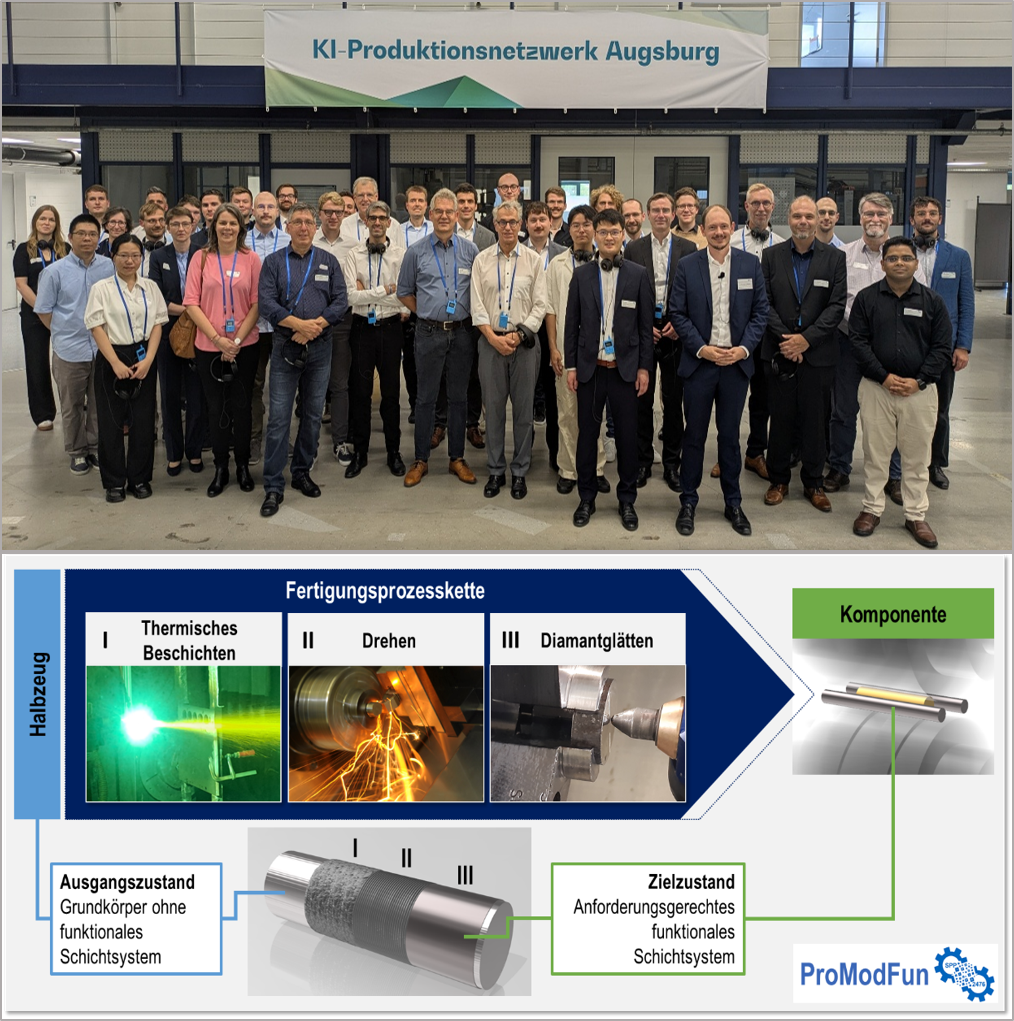
In spring, the DFG approved funding for 12 projects of the Priority programme „Cross-process modelling in production technology“ (SPP 2476), which will initially be funded for three years. A special feature of a priority programme is the supra-regional cooperation of the scientists involved. The two-day kick-off event on 3 and 4 September 2025 at the AI Production Network at the University of Augsburg provided ample opportunity to get to know each other personally and exchange ideas. The WOT team with the applicants Dr habil. Franziska Bocklisch and Prof. Dr. Thomas Lampke is also involved in SPP 2476 in cooperation with Prof. Dr. Andreas Schubert (Chair of Microfabrication Technology, TUC) with the sub-project „Cross-process modelling for the production of functionally graded layer systems by thermal spraying and mechanical post-processing – ProModFun“.
Background and scientific approach in the project: The industrial production of components involves the sequential combination of manufacturing processes in order to create products with a defined property profile. The challenges are to optimise the manufacturing process, to counter uncertainties inherent in the process and to carry out global optimisation across the process chain. Multi-criteria optimisation is demanding, as there are conflicting target values with regard to processing and functional properties.
The process chain optimisation in ProModFun is to be carried out using an experimental approach and data-based modelling. Firstly, the process chain is set up consisting of (1) thermal coating, (2) turning and (3) diamond smoothing to produce a functional surface with near-surface, graded hardness increase. The innovative property profile will be explained using the example of the component „guide roller“. By thermal coating (primary shaping), surfaces made of manganese hard steel are applied to rotationally symmetrical components and adapted in terms of core and edge properties by turning and diamond smoothing. The target variables of the process chain to be optimised are to be influenced as follows: (1) maximise surface hardness, (2) minimise surface roughness, (3) maximise the oxide content of the coating system and (4) maximise the energy efficiency of surface generation.
Sensor technology is integrated into the manufacturing processes and the measurement data is used for modelling. Statistical modelling and multidimensional, pattern-based description using grey-box AI algorithms (fuzzy pattern classification) are used as process approaches. They enable the quantification of different types of uncertainty and the forward coupling of the process chain. This is followed by the development of a procedure for inverse multi-criteria optimisation across the entire process chain for the purpose of global optimisation.
7.11.2025 – Projects of the professorship ( franziska.bocklisch@mb… )