International “Summer School on Applied Analysis” Attracts Record Participation
More than 70 researchers from Germany and abroad attended the long-standing event at the Faculty of Mathematics at TU Chemnitz in September 2026 — more than in any previous year
-
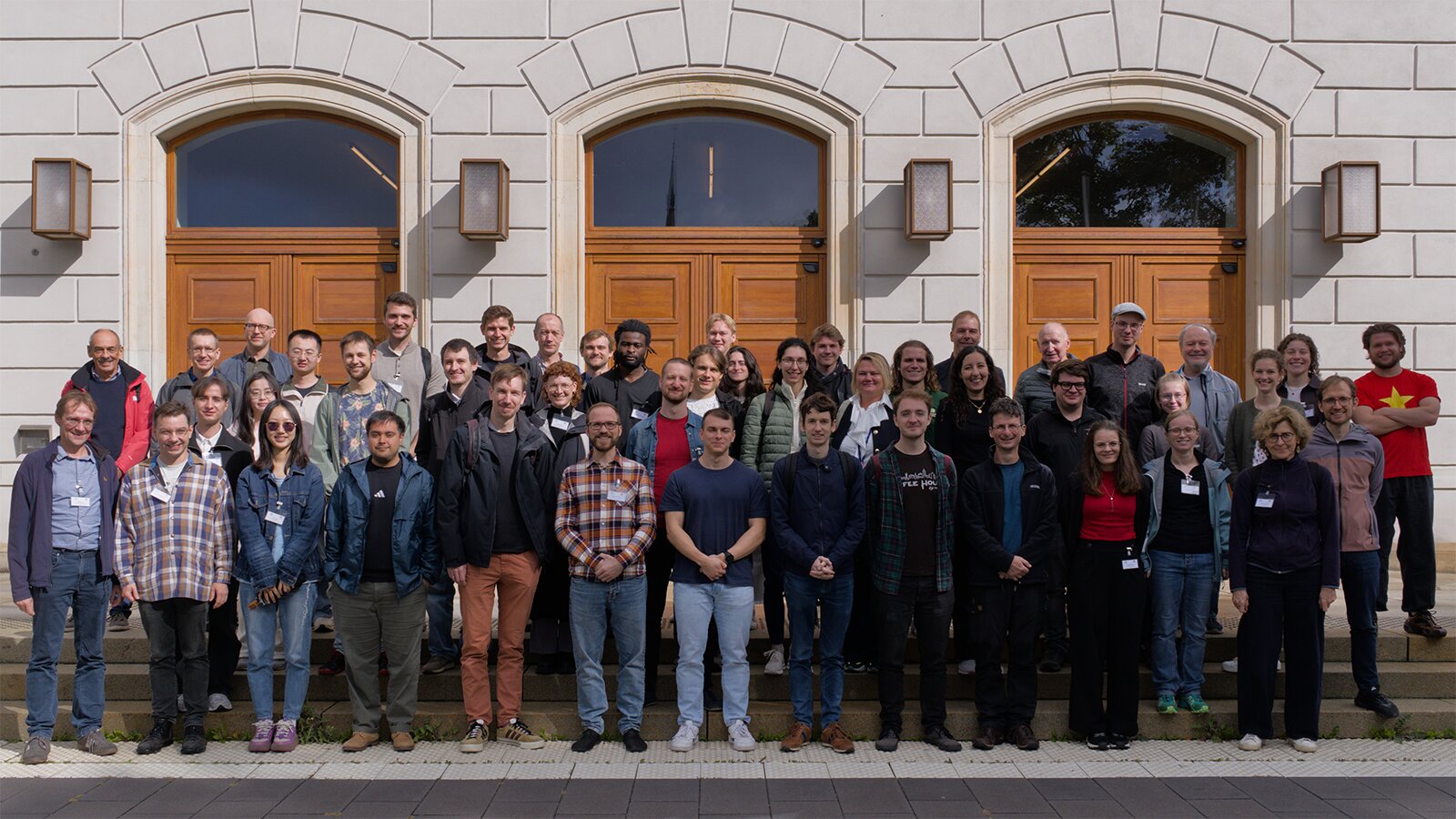
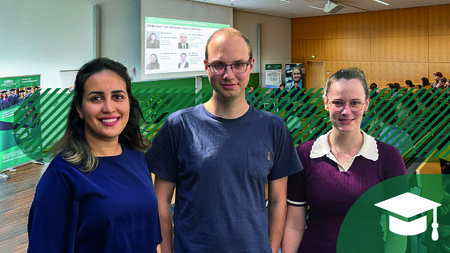
Researchers from universities in Germany and abroad took part in the summer school. Photo: Faculty of Mathematics
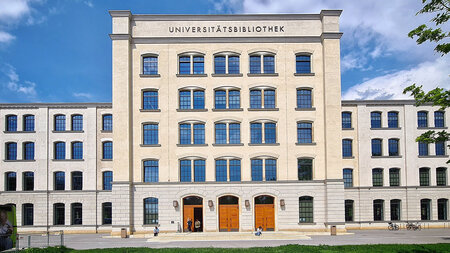
From 21 to 25 September 2026, the “Summer School on Applied Analysis” was held once again at the “IdeenReich” of the University Library. With more than 70 participants, the event, which has been organised annually since 2006, recorded the highest attendance in its history. In the mornings, four invited speakers each gave two lectures: Prof. Dr. Nicolas Boullé (Imperial College London), Prof. Dr. Hanno Gottschalk (TU Berlin), Prof. Dr. Carola-Bibiane Schönlieb (University of Cambridge) and Prof. Dr. Gabriele Steidl (TU Berlin). In addition, there were two talks from Chemnitz: Prof. Dr. Tino Ullrich (Professorship of Applied Analysis) and Prof. Dr. Sebastian Neumayer (Professorship of Inverse Problems).
The programme showed how strongly artificial intelligence now shapes applied analysis. Nicolas Boullé spoke about operator learning, i.e. learning solution operators of partial differential equations from data. Hanno Gottschalk presented a statistical theory of generative learning, and Gabriele Steidl covered generative flows — including a paper accepted as a spotlight at NeurIPS 2026, the world’s largest conference on machine learning. Carola-Bibiane Schönlieb showed how classical inverse problems in imaging are being reconsidered in the age of AI.
The two contributions from Chemnitz spanned the range from theory to practice. Tino Ullrich spoke about approximation, sampling and recovery, illustrating how closely the organisers of the summer school collaborate in their research. The closing talk was given by Sebastian Neumayer, who demonstrated how research results can be translated into software with the help of new AI-assisted tools — and how programming with AI works in practice today.
The concept that gives doctoral students in particular their first conference experience proved successful again this year: in the afternoon sessions, doctoral researchers and postdocs gave short talks or presented their research topics on posters. The award for the best talk went to Linéll Dehne (University of Greifswald) for the presentation “Parameter Identification using Physics-informed Neural Networks”. The prize for the best poster was awarded to Nikolas Klug (University of Augsburg) for the contribution “Natural Riemannian Gradient for Learning Functional Tensor Networks”.
The summer school was financially supported by the Priority Programme “Theoretical Foundations of Deep Learning” (SPP 2298) of the German Research Foundation (DFG).
“That more than 70 researchers came to us this year shows how great the need is for a format that brings together the mathematical foundations and current developments of machine learning. We were particularly pleased by how intensively the early-career researchers used the time between talks for discussion and networking,” reports Prof. Dr. Daniel Potts (Professorship of Applied Functional Analysis). Together with Dr. Franziska Nestler, Sebastian Neumayer, Prof. Dr. Martin Stoll (Professorship of Scientific Computing) and Tino Ullrich, Potts is part of the summer school’s organising team.
“Record participation of more than 70 researchers and such lively discussions in all sessions — that speaks to the appeal of this summer school,” says Prof. Alois Pichler, PhD, Dean of the Faculty of Mathematics. “I am especially pleased by how modern our applied mathematics is: the topics of the summer school are exactly those that are currently moving the field.” The next summer school will take place from 20 to 24 September 2027.
Further information is available from Prof. Dr. Daniel Potts, phone +49 (0)371 531-32150, email potts@mathematik.tu-chemnitz.de.
(Author: Prof. Dr. Daniel Potts)
Mario Steinebach
30.09.2026