Research at Minus 269 Degrees Celsius for the Quantum Computing of the Future
The new “Cryo-Lab for Materials and Electronics Packaging Chemnitz” (CRYME) enables the study of materials and systems for quantum computers at extremely low, so-called cryogenic temperatures
-
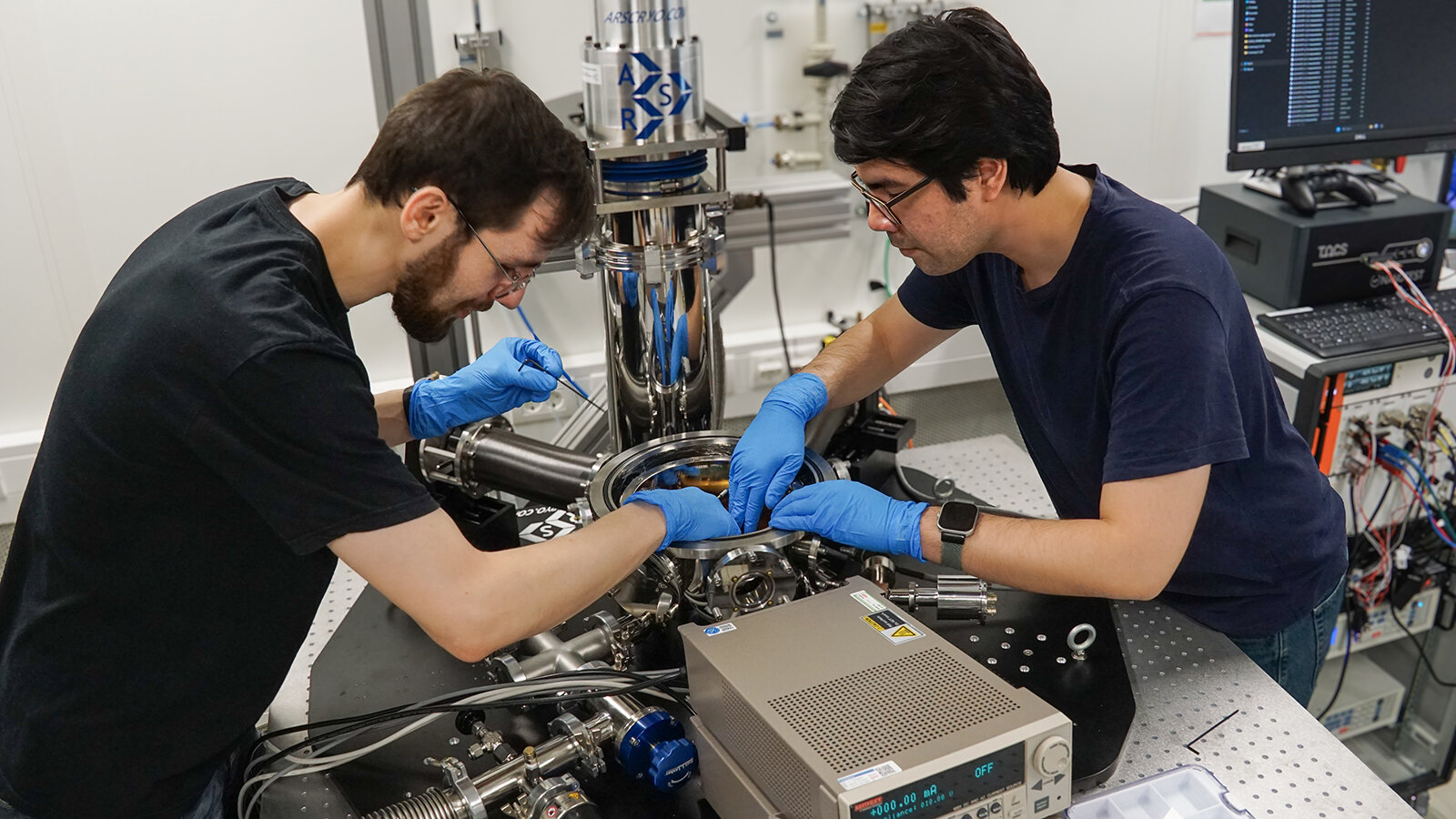
David Walther (left) and Carlos Rincon, research assistants at the Chair of Materials and Reliability of Microtechnological Systems at Chemnitz University of Technology, are installing a new test rig inside the chamber of a helium cryostat. It enables the determination of the thermal properties of thin films at temperatures ranging from -269 °C to +25 °C. Photo: Dr. Uwe Zschenderlein
In quantum computers, ions prefer to be isolated and kept at freezing temperatures because, to achieve optimal performance, they must be as isolated from their environment as possible. Only then can quantum operations be performed on them without perturbation. To this end, the ions are confined in a trap by electric fields, and the entire ion trap is cooled to a temperature of less than 10 Kelvin (just above absolute zero) in a high vacuum. Quantum computers based on such ion traps are currently attracting a great deal of interest in industry and science, particularly with regard to their miniaturization. This requires new concepts, materials, and technologies for heterogeneous system integration. This expertise is a strategic priority of the European Chips Act and will now be strengthened in Chemnitz and further developed for new areas of application. This is being carried out by Chemnitz University of Technology and the Chemnitz-based Fraunhofer Institute for Electronic Nano Systems (ENAS), in collaboration with partner institutes of the German Microelectronics Research Factory (FMD).
At the new “Cryo-Lab for Materials and Electronics Packaging Chemnitz”—CRYME for short—based at Chemnitz University of Technology, scientists aim to research and develop materials, components, and systems for future generations of quantum computers, as well as evaluate their reliability. Thanks to an investment project by Fraunhofer ENAS, funded by the Federal Ministry of Research, Technology, and Space (BMFTR), state-of-the-art equipment was acquired, including two specialized cooling devices known as cryostats, a cryogenic materials testing system for determining thermomechanical properties, and a cryogenic scanning electron microscope for materials analysis at extremely low temperatures. This technology is now jointly operated by Fraunhofer ENAS and Chemnitz University of Technology. As part of the European Test and Reliability Center (ETRC), CRYME strengthens the close collaboration between Fraunhofer ENAS and the FMD as well as the Chair of Materials and Reliability of Microtechnological Systems, the Center for Micro- and Nanotechnologies (ZfM), and the Research Center for Materials, Architectures, and Integration of Nanomembranes (MAIN) at Chemnitz University of Technology. The new laboratory is located at the Research Center MAIN. The new helium liquefaction plant at the neighboring Institute of Physics also plays an important role, as some of CRYME’s cryostats are powered by liquid helium.
“As a key technology of the 21st century, quantum computing also stands for technological leadership, high-quality jobs, and cutting-edge research. That is why the Chemnitz researchers involved in CRYME view the new laboratory as a key building block for innovation, new large-scale research projects, excellent teaching, and attracting young scientists,” says Prof. Dr. Bernhard Wunderle, holder of the Chair of Materials and Reliability of Microtechnical Systems. At the same time, he notes that the collaboration taking place here is a prime example of successful cooperation on the “Smart Systems Campus” in Chemnitz.
Dr. Remi Pantou, head of the “Characterization and Analytics” group at Fraunhofer ENAS and laboratory director of CRYME, adds: “CRYME’s new facilities are a key factor for collaborative projects with industry partners, as the complexity of this specialized research laboratory is unique in Germany and Europe. Several companies have expressed interest in collaborating. Specific collaborative projects have already begun, and additional projects are in the planning stages.”
The new laboratory will be officially opened on September 2, 2026, as part of a two-day event called “Chemnitz Seminars,” which will be held under the theme “Testing and Reliability Between Ice and Fire: New Laboratories and Methods from 4 K to 700 K.” The event covers topics related to testing and reliability and provides an ideal platform for sharing knowledge, discussing practical applications, and identifying future opportunities for collaboration within CRYME. Registration for the free seminar is open until August 21, 2026.
Program of the Seminar and Registration:
(Translation: Dona Maria, Research Center MAIN)
Mario Steinebach
13.08.2026