Successfully completed doctorate
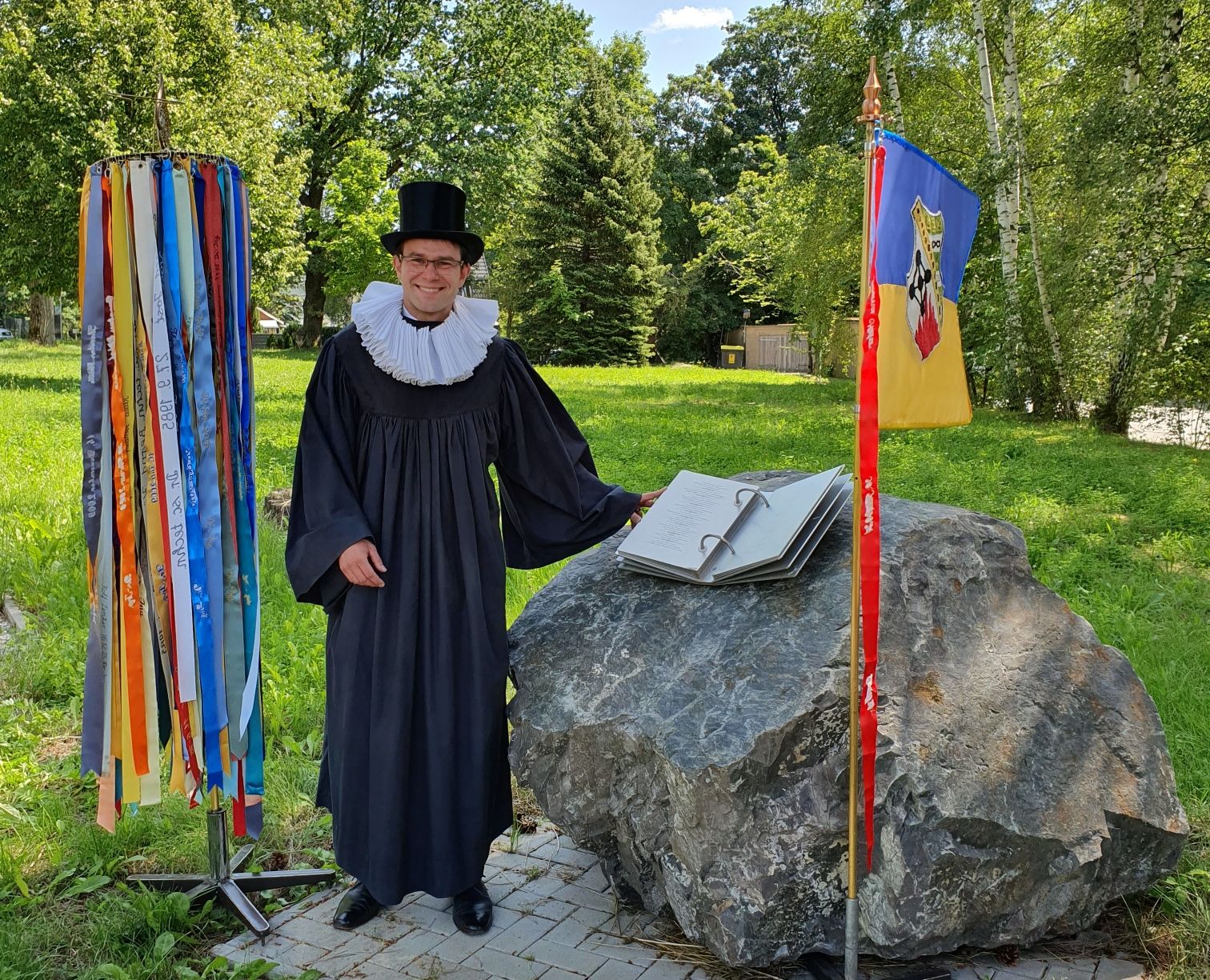
On 30 July 2021, Johannes Näther successfully defended his dissertation entitled „Influence of the structure and manufacturing route on the tribological behaviour of thermally sprayed high-entropy alloys“. The thesis was written as part of a cooperative doctoral programme between the Faculty of Mechanical Engineering at Chemnitz University of Technology and Mittweida University of Applied Sciences.
Due to its high hardness, corrosion resistance and electrical conductivity as well as its high catalytic activity for the oxygen formation reaction, iridium has great potential as a final layer for use on sliding and plug contacts as well as for polymer electrolyte membrane electrolysis (PEM electrolysis). Compared to the technically established layer application using thin-film technology, electrochemical layer deposition from aqueous electrolytes is characterised by the particularly economical production of layer thicknesses in the range of 1 μm on complex-shaped components.
As part of his dissertation, Dr Näther initially investigated electrolyte ageing using hexabromoiridate complexes by mechanistic means. The formation of an electrochemically inactive aqua complex was discussed as the main cause for the decreasing current yield of the metal deposition with increasing bath load. This process can be slowed down by separating the anode and cathode compartments, using Ir/Ru mixed oxide anodes, adding easily oxidisable compounds (buffers) and maximising the area ratio of anode to cathode. Due to the incorporation of impurity atoms and the extremely fine-grained structure, the deposited iridium layers have an indentation hardness of up to 980 HV and, compared to conventional hard gold and rhodium layers, a significantly higher wear resistance on the kaloMax NT calotte grinder. However, the coatings are subject to high residual stress, which results in cracks in the coating, higher electrical resistance and the risk of premature coating flaking when used on sliding and plug contacts. To maximise the catalytic activity, iridium was deposited on titanium sintered electrodes in the form of nanoscale particles using pulsed current.
Initial test results within the scope of the work showed a similarly good performance compared to the benchmark samples, whereby the iridium loading could be reduced by up to 90 % compared to the state of the art. In addition, the improved bonding of the particles to the electrode surface is expected to reduce catalyst degradation and consequently increase the service life of the electrolyser.
The work will soon be published under the IWW's own publishing house in the series „Werkstoffe und werkstofftechnische Anwendungen“ and in the Qucosa portal ( https://www.qucosa.de/startseite/ ).
Picture:
Dr Johannes Näther in regalia next to the IWW's traditional flag, the collection of doctoral sashes dating back more than five decades and the „philosopher's stone“ with the IWW's book of doctoral and post-doctoral graduates.
26 Aug 2021 – Personnel of the professorship ( thomas.grund@mb… )