Completion of the BMBF joint project GALACTIF
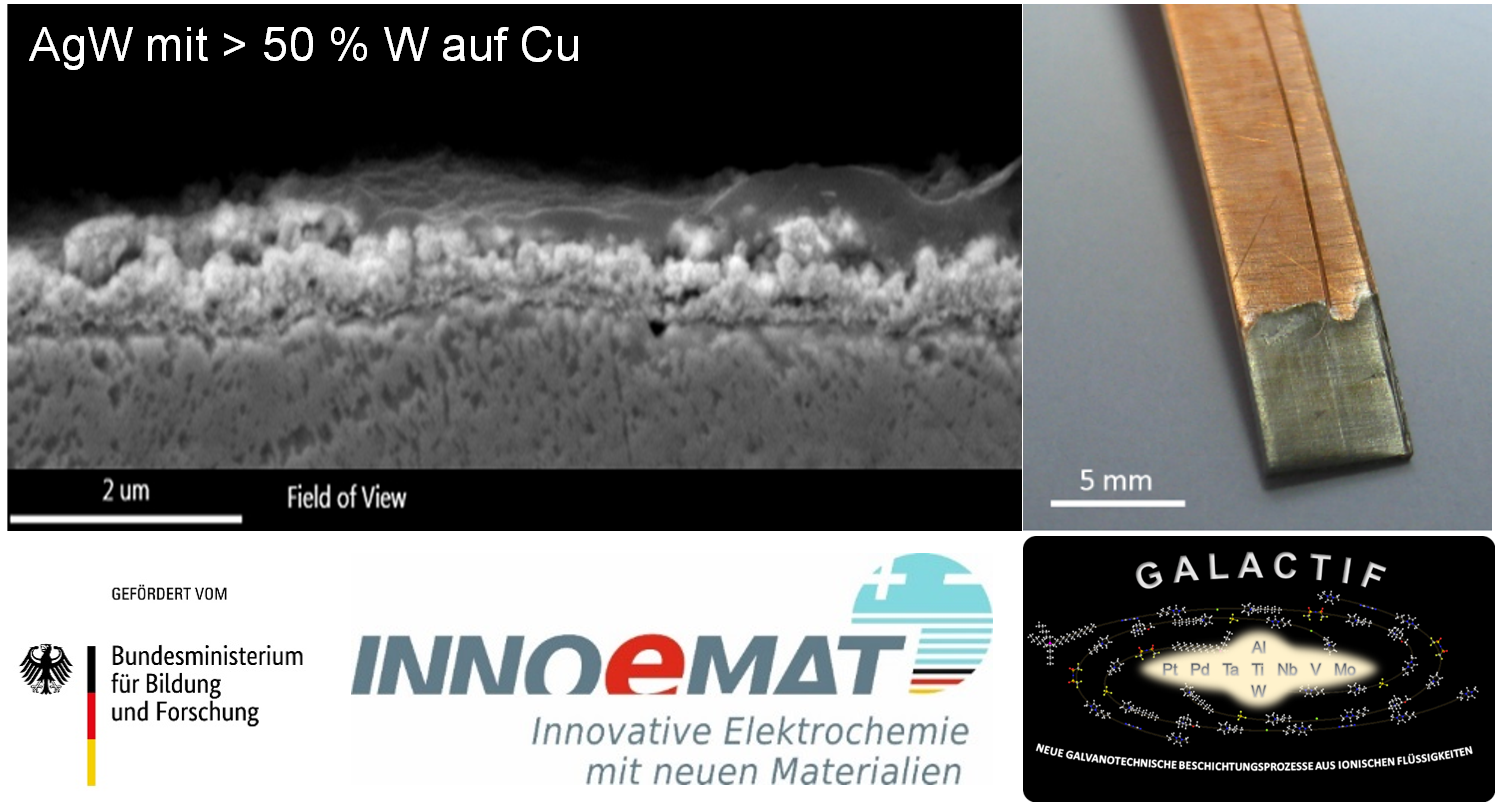
The joint project „GALACTIF - New Electroplating Coating Processes from Ionic Liquids“ was completed at the Chair of Materials and Surface Technology in the middle of the year. The aim of the joint research project was to use new technical approaches to create the basis for a cost-effective, environmentally friendly coating technology using ionic liquids.
Numerous components can be manufactured from inexpensive and readily available raw materials if they are functionalised with a suitable metallic coating. Coatings that cannot yet be produced, or at least not at a reasonable cost and with good ecological compatibility, would often be ideal. Electroplating (electrochemical deposition) from ionic liquids is an attractive alternative here. Ionic liquids are salts with large organic cations and different anions, which are liquid at temperatures below 100 °C and often already at room temperature. Due to their good thermal and electrochemical stability, ionic liquids enable the electrochemical deposition of very noble and very base metals. However, electrochemical processes in ionic liquids differ greatly from the processes known from aqueous solutions. Therefore, numerous questions had to be clarified in order to utilise the great potential of ionic liquids in industrial processes.
In the sub-projects of the project partners (TU Chemnitz, TU Munich, TU Ilmenau, TU Clausthal, fem, Fraunhofer IST), fundamental aspects of electrochemical deposition from ionic liquids were researched on the one hand and specific layer systems were focussed on the other. At Chemnitz University of Technology, these were tungsten and molybdenum alloys for later use as contact materials in power electronics.
According to the current state of the art, a mixture of silver and tungsten is obtained for contact materials by soaking a tungsten sintered body in liquid silver. In the project, the working group at the Chair of Materials and Surface Technology has succeeded in depositing silver and tungsten in a thin layer in roughly equal proportions and highly efficiently in terms of the required material input. Silver-tungsten is characterised by low electrical contact resistance and high resistance to erosion, making it a preferred contact material for high-current applications, which will be widely required for future electromobility. With the deposition process developed in the project, silver-tungsten can in future be deposited as a thin layer with layer thicknesses in the range of a few micrometres on a carrier material and fulfil the desired function.
The new variant of contact material production using a deposition process has various technological and economic advantages, e.g. a simplified production route compared to the state of the art and a significantly reduced consumption of rare and therefore valuable materials. In addition to the first layer deposition as such, the use of an ionic liquid as an electrolyte for the galvanic layer formation process should also be emphasised. With this technical approach, the researchers at the WOT professorship have responded to the so-called REACH requirements and are using starting materials that are harmless to health and the environment. The work also shows promising possibilities for moving from research to application with the still relatively new electrolyte systems based on ionic liquids.
Further information on the project results can be found in the current issue of the magazines WOMag 7-8/2020 and Coatings 2020, 10, 553 .
Figure: Silver-tungsten contact material layer electrodeposited from a so-called ionic liquid on a copper substrate
25.8.2020 – Projects at the professorship ( dominik.hoehlich@mb… )