Research Project "The Socio-Ecological Effects of Green Public Spending"
SEED is a cooperation project between the Professorship of Macroeconomics at Chemnitz University of Technology and the Scienze Politiche Univesita degli studi Bari, funded by the Hans Böckler Foundation.
What employment, growth and environmental effects are associated with green public spending? The project examines this question by compiling a novel European dataset on green public spending. Using econometric methods, the effects on socio-ecological indicators are analysed and best practices from the EU member states are identified.
Context
Climate change, the resulting adjustments to our consumption and production structures, and the consequences for workers and consumers currently constitute the greatest area of tension in our society. A central actor in this respect is the state, which can actively steer the transformation by changing infrastructure, institutions and incentives. From a political economy perspective, the question of interest is how the state can use its resources effectively to enable a just and sustainable transition, and what economic, social and ecological effects can be expected from green public spending. The project results are intended to enrich the public debate on the role of the state and the EU in managing the socio-ecological transformation, going beyond regulatory interventions and rising costs of living and production.
Research Questions
The project examines the effects of green public spending on the socio-ecological transformation in the EU. Our work will be guided by the following research questions:
- What is the extent of public environmental spending on investment, personnel and subsidies in the EU countries?
- Can green public spending promote sustainable economic growth and contribute to a just transition?
- Can green spending lead to a net increase in employment when job losses from the phase-out of carbon-intensive industries are taken into account?
- Does green public spending exacerbate or mitigate territorial inequalities within the EU?
Methodology
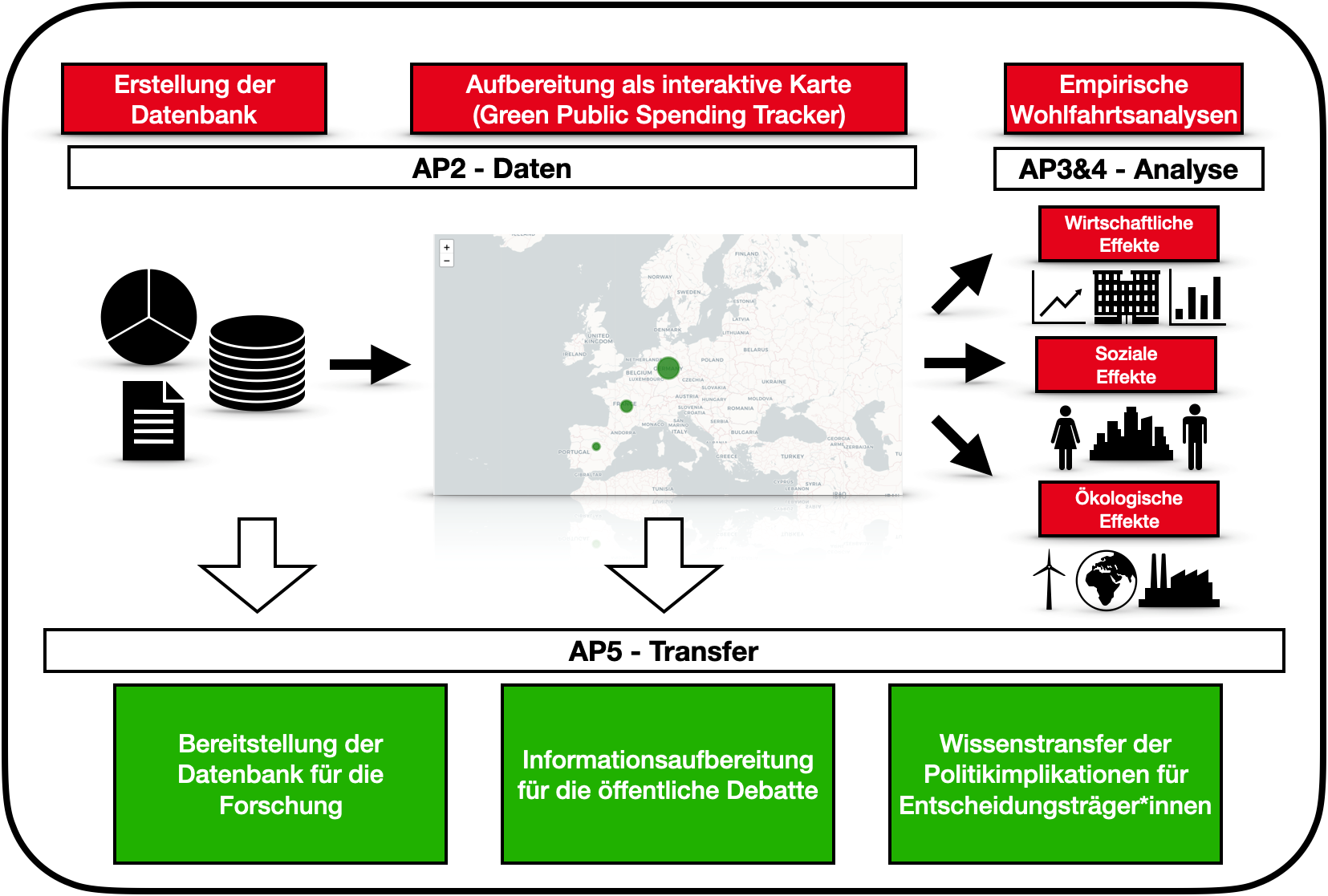
From a large number of scattered individual sources, a novel European map of green public spending is to be created that consistently provides a categorisation and quantification of government activities in the EU countries and regions over time ( Green Public Spending Tracker ). The focus is on green public investment, personnel expenditure and subsidies.
In analysing the effects of green public spending on employment-related, macroeconomic, distributional and ecological variables, econometric methods in line with the current state of research are applied. The use of structural VAR models (SVAR) and local projections (LP) makes it possible to depict the dynamics of the variables affected by green spending over time. In addition, feedback effects of the affected variables on public spending can be controlled for.
Interested students are always welcome to contribute to the project as part of their thesis.