Distributional Effects of Fiscal Policy on Income and Employment: Microeconomic Evidence for Austria
DIEFISCAL is a cooperation project between the Professorship of Macroeconomics at Chemnitz University of Technology and the Vienna Institute for International Economic Studies (wiiw), funded by the Austrian Academy of Sciences.
Funding Institution
Duration
July 2025 - June 2027
Project Partner
Vienna Institute for International Economic Studies (wiiw)
Research Question
This project provides new insights into how changes in tax and social legislation affect individual income and employment trajectories.
Methodology
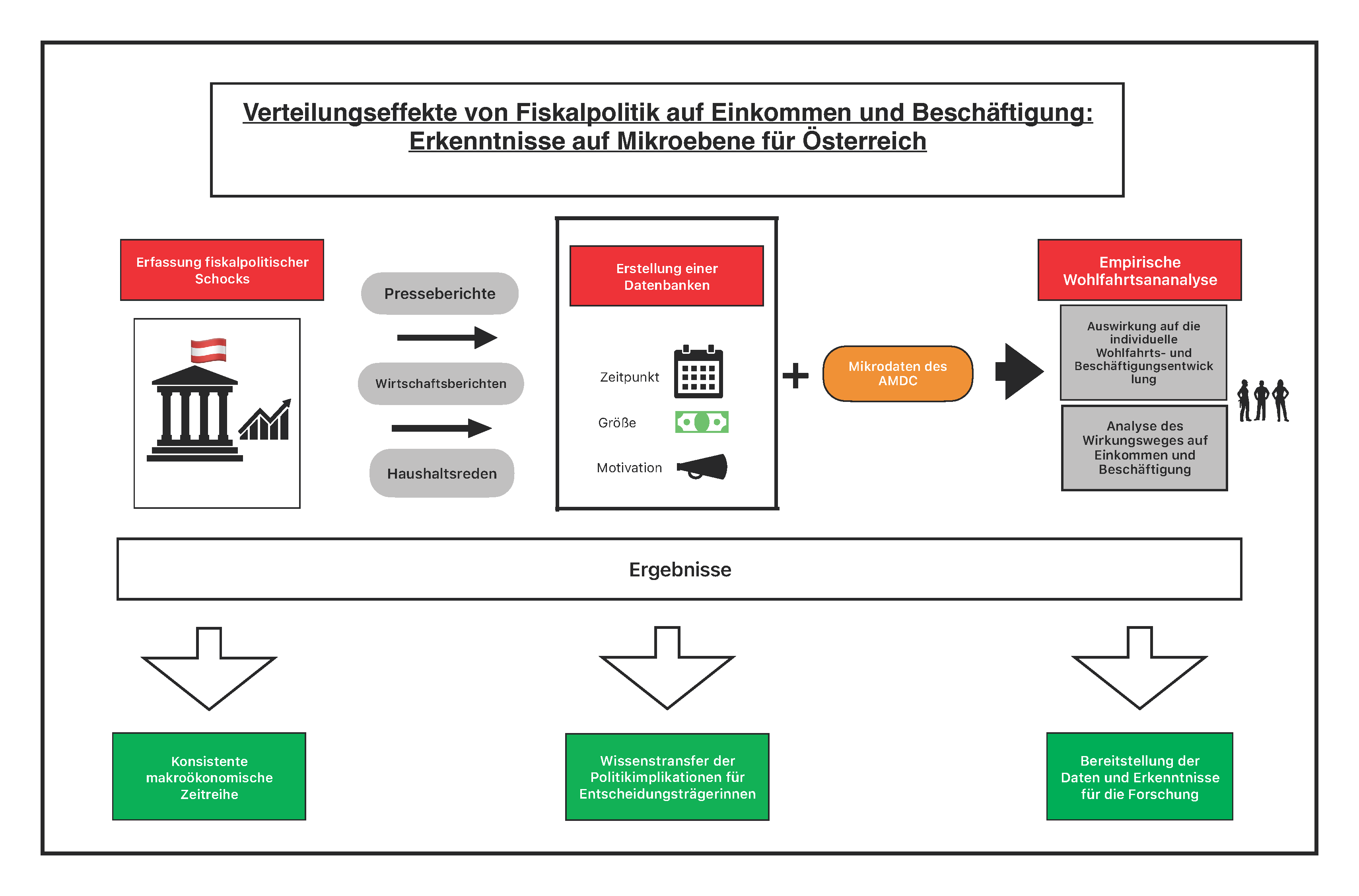
The identification of exogenous fiscal policy shocks is of central importance for the causal analysis of the effects of tax and transfer policy changes on income and employment levels. We therefore record exogenous tax and transfer shocks for Austria in a broad historical time series.
These novel data cover the timing, size, motivation and distributional impact of legislated tax and transfer changes in the period 2000 - 2022, based on information from government bills, budget reports, the annual budget speech of the Minister of Finance in the Austrian Parliament, press reports and economic reports. This dataset will be published as open source and can thus be used by other researchers for further research questions at the national level. It can also be combined with similar datasets for other countries in international panel studies or country comparisons.
We apply this narrative dataset to micro data of the Austrian Micro Data Center (AMDC) on income and employment. In this way, we can test whether different policy measures (e.g. income tax reforms, changes in consumption taxes or social benefits) have different effects on individual income and employment trajectories.
Combining the AMDC micro data with our macroeconomic dataset on fiscal shocks enables a high-frequency identification of the effects of tax and transfer shocks at the individual level. These individual tax and transfer shocks can then be tested as possible explanations for employment trajectories, reasons for unemployment and decisions on working hours, depending on the social and economic status of the individual.
Project Objectives
Our results will inform policymakers about the effects of different tax and transfer policies on employment and income developments in Austria, also with regard to exploiting regional differences. These findings will contribute to the academic literature on the effects of fiscal policy. In particular, we will gain new insights into the transmission mechanisms of tax and transfer shocks via labour supply and labour demand decisions, which are currently not well understood. The estimated parameters can feed into modern macroeconomic heterogeneous agent models.