"Complex problems are characterized by the fact that sometimes contradictory answers can both be correct. No school teaches you how to deal with that. It is based on the courage to question your own truths –
and always to ask: What if the opposite were true?" (Dirk von Gehlen)
"Anyone who believes they have no choice lacks imagination." (Picard in Star Trek: Picard)
Teaching at the Chair
The Chair actively integrates ESD, Education for Sustainable Development, into research and teaching.
Sustainability-oriented capabilities include academic, education-related, professional, societal, private, entrepreneurial, and governmental action. Competence development for realizing sustainability is actively integrated into the research and education process in order to implement Education for Sustainable Development. The Chair actively promotes the United Nations (UN)-supported initiative Principles for Responsible Management Education (PRME) with its seven principles Purpose, Values, Teach, Research, Partner, Practice, Share.

Key competencies for sustainability
- Systems thinking competency: The ability to recognize and understand relationships, analyze complex systems, and deal with uncertainty.
- Anticipatory competency: The ability to evaluate different future scenarios, develop one’s own visions, and assess risks.
- Normative competency: The ability to reflect on norms and values and to negotiate sustainability goals in conflict situations.
- Strategic competency: The ability to develop and implement innovative sustainability strategies.
- Collaboration competency: The ability to learn from others, show empathy, and facilitate group processes.
- Critical thinking competency: The ability to critically question norms and opinions and to reflect on one’s own values and actions.
- Self-awareness competency: The ability to reflect on one’s own role in society and to act in a self-motivated manner.
- Integrated problem-solving competency: The ability to combine different approaches to solving complex sustainability problems.
We have summarized these ESD competencies as well as suitable methods in a competency guide . This can provide inspiration for integration into teaching.
Thinking in Scenarios: Companies 2040
How will the corporate world in Germany change over the next two decades? Four scenarios:
- BENCHMARK
- BRICOLAGE
- B.I.G. TECH
- GEO-ECONOMICS
These explore different possible development paths for the framework conditions of corporate action.
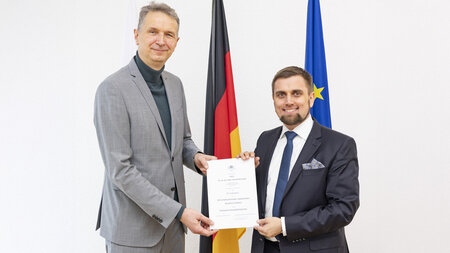
Project „Nachtigall“ receives "Hochschulperle" award
The Stifterverband für die Deutsche Wissenschaft e.V. honors TU Chemnitz and Mittweida University of Applied Sciences with the „Hochschulperle of the Month for November 2019“.