

Presenting with AI-tools
General reflections
In case that the application of AI-tools for generating texts, images, graphics, codes, tables or other elements is considered, the following initial questions may serve as start-up support:

May I make use of AI-tools? Which regulations do I have to observe?
(AI-)guidelines of the university, the professorships or the lecturers and examination regulations may determine specific requirements or limitations for the application of AI-auxiliaries in academic works. It is crucial to read those regulations carefully and observe them.

Do I really want to use this AI-tool? Which data am I willing to provide to the system by application of the AI-tool?
By entering individual or sensitive data in AI-systems, you may run risks of data protection. Infringements of copyrights may occur in the case that documents are integrated in a prompt without consent of the author.
Are the results indicated correct? How do I integrate them in my academic work?
The author of an academic works continues to be responsible for her/his examination performance. Thus, the responsibility to assure that the application of the AI-tool complies with the valid regulations and standards of scientific practice belongs to the user. This includes the critical assessment of the results generated, for example the assessment on plagiarism and inaccurate information. In addition, it should be checked whether the content produced contributes in an appropriate way to answering the research question developed or whether it should be deleted.
How do I mark those parts of an elaboration which had been produced with assistance of AI-tools?
With regard to this, the information concerning copyright law in module 4 may be helpful.
 Further information
- Learning offers of AI Campus
- Guidelines of the University of Mannheim for reflection on working with ChatGPT within studies
Practical application
For the texting of effective prompts for the generation of contents, those two guidelines may offer assistance:
Firstly, the CLEAR-framework offers an approach for the texting of efficient prompts structured by five key-elements. The five key-elements are: Concise, Logical, Explicit, Adaptive and Reflective (Lo 2023)
- Concise: short and clear wording of prompts so that the AI-model focuses on the core elements of the task.
- Logical: structured and coherent wording of prompts in order to keep the logical series of ideas prepared before and to assist the AI-model in getting the contexts and interrelations.
- Explicit: clear indications regarding the output format, content and scope. Thus, the probability of irrelevant answers may be minimized.
- Adaptive: flexible adaptation of prompts by testing different wordings and structures.
- Reflective: Continuous assessment and sophistication of the prompts by assessment of answers in order to enhance future prompts.
Secondly, those precise questions may assist in generating appropriate and optimized output within the elaboration of text-generating prompts. (Source: Hochschule RheinMain, Hints for a better Prompting)
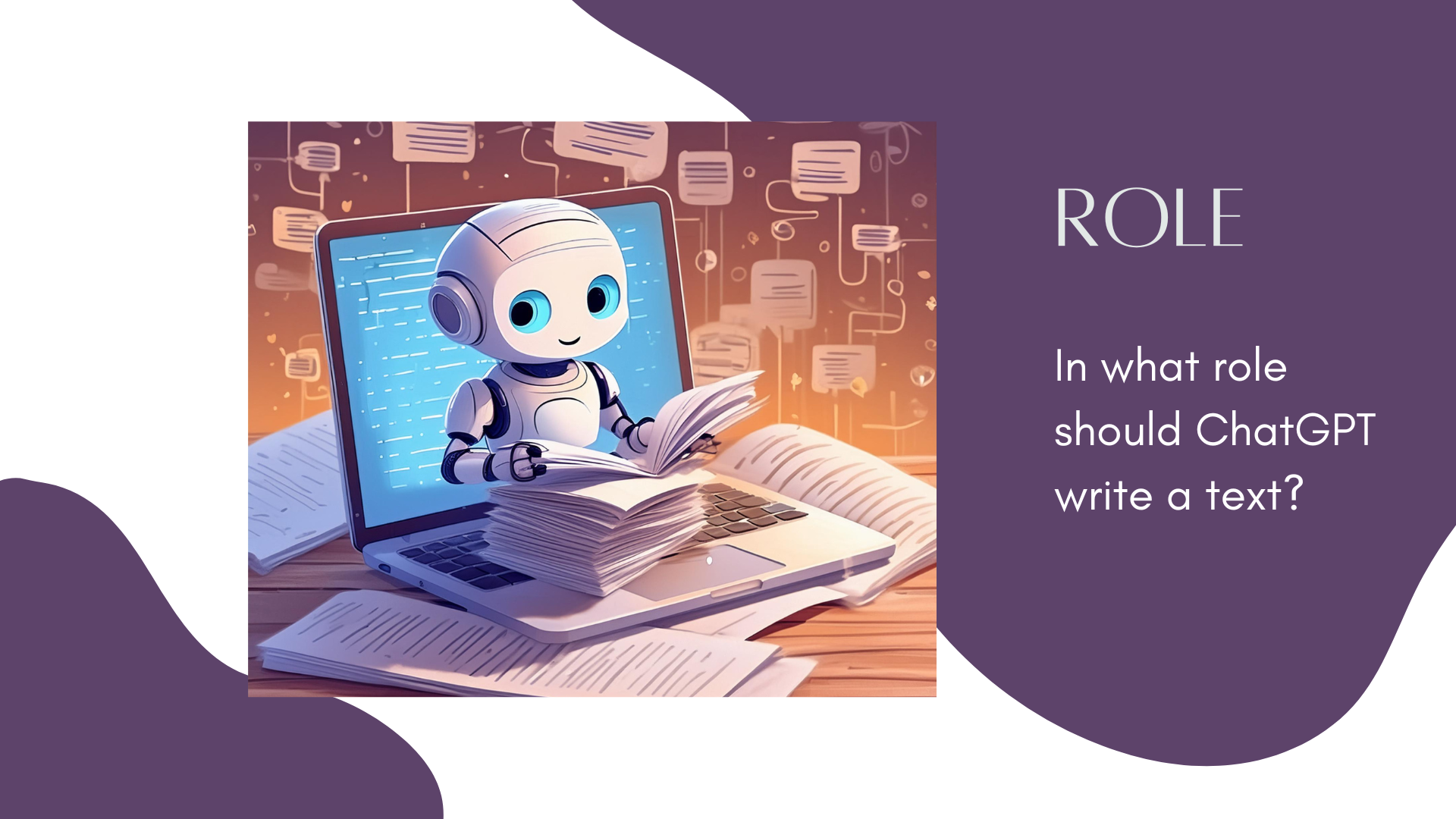


- Role: In what role should ChatGPT write a text?
- Task/goal: What is the task for ChatGPT? What should the result be? In which format should the result be (e.g. blog article, summary)?
- Addressee: Who is the text aimed at?
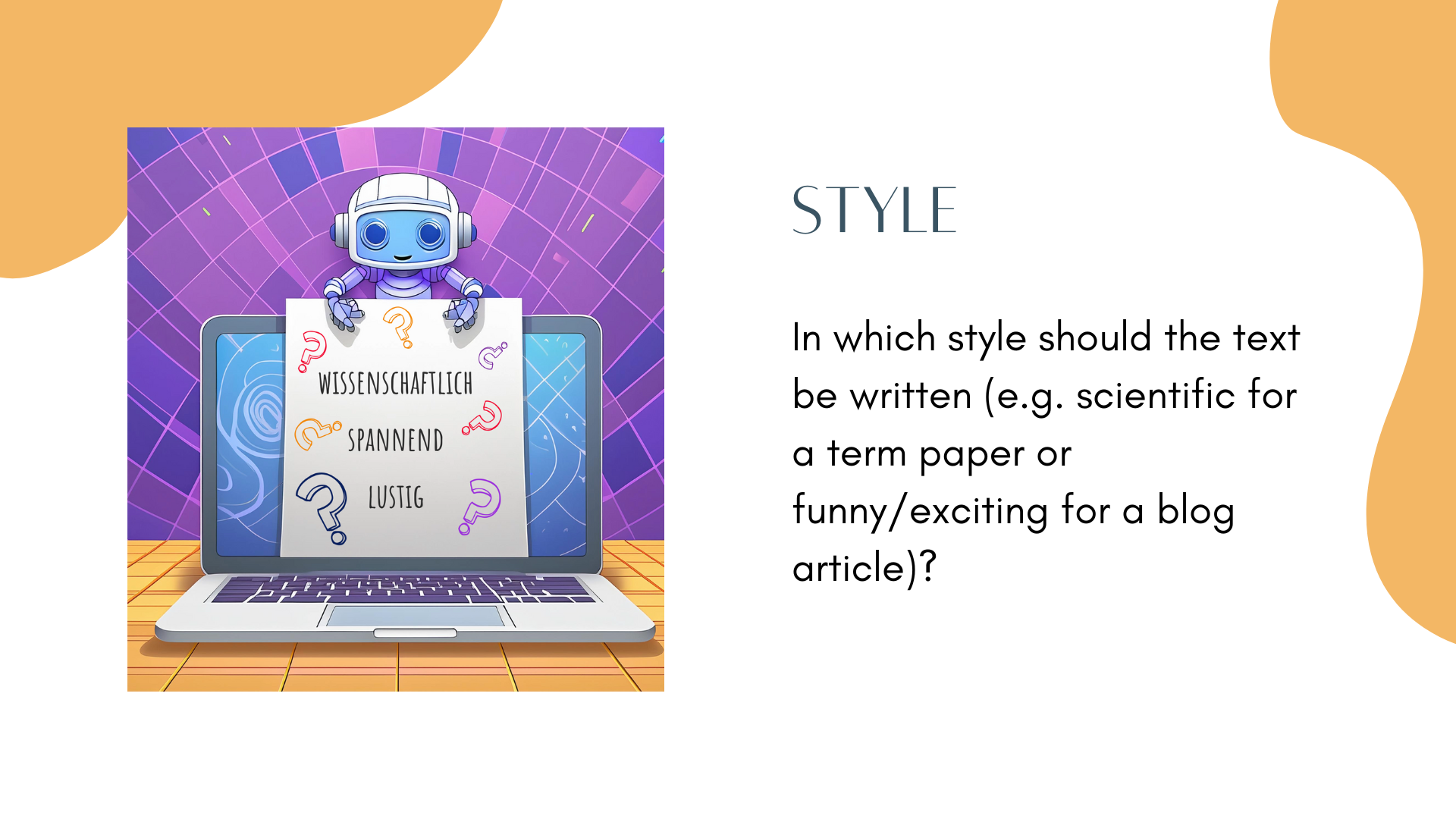
- Style: In which style should the text be written (e.g. scientific for a term paper or funny/exciting for a blog article)?
- Context: What other context could be helpful for a better result?