One Film, Two Effects
Researchers at TU Chemnitz have developed a flexible nanocomposite film that can both generate electrical energy and measure pressure.
-
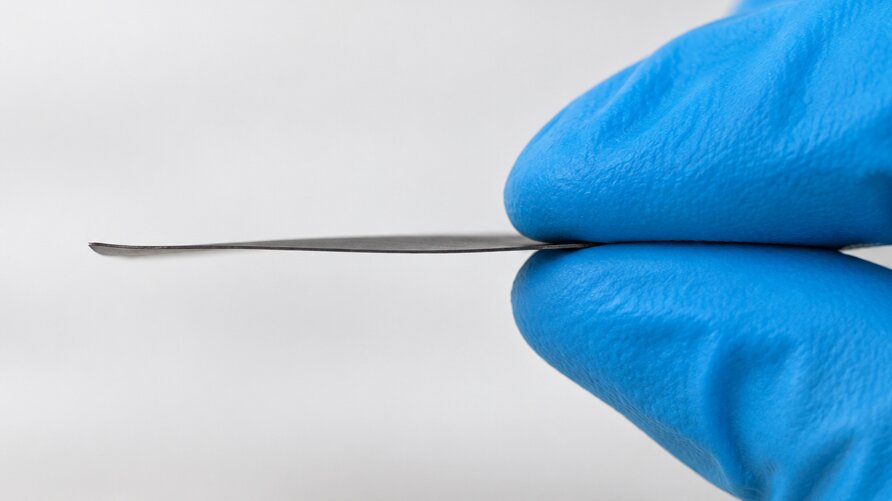
Generates electrical energy and measures pressure: nanocomposite film developed at Chemnitz University of Technology
A research team at Chemnitz University of Technology has developed a flexible nanocomposite film that uses two physical effects in one material. Under mechanical load it generates electrical charge through the piezoelectric effect. At the same time, it changes its electrical resistance through the piezoresistive effect. The material combines the polymer polyvinylidene fluoride (PVDF) with ceramic barium titanate (BaTiO₃) particles and multi-walled carbon nanotubes (MWCNTs). The results have been published in Nano Energy, one of the leading international journals in the field of energy materials and nanotechnology.
Two sensing principles in a single material
Piezoelectric materials are used in two ways. They serve as sensors for dynamic loads such as vibrations and impacts, and they can also harvest energy by converting mechanical movement into electrical energy. A piezoelectric sensor can therefore supply its own power. However, it only responds to changing loads. Piezoresistive materials respond to pressure with a measurable change in resistance, so they can also detect static loads precisely and sensitively. Until now, the two material types have usually been developed separately. The Chemnitz team combines both principles in one film only about 40 µm thick.
The two fillers divide the work between them. BaTiO₃ is a lead-free piezoceramic. It supports local polarization and promotes the formation of the electroactive phase of PVDF, which is responsible for the piezoelectric effect. The carbon nanotubes form an electrically conductive network in the polymer. When the film is compressed, the contacts between the nanotubes change and the electrical resistance changes with them. The nanotubes also reinforce the polymer mechanically.
“Our central question was how the ceramic and conductive fillers act together inside the PVDF matrix,” says Prof. Dr. Olfa Kanoun, head of the Professorship of Measurement and Sensor Technology at TU Chemnitz. “By adjusting both concentrations systematically, we could control the material structure and direct its performance toward energy conversion or pressure detection.”
PVDF is lightweight, flexible and suitable for large-area processing. To perform well as a piezoelectric material, however, it usually needs high-voltage electrical poling, mechanical stretching, or both. In the new composite, the fillers take over this task during film formation. The ceramic particles promote the polar crystal structure, and the nanotubes act as nuclei that increase the overall crystallinity of the polymer. At the interfaces between polymer, ceramic particles and nanotubes, microcapacitor-like regions form, which increase charge accumulation and polarization. As a result, the electroactive content of the films is up to about twice as high as in pure PVDF. Their piezoelectric coefficient reaches values comparable to those of electrically poled PVDF-based systems.
Simple processing produces flexible thin films
The films are produced by solution casting. PVDF and the fillers are dispersed in a solvent, then cast and thermally treated. The result is a homogeneous, flexible film. For energy-harvesting tests, the films were placed between flexible electrodes to form compact nanogenerators.
“A homogeneous distribution of the ceramic particles and carbon nanotubes was essential,” explains Dipl.-Ing. Ahmed Attaoui, lead author of the study. “The performance depends not only on the individual constituents, but also on the interfaces formed between them.”
The composition decides which effect dominates
The team succeeded to systematically vary the nanotube content at each ceramic level. This allowed them to link the composition of the material to its structure, mechanical strength, electrical output and pressure sensitivity. The composite is considerably stiffer and stronger than pure PVDF, yet it stays flexible.
A formulation with a higher nanotube content delivered the best energy harvesting. It reached output voltages of up to 25 V and a maximum power of 345 microwatts, about a hundred times more than the same material without nanotubes. The material also demonstrated long-term stability: The output voltage remained stable over 20,000 loading cycles. Even after 50,000 and 100,000 cycles, the peak voltage decreased only slightly, while the overall signal shape was preserved. A formulation with more ceramic and fewer nanotubes gave the highest pressure sensitivity, while still delivering a high electrical output. This formulation was therefore selected for all subsequent device tests.
“The important result is the controllability of the system,” says Kanoun. “One composition can be selected for higher electrical output, while another can be selected for pressure sensitivity. This gives device designers a clear basis for choosing the formulation that fits the intended function.”
“Combining piezoelectric and piezoresistive effects in one material opens up a range of possible uses, from sensors to energy harvesters and, in future, actuators,” says Kanoun. “Our results provide a materials basis for exploring these functions within one composite system.”
Toward self-powered smart skins and wearable electronics
A demonstration shows how the two effects complement each other in a single device. When the researchers pressed the film steadily with a fingertip, its electrical resistance dropped clearly while almost no voltage was generated. Rapid tapping, by contrast, produced strong voltage pulses. The same film can therefore register how strongly and how long it is pressed, and at the same time harvest energy from movement. The team also showed that the harvested energy is usable: The rectified output charged capacitors within a few seconds and powered an array of LEDs.
The concept is aimed at flexible and wearable electronics, where space, weight and energy supply are limited. Potential applications include self-powered pressure sensors, electronic skins, health-monitoring patches, robotic tactile interfaces, structural monitoring and autonomous Internet of Things devices.
The researchers are now investigating whether the material can also produce controlled mechanical motion under electrical excitation. This could extend the concept to actuation, for example vibrotactile feedback in wearable and interactive systems. “The study provides a materials basis for compact autonomous devices”, says Attaoui. “The next step is to translate the measured material properties into reliable components and to evaluate how energy harvesting, sensing and actuation can be integrated at device level.”
Interdisciplinary and international cooperation
The study is the result of a cooperation between the Professorship of Measurement and Sensor Technology and TU Chemnitz alumna Dr. Ayda Bouhamed. She is now at the Faculty of Sciences of Gafsa, University of Gafsa, and a member of the Laboratory of Electromechanical Systems at the National Engineering School of Sfax in Tunisia. The work was carried out during her visiting professorship at TU Chemnitz. The visiting professorship allowed the partners to combine their expertise in nanocomposite materials and sensor technology. It also strengthens the long-standing collaboration between TU Chemnitz and research institutions in Tunisia.
“It is a special pleasure for me to collaborate with my alma mater,” says Dr. Ayda Bouhamed. “The visiting professorship program gave us the opportunity to bring our expertise together in Chemnitz, and it shows how well scientific cooperation works across borders today.”
Further partners from TU Chemnitz contributed their expertise: Prof. Dr. Martin F.-X. Wagner and Mario Scholze from the Institute of Materials Science and Engineering, and Prof. Dr. Christoph Tegenkamp from the Professorship of Analysis of Solid Surfaces at the Institute of Physics. Prof. Dr. Chokri Bouraoui from the Laboratory of Mechanics at the National Engineering School of Sousse, University of Sousse, co-supervised the work. The cooperation brought together measurement and sensor technology, materials science and surface physics.
Publication: Ahmed Attaoui, Ayda Bouhamed, Mario Scholze, Martin F.-X. Wagner, Christoph Tegenkamp, Chokri Bouraoui, Olfa Kanoun: "High-performance self-poled PVDF-BaTiO₃-CNT nanocomposites: A multifunctional material for flexible next-generation energy harvesting and sensing." Nano Energy, 2026, 148, 111688. DOI: https://doi.org/10.1016/j.nanoen.2025.111688
Further Information: Prof. Dr. Olfa Kanoun, phone +49 (0)371 531-36931, email olfa.kanoun@etit.tu-chemnitz.de
(Author: Ahmed Attaoui)
Detlef Gürtler
01.10.2026