Smart Vehicle Technology Aims to Reduce Injury Risks for Pedestrians and Cyclists
Chair of Cognitive Psychology and Human Factors of Chemnitz University of Technology is involved in research project that aims at developing and validating an automated driving function capable of initiating targeted braking and steering maneuvers in situations in which collisions are unavoidable
-
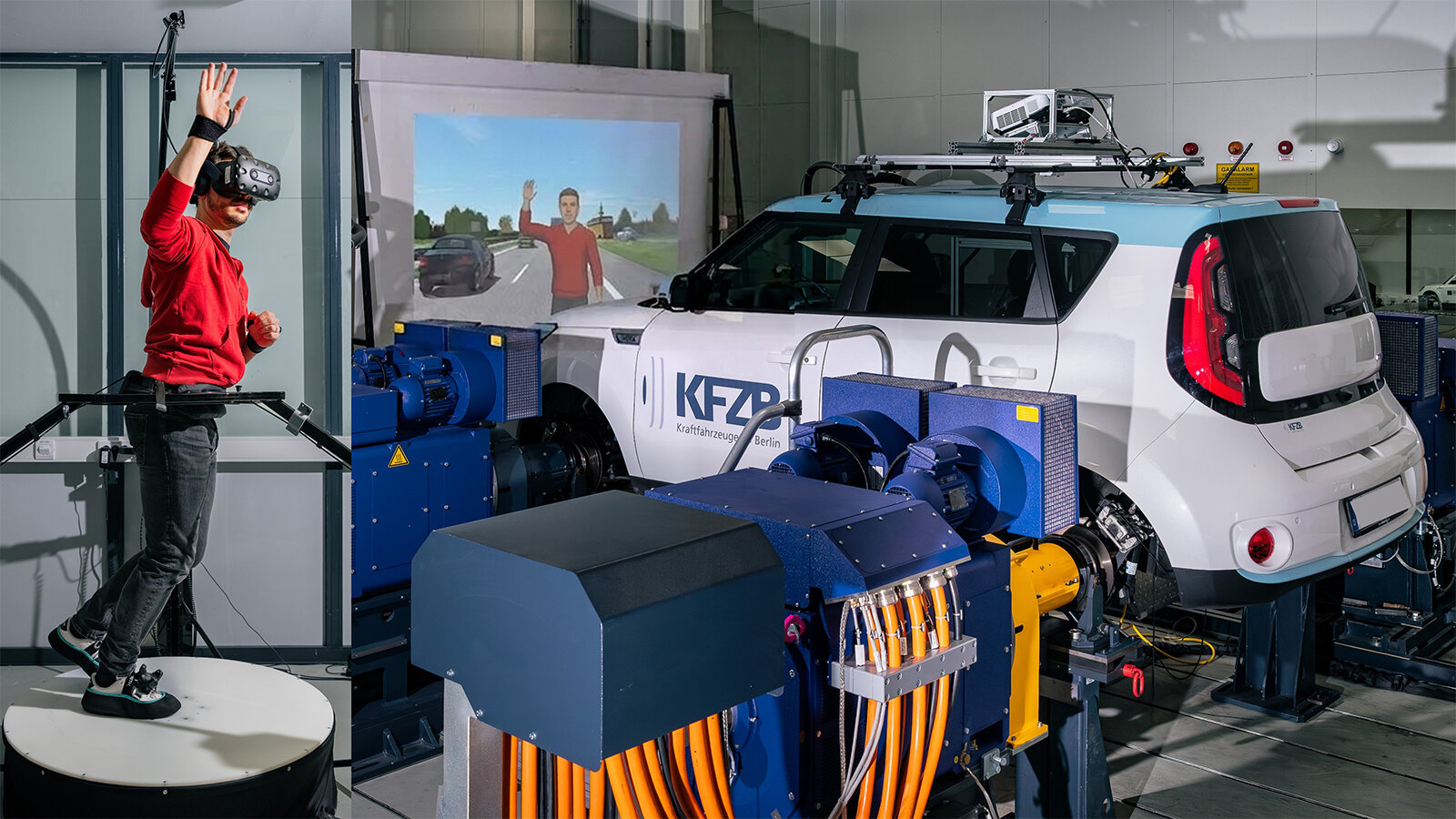
Blurring the lines between reality and simulation: In the test environment at TU Berlin, the project partners are investigating how a vehicle control system designed to minimize the risk of injury behaves when interacting with real people and realistic hardware—without posing any real risks. The research team at TU Chemnitz will also use this laboratory. Photo: Kevin Fuchs
Pedestrians and cyclists are particularly vulnerable in road traffic accidents. Statistics from the past ten years show that they account for 75 to 85 percent of all seriously and fatally injured individuals in Germany—even though they are only involved in about one in ten accidents. While the absolute number of road fatalities continues to decline, partly as a result of stricter requirements for vehicle structural design and advanced driver assistance systems, the safety of “vulnerable road users” (VRUs) remains a key challenge.
From brake assistance to advanced driving maneuvers
Existing driver assistance systems prevent or mitigate accidents or their consequences through braking maneuvers. In the VIRTUS project, Chemnitz University of Technology, the Fraunhofer Institute for High-Speed Dynamics/ Ernst-Mach-Institute (EMI) and Technische Universität Berlin are investigating the extent to which injuries can be reduced through additional, targeted steering maneuvers – specifically in situations where a collision is unavoidable. The project is funded by the German Federal Ministry of Research, Technology and Space with €1.6 million, of which €247,000 Euro is allocated to TU Chemnitz. Fraunhofer EMI is the project coordinator.
VIRTUS builds on findings from the project “ATTENTION”, funded by the Federal Ministry for Economic Affairs and Energy. Using cyclists and pedestrians as examples, the researchers demonstrated in a virtual test environment that injury risks could be reduced with targeted steering and braking interventions performed by involved vehicles. Over the next three years, the VIRTUS project partners will verify whether this also works reliably under realistic conditions.
At the core of the project is an algorithm that, based on sensor data, vehicle movement, and the predicted movement of the VRU, calculates driving strategies in very short time that minimizes injury risk. The Chair of Cognitive Psychology and Human Factors of TU Chemnitz is responsible for the user studies and the human-centered validation of the algorithms. “Within the project, we investigate the effectiveness of the automated driving function while taking the VRU behavior, the system acceptance, as well as the interaction between drivers and the driving function into account,” says Prof. Stefan Brandenburg.
Realistic testing in a virtual environment
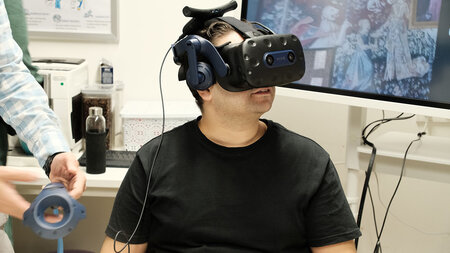
For the tests, the project partners will use a highly integrated test bench system. Within a virtual traffic scenario, a real vehicle mounted on a test bench, a pedestrian in a virtual environment, and a human driver in a driving simulation are integrated into the system and interact in real time. By coupling these components, accident scenarios and the interactions between different road users can be realistically replicated and investigated without exposing participants to risks and in compliance with ethical requirements.
“In this test environment, we can investigate how an injury risk-minimizing vehicle control system behaves in interaction with real people and realistic hardware for the first time—without real risks for any of the people involved. This is an important step toward deployment-ready safety technology,“ project leader Dr. Thomas Soot explains. Prof. Stefan Brandenburg adds: “The user studies of the project will provide important insights how people respond intuitively and how their reactions affect the effectiveness of this safety technology during such encounters.”
Beyond testing the specific driving function, VIRTUS pursues another goal: The developed test methods and ethical guidelines of the project are intended to be applicable for other automated driving systems in the future. In this way, the project supports the safe development and testing of automated vehicle technology in Germany.
For further information, please contact Dr. Ann-Christin Hensch, Telefon 0371 531-35419, E-Mail ann-christin.hensch@psychologie.tu-chemnitz.de, Bettina Kämpfe, Telefon 0371 531-36314, E-Mail bettina.kaempfe@psychologie.tu-chemnitz.de, and Prof. Dr. Stefan Brandenburg, Telefon 0371 531-31312, E-Mail stefan.brandenburg@psychologie.tu-chemnitz.de.
(Sources: Fraunhofer EMI, Professur Allgemeine Psychologie und Human Factors der TU Chemnitz)
Mario Steinebach
30.09.2026