Organic Solar Cells Move Towards Scalable Manufacturing
solar cells achieved power conversion efficiencies of 7.3 % – a record for fully roll-to-roll-compatible organic solar cells with a gravure-printed photoactive layer
-
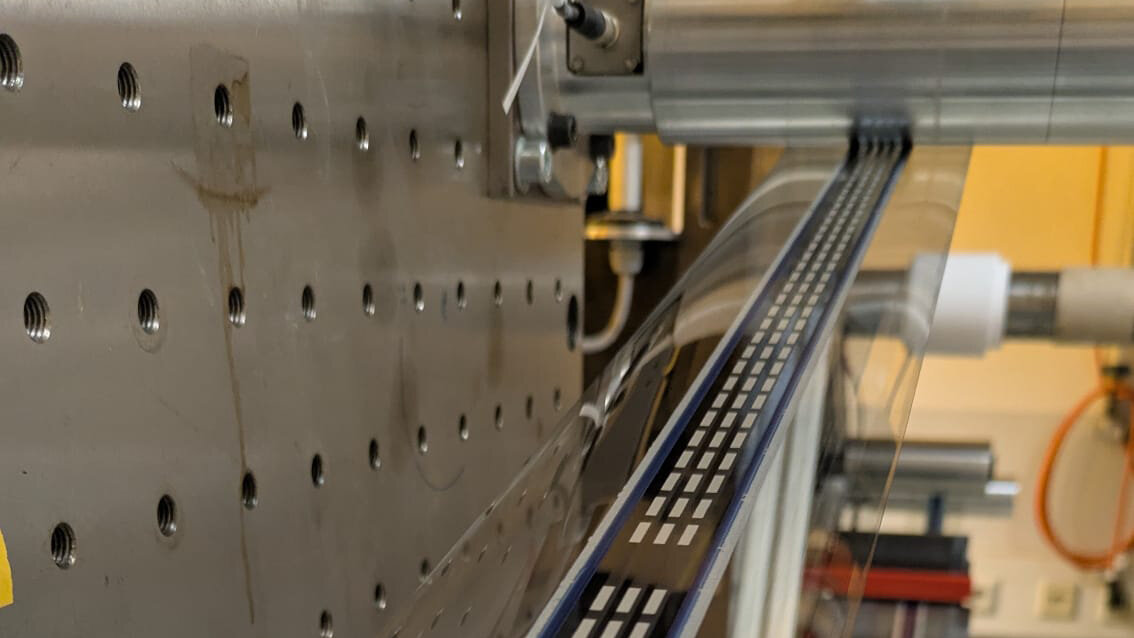
A close-up of the printing process at the Institute for Print and Media Technology at Chemnitz University of Technology: A printed material web is guided through a printing machine. Photo: David Holzner, Institute for Print and Media Technology, Chemnitz University of Technology
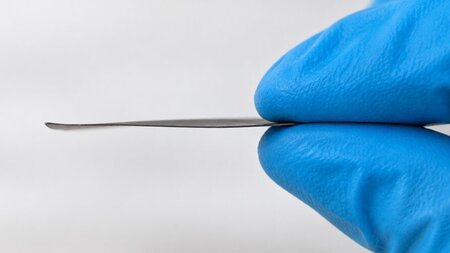
Organic solar cells can be thin, lightweight and flexible. Although laboratory devices now achieve efficiencies of more than 20 %, maintaining a high performance when moving towards large-scale production remains a challenge. Researchers at Chemnitz University of Technology have now demonstrated organic solar cells based on non-fullerene acceptors using scalable printing and coating processes on flexible substrates. At the same time, they investigated why these devices are less efficient than their laboratory-scale counterparts.
The researchers used the photoactive material system PM6:Y12 and deposited the photoactive layer by gravure printing instead of conventional spin coating. In this process, the material solution is transferred onto the substrate using an engraved cylinder – a method suitable for continuous roll-to-roll production. They also used o-xylene, a non-halogenated solvent that is both more environmentally friendly and better suited to industrial processing than the commonly used laboratory solvent chloroform.
"We were able to produce uniform photoactive layers using gravure printing and a solvent suitable for industrial processing. However, printing the active layer is only one part of the challenge. All the layers have to work together, and each manufacturing step must be compatible with the layers underneath," said Svitlana Taranenko, first author of the study and researcher at the Institute for Print and Media Technology at Chemnitz University of Technology.
Gravure printing itself is not the limitation
An obvious explanation for the lower efficiency would be that gravure printing changes the morphology of the photoactive layer – in other words, how the two photoactive materials arrange themselves. However, the results reveal a more complex picture. "Our measurements show that gravure printing largely preserves the photoactive material's ability to absorb light and generate charge carriers. A substantial part of the efficiency loss comes from the architecture of the complete solar cell. At the same time, slower charge transport and additional recombination further reduce the performance," said Dr. Maria Saladina, corresponding author of the study and postdoctoral researcher at the Professorship of Optics and Photonics of Condensed Matter at Chemnitz University of Technology.
Despite these losses, the solar cells achieved power conversion efficiencies of 7.3 % – a record for fully roll-to-roll-compatible organic solar cells with a gravure-printed photoactive layer. "We now understand better where the remaining limitations lie. To bring the efficiency of printed solar cells closer to that achieved in the laboratory, we need to optimise the entire device architecture, including the interfaces and charge-transport layers. This provides a clear direction for the next steps towards scalable manufacturing," adds Dr. Saladina.
While hundreds of studies focus on laboratory-scale organic solar cells, only a small number investigate devices manufactured entirely using roll-to-roll-compatible methods. Among the few research groups pursuing gravure printing for organic photovoltaics are those led by Prof. Chang-Qi Ma in China and Prof. Arved C. Hübler at Chemnitz University of Technology. "Our results show that there is no fundamental obstacle to transferring modern organic solar cells to scalable printing techniques. The challenge is that far fewer researchers work on these manufacturing methods than on laboratory-scale devices. With more research effort, more people and sustained funding, we could accelerate efficiency improvements and bring printed solar cells much closer to their laboratory counterparts," said Prof. Dr. Carsten Deibel, head of the Professorship of Optics and Photonics of Condensed Matter at Chemnitz University of Technology and spokesperson for the DFG Research Unit POPULAR.
The study demonstrates how interdisciplinary research combining printing technology, materials science and semiconductor physics can help bridge the gap between laboratory-scale organic solar cells and their future industrial production. The new publication, entitled "Bridging the lab-to-fab gap in non-fullerene organic solar cells via gravure printing" (https://doi.org/10.1039/d6el00051g), appeared in EES Solar, a journal of the Royal Society of Chemistry. The research was conducted by researchers from Chemnitz University of Technology in collaboration with Friedrich-Alexander-Universität Erlangen-Nürnberg and Durham University in the UK.
The POPULAR research project
Within the DFG Research Unit "Printed & Stable Organic Photovoltaics with Non-Fullerene Acceptors – POPULAR" (FOR 5387), researchers from 9 universities are working together to advance organic solar cells for large-area printing processes. Their research focuses on improving the performance and stability of these solar cells while gaining a better understanding of the underlying physical processes. The Research Unit is funded by the German Research Foundation (DFG) and coordinated by Prof. Dr. Carsten Deibel at Chemnitz University of Technology.
For further information, please contact Maria Saladina, phone +49 (0)371 531-34046, email maria.saladina@physik.tu-chemnitz.de, and Prof. Dr. Carsten Deibel, phone +49 (0)371 531-34878, email deibel@physik.tu-chemnitz.de.
(Source: Professorship of Optics and Photonics of Condensed Matter)
Mario Steinebach
21.09.2026