How gentle touches affect the wave transport properties in crystals
Franco-German research team uncovers the role of contact points for the formation of band gaps in two-dimensional crystal lattices
-
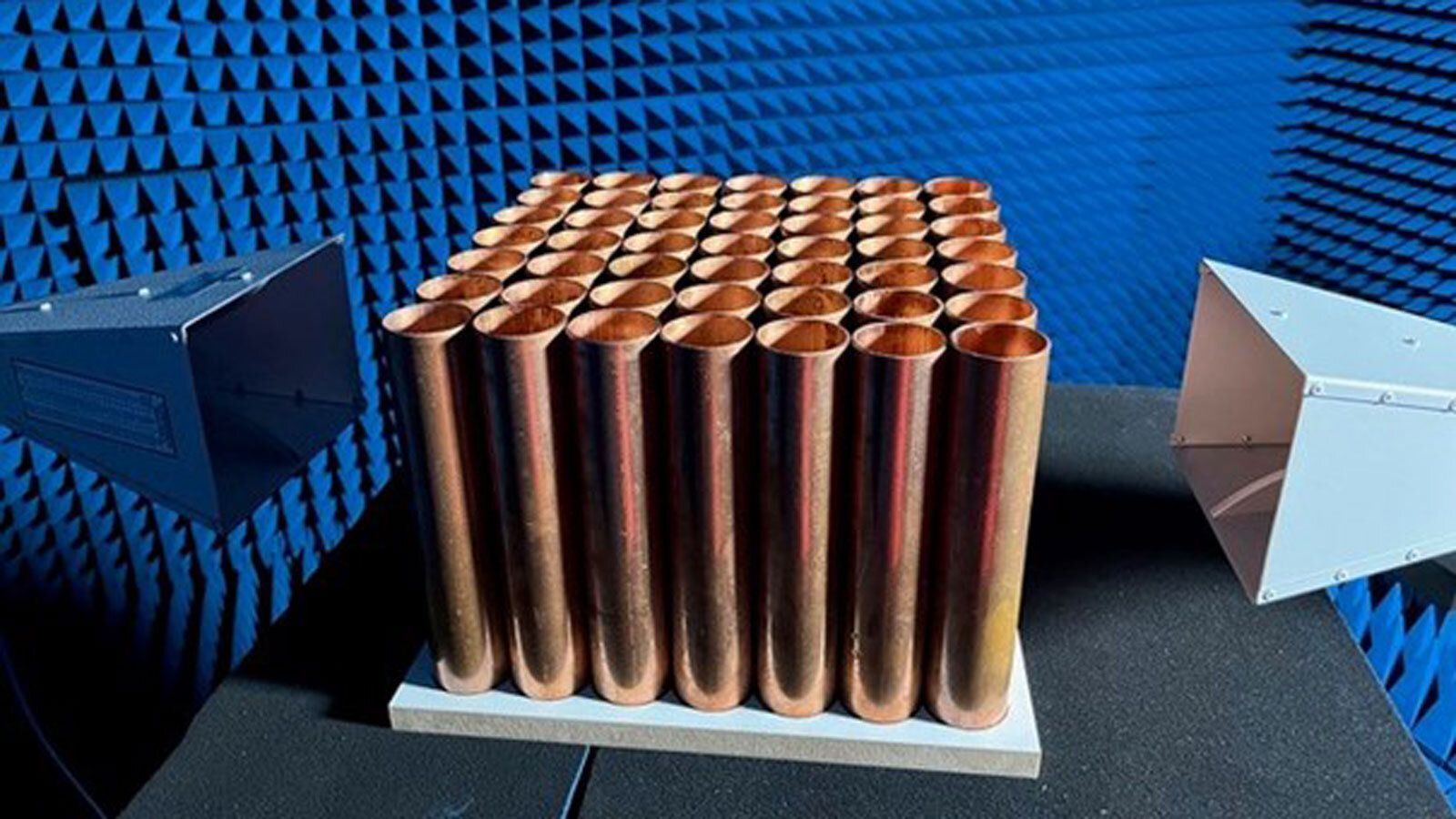
The two-dimensional electromagnetic crystal consists of a 7×7 array of copper tubes (approx. 20 cm long) arranged in a square grid, with the connections between the tubes facilitated by a specially designed wooden base plate. The setup is shown here prior to transmission measurements between two horn antennas at the Professorship of High-Frequency Technology and General Electrical Engineering (Prof. Ralf Zichner). These measurements take place in the anechoic chamber, a special room that enables measurements at extremely low noise levels. In addition, the Professorship of Theoretical Physics and Simulation of New Materials (Prof. Angela Thränhardt) and the Research Center MAIN at Chemnitz University of Technology contributed to the work. Photo: David Röhlig
A Franco-German research team of members of the FEMTO-ST Institute at the Université Marie et Louis Pasteur, Besançon, as well as the Faculties of Electrical Engineering and Information Technology and Natural Sciences, and the Research Center for Materials, Architectures and Integration of Nanomembranes (MAIN) at Chemnitz University of Technology, have uncovered new insights into the formation of forbidden frequency bands in periodic solid-state structures. The study, titled “Contact points open wide band gaps in all two-dimensional Bravais lattices,” was published in late April in the physics journal Physical Review B and makes fundamental contributions to the understanding of the electromagnetic wave transport properties through regularly arranged materials.
This study examines the influence of contact points between copper tubes as individual scatterers arranged regularly in space on the propagation of radio waves and, consequently, on the formation of forbidden frequency regions for these waves—so-called band gaps. Using theoretical considerations, numerical simulations, and experimental measurements of scattering across all possible two-dimensional arrangements—known as Bravais lattices—of the tubes, the researchers demonstrate that contact points systematically generate wider band gaps, thereby enabling broadband filters for radio-frequency waves.
The results underscore that a precise understanding of the geometric structure of the scatterers and their exact positioning relative to one another, especially in the case of touch, can systematically influence and control the band structures, thereby helping to control and tailor the propagation of waves. Large, adjustable band gaps are of crucial importance, particularly for applications in electronics and photonics, as they determine the electrical and optical behavior of the components.
This study is part of the current research on the development of geometric effects in functional, two-dimensional membrane materials and is consistent with findings from previous research in which the authors demonstrated a similar effect for sound. It is inspired by work conducted as part of the TUCculture initiative on the stele artwork “Model of Thought and Perception for the Phenomenon of Color” by Dresden-based artist Stefan Nestler (1998), located in front of the Central Lecture Hall and Seminar Building at Chemnitz University of Technology. This artwork has been discovered as the world’s largest realization of a photonic crystal. By further developing this field, the authors are now making a positive contribution to basic research in the field of wave physics and providing a new impetus for materials research.
Original publication: D. Röhlig, R. Zichner, T. Blaudeck, A. Thränhardt, V. Laude: „Contact points open wide band gaps in all two-dimensional Bravais lattices“, Physical Review B 113, 144391 (2026). URL https://doi.org/10.1103/9ql7-t9rh
(Author: Dr. Thomas Blaudeck)
Anne Eichhorn
06.05.2026