SmartCargoDrone — Development of an Autonomously Operating Multicopter Cargo Drone
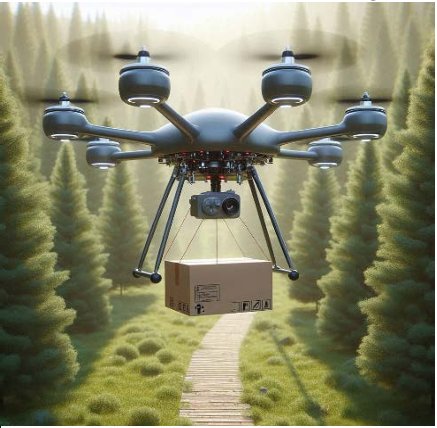
Commercially used drones have become established in areas such as surveying, mapping and inspection, but are predominantly deployed in a passive role of “detecting and imaging”, with cargo transport limited to light loads below 6.5 kg. Current UAV systems navigate primarily via GPS, IMU and compass, which are disrupted near high-voltage installations by electromagnetic fields. Flight control and mission control operate in existing architectures as separate layers without automatic interaction, model-based energy management is entirely absent, and the available trajectory planning algorithms are designed for two-dimensional, ground-based navigation and cannot be transferred to 3D flight operations.
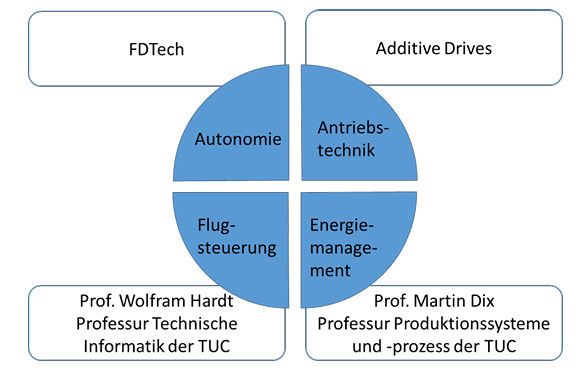
The aim of the project is to develop an autonomously operating multicopter cargo drone that independently transports packages to a geographic destination, actively dampens pendulum movements of the suspended load, and completes the entire mission without human intervention. The consortium of four partners covers four core areas. The Computer Engineering Chair at TU Chemnitz develops an adaptive platform with multiple control layers that enables automatic interaction between flight control and mission control, processing sensor data from LiDAR and camera as well as regulatory flight requirements on-board in real time. FDTech extends existing AI modules for vehicle trajectory planning to the full 3D space and trains the model under optimisation criteria such as energy minimisation, time optimisation, and adherence to safety margins. Additive Drives manufactures motor coils from copper and aluminium using 3D printing, achieving an increase in fill factor of up to 30 % and a power density of 15 kW/kg. The Chair of Production Systems and Processes implements a model-based energy management system with real-time consumption prediction and a remaining range estimation with 95 % accuracy.
The greatest technical challenge lies in real-time on-board decision-making: at flight speeds of up to 130 km/h, safe mission decisions must be made in milliseconds while simultaneously accounting for fixed obstacles, moving objects, and the current trajectory direction — all on compact, weight-optimised embedded hardware, since heavy processors are not feasible for drone deployment. Damping the pendulum movements of the payload poses a further challenge, as the moments of inertia of the cargo directly affect flight dynamics and must be compensated in real time. The project is deliberately limited to TRL 5 — the goal is to demonstrate feasibility in an experimental setup, not to achieve production readiness.
Project Partners
The joint project is carried out by four partners who together cover the areas of autonomy, flight control, drive technology, and energy management. The consortium is led by FDTech GmbH.
-
FDTech GmbH
Contact: Dr. Anke Stoll
Sub-topic: Autonomous mission control, 3D trajectory planning -
Additive | Drives GmbH
Contact: Philipp Arnold
Sub-topic: Development of a high-performance drone motor -
TU Chemnitz — Chair of Production Systems and Processes (PSP)
Contact: Dr.-Ing. Holger Schlegel
Sub-topic: Control engineering and energy management system, incl. flight-characteristics and energy-consumption simulation -
TU Chemnitz — Chair of Computer Engineering (TI)
Contact: Prof. Dr. Dr. h.c. Wolfram Hardt, Dr. Ariane Heller
Sub-topic: Automatic interaction between flight control and mission control
The project is funded by the Sächsische Aufbaubank – Förderbank – (SAB) under the 2021–2027 collaborative R&D funding programme, co-financed by the European Regional Development Fund (ERDF) and tax revenues of the Free State of Saxony.
Publications
Publications.