Shuttle Project: Human-Centred Interaction with Automated Shuttles
Project Partners
Funding

Sächsische Aufbaubank (SAB) / European Social Fund Plus (ESF+)
Duration at the Chair of Cognitive Psychology and Human Factors
January 2026 to December 2027
Description
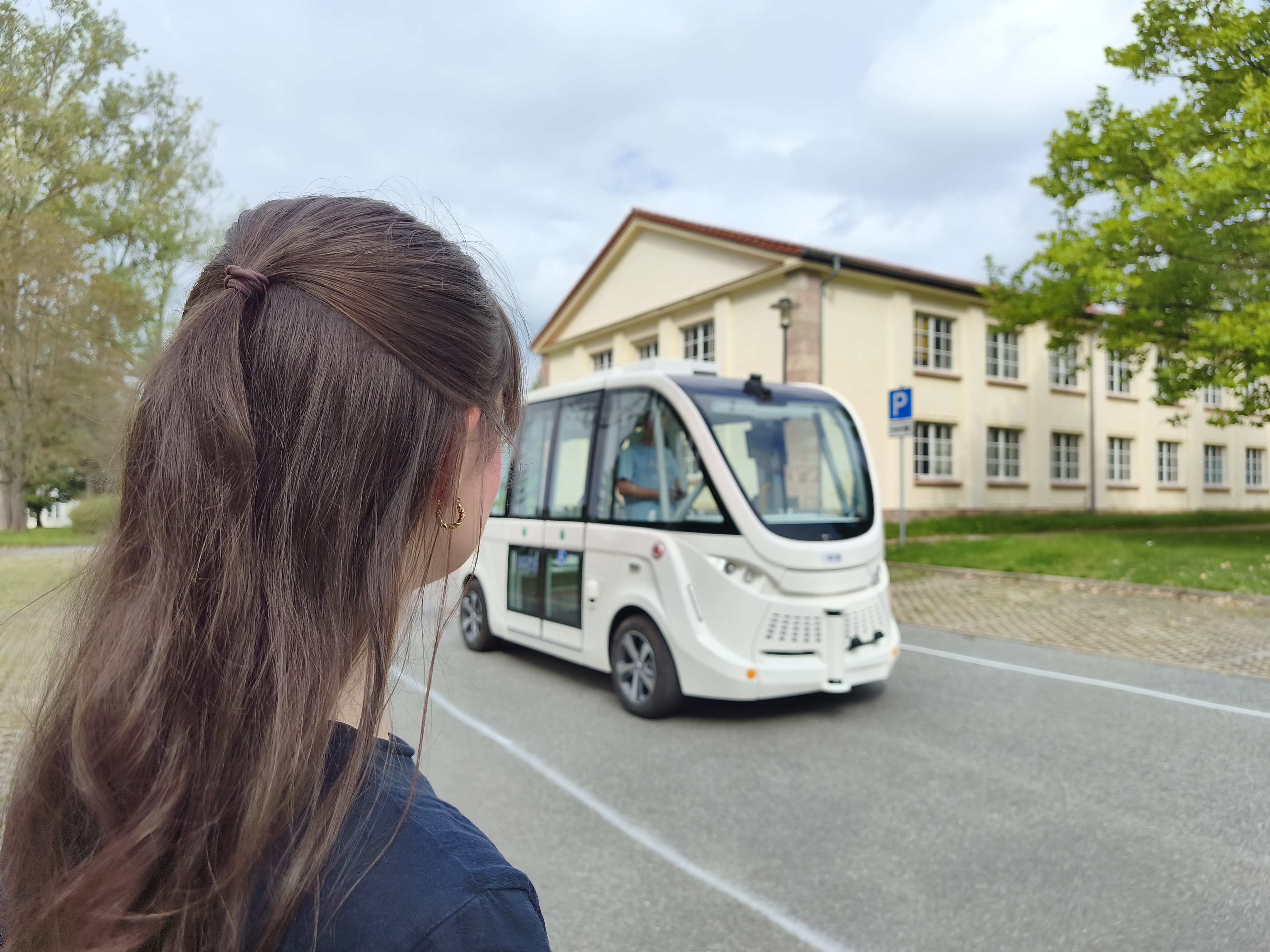
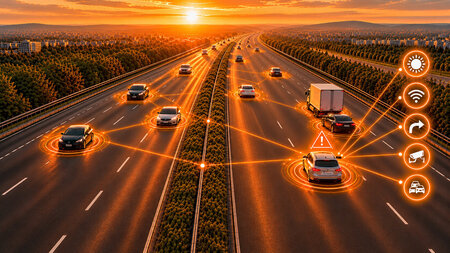
In the future, automated vehicles will increasingly interact with vulnerable road users, such as pedestrians, in public spaces. For a safe and accepted introduction of these forms of mobility, technical performance alone is not decisive. It is equally important to understand how people perceive and interpret the behaviour of automated vehicles. For example, the vehicle mode or braking strategy may influence whether an interaction is perceived as safe, comprehensible, and trustworthy.
As part of the project, Chemnitz University of Technology and Technische Universität Berlin investigate the human-centred and ethical design of interactions between pedestrians and an automated shuttle. First, different vehicle modes (automated, manually driven, and teleoperated), different approach speeds, and alternative braking strategies are experimentally compared in realistic field studies. The aim is to derive design recommendations for vehicle behaviour that is intuitive and positively perceived by pedestrians, thereby contributing to the development of automated mobility that consistently takes users’ needs into account.
Subsequently, the interaction scenarios and experiments used in the field studies will be transferred to a pedestrian-in-the-loop simulator as well as to video-based laboratory and online studies. By systematically investigating comparable scenarios using different research methods, the project will examine how the respective method influences the perception, behavioural intentions, and evaluation of interactions between pedestrians and automated vehicles. The findings will contribute to the human-centred development of automated mobility.
Press & Media
Autogazette, 13.10.2026: Autonome Shuttles: Sicher stoppen reicht nicht
A3: Association for advancing automation, 12.10.2026: Researchers Study People to Determine How Self-Driving Cars Should React
Verkehrsunfall und Fahrzeugtechnik, 12.10.2026: Auf das Bremsen kommt es an
Oiger, 12.10.2026: Studie: Akzeptanz von Roboterbussen sinkt, wenn sie schnell fahren
minq media, 10.10.2026: Wie soll ein automatisiertes Shuttle für Fußgänger bremsen?
Welt, 08.10.2026: Autonome Autos und Fußgänger
Chemnitzer Zeitung, 08.10.2026: Blick in die Zukunft der Mobilität
Frankfurter Rundschau, 08.10.2026: Auf das Bremsen kommt es an – Autonome Autos und Fußgänger
Freie Presse, 07.10.2026: Autonomes Fahren in Chemnitz? – Wie ein Visionär, ein Menschenkenner und ein Pragmatist darüber denken
ASU - Zeitschrift für medizinische Prävention, 07.10.2026: Wie sollten automatisierte Fahrzeuge mit Fußgängerinnen und Fußgängern interagieren?
Industr.com, 07.10.2026: Wie sicher fühlt sich ein Roboter-Shuttle an?
MDR WIssen, 05.10.2026: Wie Fußgänger auf automatisierte Fahrzeuge reagieren
Windenberg.net, 05.10.2026: Bridging the Human-Machine Gap: New Insights into Pedestrian Trust in Autonomous Shuttles
Pugnalon, 05.10.2026: Uni Chemnitz untersucht Wirkung autonomen Fahrens auf Fußgänger
Freie Presse, 04.10.2026: Chemnitzer Spedition startet Roboter-Stapler zwischen seinen Hallen
Knowridge, 03.10.2026: When Driverless Vehicles Stop, Pedestrians Notice More Than You Think
Aktuell24, 02.10.2026: Wie sollten automatisierte Fahrzeuge mit Fußgängerinnen und Fußgängern interagieren?
AEE Mobility, 02.10.2026: Forschende untersuchen Interaktion von automatisierten Fahrzeugen mit Fußgängern
TechXplore, 02.10.2026: How should automated vehicles interact with pedestrians?
TUC Aktuell, 02.10.2026: How should automated vehicles interact with pedestrians?