Selected projects

CUBES Circle
CUBES Circle: Agricultural systems of the future: A closed symbiotic cycle system of modular units with the aim of resource-efficient food production (2019-2028)
In the project CUBES Circle (closed urban modular energy- and resource-efficient agricultural systems), three agricultural production systems - aquaculture, insect production and horticultural plant production - are linked together as a closed-loop system. The organisms utilize the residual materials from the respective other production processes. In this way, the residual materials from one production step become valuable materials again in the next. The CUBES production systems are also digitally networked in order to control and optimize the circulation system.


MORE KIBA
MORE-KIBA: Human-understandable, optimal resource and energy management for complex, grid-integrated, biogenic production plants (2025-2028)
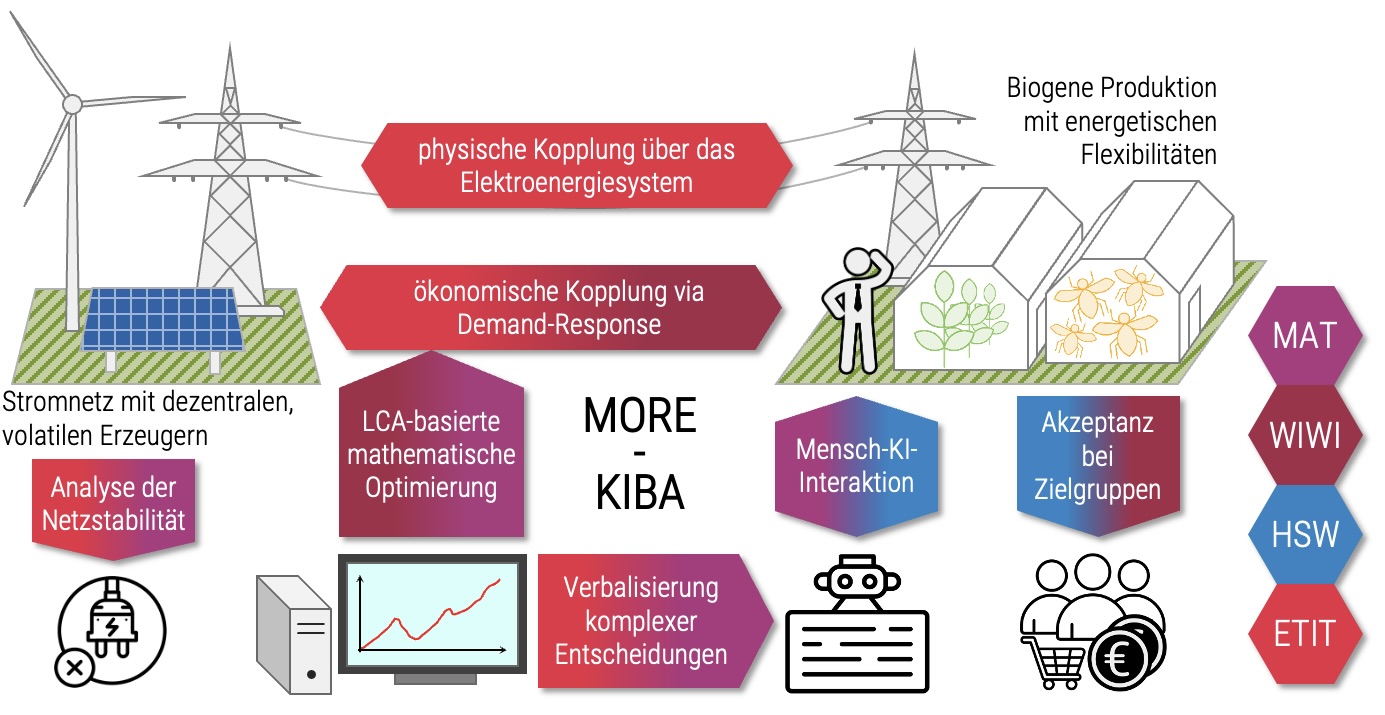
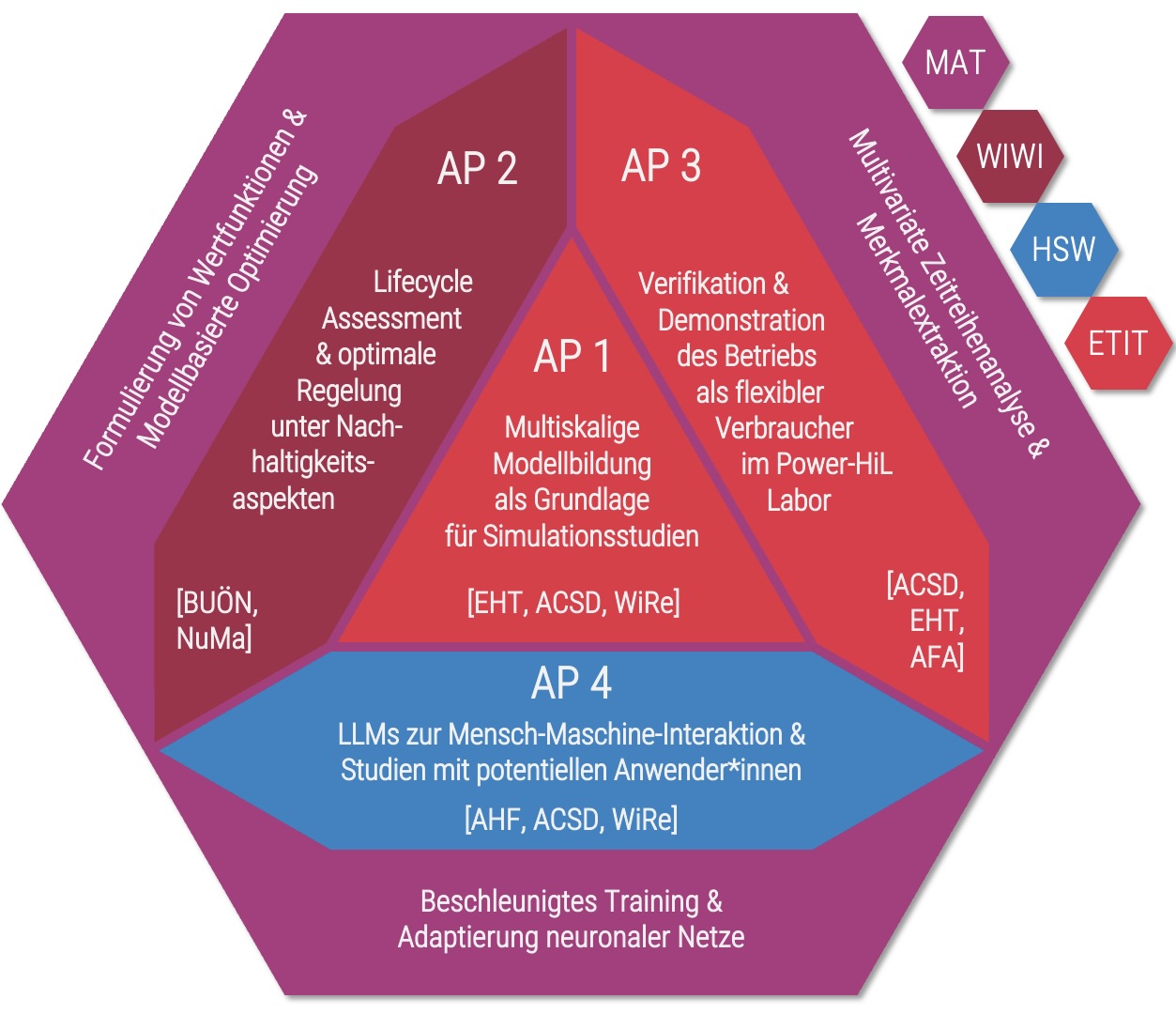
In times of scarce resources, it is imperative to operate production plants optimally. Suggestions for optimizing technical processes are often based on mathematical algorithms, which can be difficult for operators to understand due to the complexity of the plants and the algorithmic description. As a result, potential for sustainable operation is squandered, or technologies are even discarded whose optimized operation could lead to considerable short-term savings. The goal of this junior research group is to make algorithmic decisions transparent and understandable for the operators of technically complex production systems using AI. The approach will be demonstrated using the example of a biorefinery coupled with an energy grid simulator. The transferability and applicability of the approaches are ensured by the participation of various operators and stakeholders from the Saxon economy during the project itself. More information can be found on the official website of the project.


DFG: Linking ADP, MPC, and Dissipativity
DFG: Linking Approximate Dynamic Programming, Predictive Control, and Dissipativity:Novel Adaptive Control Approaches for Nonlinear Systems (2026-2029)
This project explores new approaches to adaptive control of nonlinear systems linking Adaptive Dynamic Programming, a technique from reinforcement learning to solve optimal control problems, Model Predictive Control, and dissipativity, which can be interpreted as a generalization of energy conservation in the context of dynamical systems. Each of these techniques and concepts has been applied to a wide diversity of problems ranging from robotics, biological systems and economic optimization. This project aims to combine the advantages of these techniques for adaptive control of nonlinear systems to compensate for model error and improve closed-loop performance. This research is carried out in cooperation with Prof. Dr.-Ing. Timm Faulwasser from the Hamburg University of Technology.


HZwo:RAHD
HZwo:RAHD: Hydrogen Storage and Electric Drive Functional Solution for Heavy Fuel Cell-Powered Agricultural and Forestry Vehicles (2023-2026)
This project focuses on the development of an overarching vehicle-wide control system for fuel cell-powered agricultural and forestry vehicles. The system includes, among other features, optimal energy management for the drive system, which consists of a fuel cell and a battery, as well as an adaptive traction control that detects local ground conditions and adjusts traction performance accordingly.
This project is co-financed from tax revenues on the basis of the budget adopted by the Saxon State parliament and co-financed by the European Union.


EETCM
EETCM: Energy-efficient and robust traction control of trains (2020-2023)
Despite identical route conditions, fuel consumption and wear of the very same train can vary significantly. This can be attributed, for example, to differences in experience and route knowledge among train drivers. A lack of experience is reflected in higher environmental impact as well as increased maintenance costs. To reduce wear on rails and wheels, a predictive approach was employed with the aim of preventing sliding and skidding (i.e., wheel spin). By using model predictive control, constraints can be taken into account and disturbances can be reacted to in real time. The required robustness was ensured by considering an uncertain train mass, which reflects the unknown number of passengers. Within the project, it was demonstrated that a driving recommendation for the train driver can be provided in the form of a throttle/brake lever position, enabling the train to reach its destination in an energy-optimal manner, without sliding or skidding, and while adhering to a timetable.
The project results were presented at a scientific conference, ECC 2023. The paper with further information can be found here and here.


Apfel4NULL
Apfel4NULL: Use of sensors for sustainable apple production and storage (2020-2023)
The storage of fruit, especially long-term storage, is of fundamental importance today for price-stable marketing, but also for supplying consumers in Europe across seasons. Robust prediction methods for apple diseases do not generally exist. Methods of data analysis and machine learning show great potential to classify such complex processes. Based on spectral measurements, weather data and storage measurements, apples are classified according to fruit quality. Further information can be found on this website.


FlexApp
FlexApp: Feed management for flexible biogas plants in practical operation (2023-2025)
With regard to the further expansion of renewable energy sources (such as wind and solar energy), the demand-oriented provision of electricity by biogas plants makes an important contribution to the flexibility and stability of the future energy supply. The research project on feed management for flexible biogas plants in practical operation is concerned with the further development and large-scale demonstration of available control methods for demand-oriented biogas production in agricultural biogas plants. Interdisciplinary cooperation in the fields of bioprocess engineering, control engineering and business economics will enable a meaningful and reliable application of suitable methods for model-based plant simulation, electricity price forecasting and process control. For the first time, available methods for automated process simulation and control will be implemented, evaluated and optimized in regular practical operation at a large-scale biogas plant.


DFG: Admissible Sets
DFG: Admissible Sets: Characterization and Approximation of the Boundary of the Admissible Set (2024-2027)
The admissible set of a constrained control system consists of all initial conditions for which a control exists such that the given constraints of the system can be satisfied. This set is used in many research areas, including sustainable resource management, epidemics, energy systems and robotics. It also plays an important role in stability and recursive feasibility analyses in model predictive control (MPC). In this project, we exploit the so-called minimum principle, which holds for special system trajectories on the boundary of the admissible set, in order to characterize the set itself.


HZwo:EcoCC
HZwo:EcoCC: Development of a cost-effective and reliable measurement and control concept for automotive fuel cell systems (2019-2022)
Within the framework of the HZwo initiative, the Eco-CC project focuses on the development of a more cost-effective and reliable concept for the measurement and control of low-temperature polymer electrolyte membrane fuel cells (PEMFCs) for automotive applications. By combining data from existing sensors with dynamic control-oriented models, measurement accuracy can be improved without the need to develop new and expensive hardware. In addition, this software-based solution is capable of detecting faults and reconstructing missing data from other measurements, and may even enable the replacement of currently used physical sensors with virtual ones. More specifically, the project pursues several key objectives. These include the development and validation of dynamic, control-oriented models for specific components of a PEMFC-based powertrain. Another objective is the analysis of system observability and the identification of optimization potential with respect to the required hardware components. In addition, the project involves the implementation of an identification and adaptation scheme for online operation. It further focuses on the analysis of sensor data fusion and the feasibility of virtual sensors. Finally, a fault-tolerant and optimal control scheme for PEMFC-based powertrains is implemented and tested.


ELFE
ELFE: Precise localization and motion control for autonomous railway vehicles (2023-2025)
Based on fused position data (indoors and outdoors) provided by project partners, a braking control system is to be developed that brings the train to a standstill at a desired location with a deviation of less than 10 centimeters. The background is that various shunting and positioning movements are to be automated in order to relieve the train driver.
An article in the Freie Presse (local newspaper) reports in detail on the project and our tasks.

SensCEA
SensCEA: Sensor-based efficiency enhancement in controlled environment agriculture (2023-2026)
The aim of the project is to develop a digital twin for the optimization and automation of cultivation processes for agriculture in controlled environments (greenhouses, vertical farms). The core of the digital twin is a growth model that describes plant growth as a function of the material and energy flows, which are influenced by the energy-intensive climate and light control, among other things. The modeling is intended to deepen the process understanding of the biotechnical greenhouse system so that energy requirements can be reduced. This is to be achieved, for example, by shortening the lighting time with artificial light (LED lighting) through increased CO2 fertilization. In addition, the potential of optimal control algorithms based on model predictions is to be exploited (predictive control). For modeling, data is collected in experiments on GreenResearcher systems from greenhub, the data transfer and the development of a graphical user interface is carried out by mewedo.


OptiFood
OptiFood: Development of sustainable and competitive insect foods (2024-2027)
The project aims to develop innovative foods containing insect protein that will have significantly high quality, sustainability, and competitiveness compared to other competing products by improving the production cost. Additionally, these foods should also act as an alternative source of protein. In order to achieve this goal, the project aims to develop and implement the technology basis for the development of such insect foods in a sustainable way. Firstly, the project focuses on processing insect protein as a consumable product. Secondly, the project focuses on reducing the production cost and increasing the sustainability of the production cost by selecting the agricultural side streams to feed insects. Thirdly, a suitable insect-based protein product based on the feed selected must be developed by automating the insect growth process. The project is supported by funds of the Federal Ministry of Agriculture, Food and Regional Identity (BMLEH) based on a decision of the Parliament of the Federal Republic of Germany via the Federal Office for Agriculture and Food (BLE) under the innovation support programme. Our task in this project is to model the rearing process as a function of feed input, to later use the model to make decisions to optimize the process such that high quality of insects (protein-rich) are produced. More details about the project and its collaboration partners can be found on the website.


HZwo:StabiGrid
HZwo:StabiGrid: Technical and Economic Design of the Hydrogen System for Stabilizing the Power Grid with 80% Renewable Energy (2023-2025)
This project provides a comprehensive analysis of the challenges associated with integrating hydrogen systems for the stabilization of the power grid. To this end, the required capacity of hydrogen systems within the power grid is determined for different combinations of renewable energy sources and synchronous machines. The complex interaction between energy supply and demand across the involved subsystems, namely electrical power systems, hydrogen systems, and the energy market, gives rise to a range of scientific challenges. Our professorship focuses on the impact of power electronic converters on the stability of the energy system. A second key area of work addresses the design of robust control strategies for converters, with a particular emphasis on integrating hydrogen storage technologies into the power grid. Further information is available on the project website.


5D.Rail
5D.Rail: Sensor data analysis for digital maps in intelligent railway systems (2024-2025)
In this project, map data are to be recorded and classified that store information along the route and can be accessed during future journeys. These data may, for example, include traction-related data required to improve the modeling of train dynamics and, consequently, the control strategies for avoiding sliding and skidding (see project EETCM).


ReSIDA-H2
ReSIDA-H2: Smart Fuel Cells - Sensor Integration and Efficient Data Analysis for the Control of Hydrogen Fuel Cells (2023-2025)
The objective of this interdisciplinary ESF junior research group is the development and integration of novel sensor concepts directly into the fuel cell stack, as well as the use of sensor data for efficient data analysis and control. To this end, two sensor concepts are being pursued that are intended to function as integrable hydrogen sensors in hydrogen fuel cells. In close coordination with fuel cell experts, sensor specifications and integration concepts are developed with a strong focus on practical applicability. In addition, requirement profiles and measurement parameters are defined on the basis of the developed models. Through efficient data analysis, the sensor data are prepared for the application of advanced control algorithms. Further information is available on the project website. A publication resulting from the project is also available here.


ENABLE
ENABLE: Development of algae-based bioactive foods (2024-2025)
Microalgae are a promising raw material for new and innovative foods. In particular, the unicellular freshwater algae Chlorella zofingiensis is characterized by numerous valuable ingredients such as primary and secondary carotenoids and a broad spectrum of unsaturated fatty acids. The aim of the ENABLE project is to analyze the various trophic process modes in terms of their economic viability. To this end, a process model is being developed and a techno-economic analysis carried out for various production methods. In addition, further investigations will focus on new, gentle treatment and processing technologies using pulsed electric fields for the efficient extraction of fresh algae biomass and a correspondingly high product quality and bioactivity. Finally, demonstration products from C. zofingiensis will be developed and sensory analyzed in the project. This should provide important insights into product perception and for future product developments.


INTERKOP
INTERKOP: Integrative and digital coupling systems for bio-based recyclable material production (2025-2027)
The INTERKOP project aims to expand individual modules of controlled environment agriculture into a modern, digitized biorefinery farm by investing in energy coupling, automation, digitization, and robotics. This is to serve as a technology platform for application-oriented research and interdisciplinary education. In contrast to previous approaches, which mostly only consider individual process steps, INTERKOP enables the linking of biological, material, and energy processes in a practical environment. This allows energy-optimized biorefinery processes for the production of bioproducts and energy sources from regional raw materials to be researched.


PhotoKon
PhotoKon: Photocatalytic conversion of CO2 to glycolate by microbial cell factories using random mutagenesis and artificial intelligence (2024-2027)
In the interdisciplinary cooperation project PhotoKon between Chemnitz University of Technology, Leipzig University and the Fraunhofer FEP, biologists and engineers are working on the development of photocatalytic cell factories that convert CO2 into the organic platform chemical glycolate via the photosynthetic apparatus. PhotoKon is developing the scientific basis for the use of ionizing radiation as a new process for the targeted cultivation and optimization of photosynthetically active cells. The screening and isolation of positive mutants is carried out using an AI-based image recognition process. By isolating promising cell factories, both the biological basis for the effect of ionizing radiation on the cells can be investigated and the scaling can be implemented in technical bioprocesses. Through an intelligent control technique for the efficient production of glycolate on a laboratory scale, the PhotoKon technology opens up a possibility for the sustainable and bio-based conversion of CO2 into the basic chemical. The process provides important biological insights and technological developments for the provision of organic compounds that can be produced directly from CO2 for a regional bioeconomy.


H2BioProd
H2BioProd: Technology platform for the production of biogenic hydrogen and bioeconomy products using residual materials and renewable energies (2024-2026)
Objective: As part of the H2BioProd project, Chemnitz University of Technology plans to establish a technology platform for the utilization of residual materials through coupled Controlled Environment Agriculture (CEA) modules. CEA modules comprise technical facilities for the efficient production of biomass under controlled environmental conditions (e.g., plants, algae, fungi). These can be utilized both materially and energetically.
Infrastructure: The platform combines specialized individual devices for analyzing biogenic processes with modular, connectable production units that can map resource- and energy-efficient circular processes. This creates a flexible research infrastructure that enables the development of new value chains and innovative bioproducts. The investments in equipment also enable research into new technical and social science issues in Saxony's energy and raw materials transition towards a sustainable bioeconomy. In addition to process and control engineering issues in the utilization of complex biogenic resources and the production of recyclable bioproducts, new interdisciplinary issues are emerging.