A second, electronic skin
Chemnitz University of Technology participates in European research project to develop self-sufficient and modular sensor systems for the digital medicine of the future
-
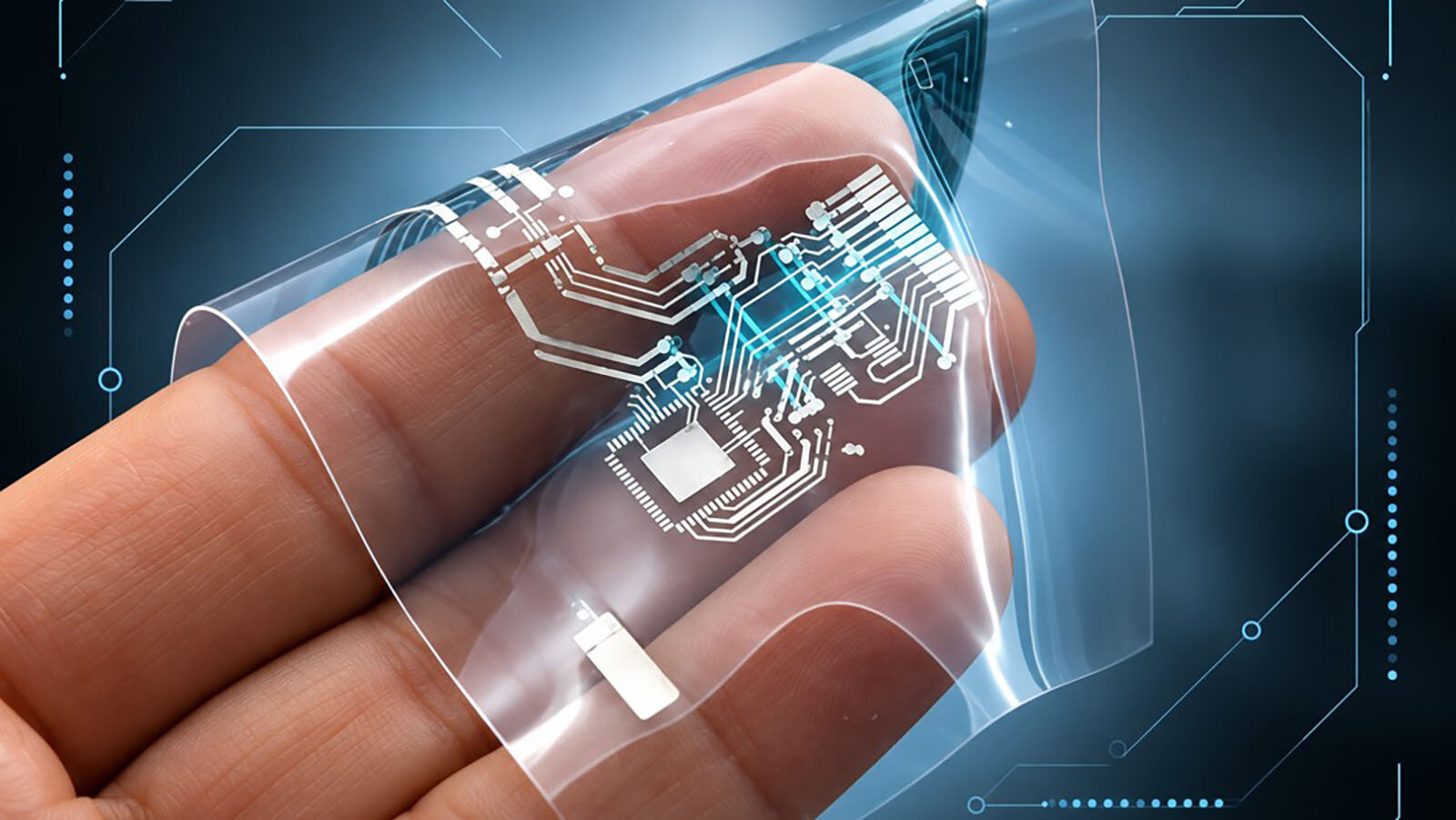
Project objective: an ultra-thin, modular sensor platform that monitors body and environmental data carried on the skin. Graphic: MORPHEUS -
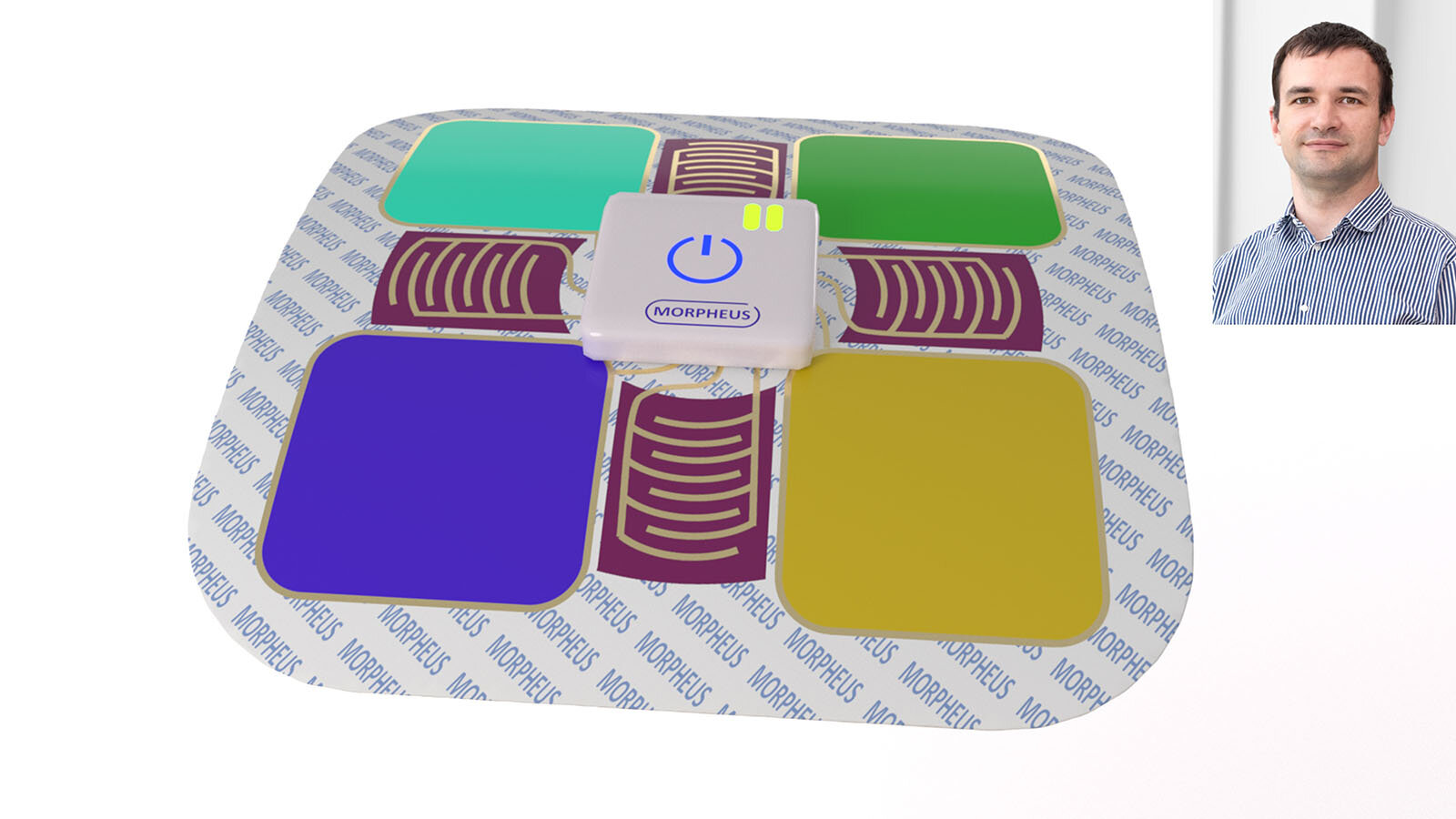
Modular, recombinable sensors on a platform. Right: Daniil Karnaushenko, MORPHEUS-Project head at TUC. Photo: S. Serfling -
The MORPHEUS project is funded by the European Union under the Horizon Europe research and innovation programme, Grant Agreement No. 101297277.
With new materials, flexible electronics and modular sensor concepts, researchers from Europe want to make the continuous monitoring of patients more comfortable and sustainable in the future. Over the next four years, an international consortium of 13 partners will develop a modular sensor platform that can continuously capture physiological and environmental parameters in clinics, medical practices and nursing facilities. Chemnitz University of Technology is a partner in the new European research project MORPHEUS. On 1. Launched in June 2026, the project was held on 5. /6. November 2026 his first technical plenary session in Turin.
MORPHEUS stands for “MOdular Reconfigurable Platform for Health and Environmental Universal Sensing”. The project, funded by the European Union as part of the Horizon Europe research and innovation programme, has a total funding of almost five million euros. Chemnitz University of Technology accounts for 566,875 euros. The project duration is four years, the coordinator is the Politecnico di Torino (Italy).
“With MORPHEUS, we want to take an important step towards flexible, modular and sustainable sensor systems that can be adapted to different requirements in the healthcare sector,” says Dr. Daniil Karnaushenko (MAIN Research Group Shapeable Electronics), responsible project manager at Chemnitz University of Technology. “Combining novel materials, flexible electronics and interchangeable sensor modules opens up new possibilities for continuous and unobtrusive patient monitoring.”
Flexible sensor platform for body and environmental data
The project focuses on a so-called “plug-and-sense” architecture. Different sensors are integrated on a common flexible platform. The platform is designed for discreet, unobtrusive use and so thin that it can be applied directly to the skin or clothing. Individual sensor modules on this platform can be supplemented, replaced or reconfigured depending on the application.
The planned platform will monitor physiological variables such as blood pressure, bioimpedance and cortisol, but also environmental parameters such as temperature and other variables relevant for clinical environments. The project combines several technologies, including two-dimensional materials, functional hydrogels, solution-processable electronics, flexible batteries and supercapacitors, wireless communication modules and flexible displays.
Biocompatible and sustainable sensor systems
A key challenge is to make the electronic systems as flexible, biocompatible and sustainable as possible. MORPHEUS will therefore investigate new biocompatible and biodegradable substrates, coatings and encapsulation materials.
Sustainability is another central aspect of the project. Life-cycle assessment and life-cycle costing will be used to investigate the extent to which modular sensing systems can reduce material consumption and waste compared with conventional single-use solutions. The project will also address pre-standardisation and regulatory pathways for flexible, biodegradable and modular monitoring technologies.
At TUC, the research is conducted at the MAIN Research Center (Scientific Director: Prof. Dr. Oliver G. Schmidt). It draws on expertise in the field of flexible electronics within TUC’s core competency area of “Materials and Intelligent Systems.” Together with international partners, the Central Scientific Institution is developing technological approaches that will support the long-term transition of flexible sensor systems into practical applications.
TUC project manager Karnaushenko sees this as a special opportunity for Chemnitz University of Technology: “MORPHEUS provides an opportunity to connect our expertise in flexible electronics with current challenges in healthcare research. The international and interdisciplinary composition of the consortium is particularly important for addressing the entire innovation chain – from the development of new materials and electronic components to clinical application.”
By the end of the project, MORPHEUS aims to deliver a demonstrator at Technology Readiness Level 5 (TRL 5). The project will also develop new biocompatible and sustainable material systems and a library of interchangeable sensor modules. These results are intended to provide a foundation for future flexible and resource-efficient monitoring systems in healthcare.
Background: MORPHEUS project
In addition to the coordinating Politecnico di Torino and TUC, the MORPHEUS consortium comprises Technische Universität Dresden (Germany), DROPPER S.R.L. (Italy), NOVA ID FCT (Portugal), Bursa Teknik Üniversitesi (Türkiye), Asociația de Standardizare din România (Romania), Universidad de Granada (Spain), INNOVA S.R.L. (Italy), Shades of Blue (IntroVertical) S.R.L. (Italy), Libera Università di Bolzano (Italy), Aristotelio Panepistimio Thessalonikis (Greece), NGRAFI NANO TEKNOLOJI ANONIM SIRKETI (Türkiye), and the University of Padua (Italy).
The MORPHEUS project is funded by the European Union under the Horizon Europe research and innovation programme, Grant Agreement No. 101297277.
Project Website: www.morpheus-horizon.eu
LinkedIn: https://www.linkedin.com/company/morpheus-heu-project/
Author: Thomas Blaudeck
Detlef Gürtler
06.11.2026