Phoxonic Art: How 187 Metal Steles in the European Capital of Culture Chemnitz combine Art and Physics
Projects from the TUCculture2025 initiative performed by the Faculties of Natural Sciences and Electrical Engineering and Information Technology and the Research Center MAIN are featured in the most important German-language physics journal
-
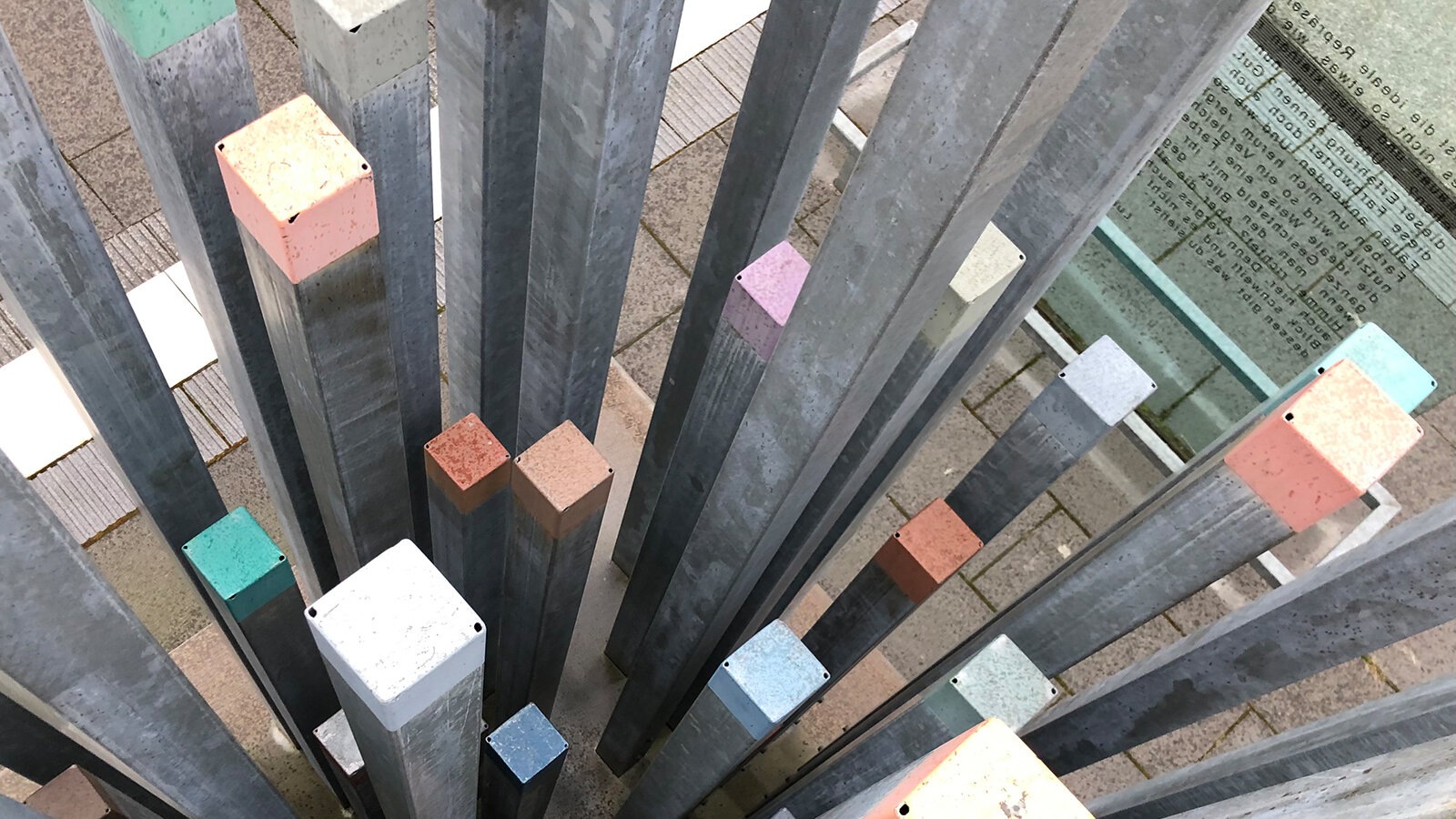
The artwork “Thinking and Perception Model on the Phenomenon of Color” in front of the Central Lecture Hall and Seminar Building served as a source of inspiration for scientific research. Photo: David Röhlig
The Physik Journal, the member magazine of the German Physical Society (DPG, Deutsche Physikalische Gesellschaft e. V.), the most important specialist medium and central information forum for over 50,000 physicists of all disciplines in German-speaking countries, features an overview article in its January 2026 issue on two projects from the TUCculture2025 initiative of Chemnitz University of Technology in recent years that have combined art and physics in a special way. For example, the stele artwork “Thinking and Perception Model for the Phenomenon of Color” by Dresden artist Stefan Nestler, erected in 1998 as part of the construction of the Central Lecture Hall and Seminar Building at Chemnitz University of Technology, demonstrated how abstract concepts of modern physics can be explored through aesthetic experience. From the viewpoint of the end of 2025, the article puts the European Capital of Culture Chemnitz again into a retrospective focus.
Behind a largely regular arrangement of 187 metal steles, which have adorned the forecourt of the Central Lecture Hall and Seminar Building as a work of art since 1998, lies more than just an aesthetic object: it represents a kind of color in itself, a variation on what it conveys as its main message. What sounds like a somewhat convoluted but trivial statement is the result of more than three years of intensive and interdisciplinary scientific observation, funded in part by the projects “Chemnitz: Wood, Light, Sound” and “Wave Plays” as parts of the TUCculture2025 initiative. The work revealed that the artwork “Thinking and Perception Model for the Phenomenon of Color” is the world's largest scientifically described realization of a photonic crystal for electromagnetic waves and, at the same time, represents a phononic crystal that can be used fort he manipulation of sound waves. It thus represents forbidden regions, i.e., barriers for waves in several spectral ranges: the band gaps occur for both sound and radio waves, so that the artwork has its own “color” in each of these two domains.
This special connection between physics, art, and the worlds of human perception and metrological measurement is the focus of the overview article titled “Phoxonic Art” Herein, Prof. Dr. Angela Thränhardt, Professor of Theoretical Physics at Chemnitz University of Technology and Dean of the Faculty of Natural Sciences, and Dr. Thomas Blaudeck, Managing Director of the Research Center for Materials, Architectures, and Integration of Nanomembranes (MAIN) at Chemnitz University of Technology, explain how Stefan Nestler's stele arrangement allowed fundamental wave equations to be examined clearly and how numerical simulations, theoretical models, and metrological experiments were interlinked with the expertise of the faculties of Natural Sciences and Electrical Engineering and Information Technology. The adjective “phoxonic” in the deliberately pejorative title “Phoxonische Kunst” (Phoxonic Art) refers to the fact that several “forbidden regions” for the propagation of waves, i.e., band gaps, occur in one and the same object. This applies both to the photonic case, i.e., that related to light and electromagnetic waves in the field of established communication technologies, and to the phononic case, i.e., that are related to acoustics and hence sound. An interaction between these domains is also conceivable, at least in principle. This demonstrates the remarkable visionary nature of artist Stefan Nestler, who has imbued his artwork with a unique, phoxonian model of perception that is measurable and therefore verifiable.
The overview article also highlights that physical research not only unlocks new insights into abstract or complex phenomena in nature, but also opens up innovative avenues for science communication through its connection with art: as part of the TUCculture2025 projects, the artwork and its surroundings were transferred to a laboratory environment where the complex wave phenomena of photonics and phononics, such as scattering, interference, and diffraction, became audible and tangible in surprising ways. The artwork thus became the starting point for dialogue between scientists, friends of art, and the general public, for example at the Open House Days (TUCtage) since 2022 or the Christmas market at Chemnitz University of Technology. This is an example of bringing physics out of the “ivory tower” and into the urban and cultural space.
Beyond the specific topic, the overview article provides an outline of other projects with a “physical flavor” from the TUCculture2025 initiative of Chemnitz University of Technology, which since 2022 has bundled many of the university's activities at the interface of science, art, and society since 2022 and was geared toward 2025, when Chemnitz held the title of “European Capital of Culture.” The article also looks back on cultural projects and events in Chemnitz during the European Capital of Culture year that had a special connection to physics and thus became part of the broad cultural program in Chemnitz as scientific sprinklings.
The article has been available as a summary on the Physik Journal website (issue 01/2026) since January 5, 2026 (login required to access the PDF).
For further information, please contact Dr. Thomas Blaudeck, phone +49 (0)371 531-35610, e-mail thomas.blaudeck@main.tu-chemnitz.de, and Prof. Dr. Angela Thränhardt, phone +49 (0)371 531-37636, e-mail angela.thraenhardt@physik.tu-chemnitz.de.
(Author: Dr. Thomas Blaudeck, Translation: Tobias Bollig)
Mario Steinebach
06.01.2026