
First-semester students generally begin their studies in the winter semester.
With the approval of the Examination Board, enrollment is also possible for the summer semester. However, this may extend the duration of study beyond the standard period of study.
It is also possible to apply for admission to a higher semester, provided that sufficient eligible credits have been earned and the requested semester classification corresponds to the semester for which admission is granted.
Further information on the application process can be found on the Student Services website.
Part-time study is possible (standard period of study: 12 semesters).
The degree program can be studied part-time in the case of employment, particular family commitments or specific health-related circumstances.
Further provisions on part-time study can be found in Section 10 of the Study Regulations.
For applications for the winter semester, the following periods generally apply:
-
Application via the TU application portal:
approximately from the end of May to mid-September -
Application via uni-assist:
approximately from the beginning of April until 15 July
Which application procedure applies to you and which deadlines are currently binding can be found on the Student Services website.
Information on the application procedure
Current application and admission deadlines
Different contact points are responsible for different types of enquiries. The following overview will help you find the appropriate contact.
Central Student Advisory Service
For general questions about choosing a degree program, orientation before starting your studies, or if you are still unsure which degree program is right for you.
Academic Advisory Service
For subject-specific and individual questions about the degree program, the course of study, module selection or your personal study planning.
Examination Board
For matters requiring a formal decision, for example applications, recognition of academic achievements or special cases relating to examination regulations.
Dean of Studies
For overarching matters concerning teaching and the quality of the degree program, particularly if an issue cannot be resolved through the usual contact points.
-
Email:
-
WWW:
-
Telephone:+49 371 531 55555, -32549, -31690
-
Fax:+49 371 531 12128
-
Room:Straße der Nationen 62, Room 046

-
Phone:+49 371 531-24055
-
Email:
-
Address:Reichenhainer Straße 70, 09126 Chemnitz
-
Room:C25.114 (prev. 2/W114)

-
Phone:+49 371 531-37114
-
Email:
-
Address:Reichenhainer Straße 70, 09126 Chemnitz
-
Room:C25.319 (prev. 2/W319)

-
Phone:+49 371 531-36956
-
Email:
-
Address:Reichenhainer Straße 70, 09126 Chemnitz
-
Room:C25.406 (prev. 2/W406)


studies and teaching
Overview
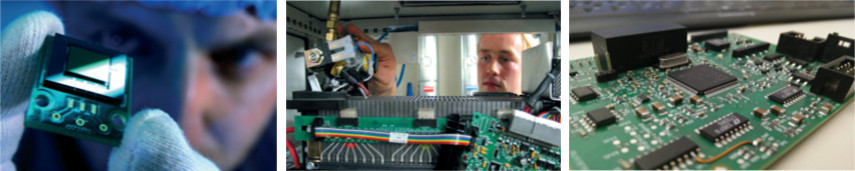
The field of Electrical Engineering and Information Technology covers all areas of technology concerned with electricity as an energy carrier and as the basis of modern information processing.
Scientific findings are examined from a practical perspective and applied to technical applications. This takes place in a wide variety of fields and on very different scales: conventional and renewable power plants, high-voltage transmission lines, substations, electric drives in machines and vehicles, automated production lines and robots, communications engineering, communication networks, mobile communications, radar, automotive electronics, modern aviation and space technology, audio, television and video technology, as well as the development and production of the microelectronic and nanoelectronic components required for these applications are all possible fields of activity for electrical engineers and information technology engineers.
The degree program reflects this diversity by offering a comprehensive range of professional specializations that can be selected during the course of study:
- Automation Engineering
- Electrical Power Engineering
- Microsystems and Nanoelectronics
- Information and Communication Technology
Students do not decide on one of these professional specializations until the 4th or 5th semester, i.e. during their studies, after they have acquired a common foundation and gained deeper insight into the entire field.
The Bachelor's degree program in Electrical Engineering and Information Technology at Chemnitz University of Technology is therefore also a good choice for students who are generally interested in the field but do not yet wish to decide on a specific specialization immediately after completing their university entrance qualification.
Career Prospects
Graduates find interesting career opportunities in many fields on both the German and international job markets. Depending on the specialization selected, these include, for example:
- Electronics and Chip Industry
- Telecommunications Industry
- Computer Industry
- Electrical Power Supply
- Automation Engineering and Robotics
- Environmental Engineering
- Transportation Engineering
- Software Development
- Chemical and Pharmaceutical Industry
- Automotive Manufacturers
- Aviation and Aerospace
- Research Institutions
After completing this Bachelor's degree program, Master's degree programs offer a consecutive continuation of the academic education. In Chemnitz, depending on the professional specialization selected, these include in particular Energy and Automation Systems, Microsystems and Microelectronics, as well as internationally oriented English-taught programs such as Embedded Systems, Information and Communication Systems and Micro and Nano Systems.
Program Structure
Module Areas
| 1st to 4th semester |
Foundation Modules
Mathematical and Physical Foundations
Electrical Engineering Foundations
Information Technology Foundations
General Engineering Foundations
|
| 5th to 6th semester |
Specialization Modules
Students choose one of four professional fields for their technical specialization: Automatisierungstechnik (Automation Engineering)
Elektrische Energietechnik (Electrical Power Engineering)
Mikrosysteme und Nanoelektronik (Microsystems and Nanoelectronics)
Informations- und Kommunikationstechnik (Information and Communication Technology)
|
| 2nd to 6th semester |
Complementary Modules
Depending on the selected professional field, students complement their studies with field-specific and interdisciplinary electives as well as modules from professional fields not selected. Field-Specific Electives Additional modules in automation engineering, electrical power engineering, microsystems and nanoelectronics, and information and communication technology allow students to further develop their individual technical profile. Interdisciplinary Electives
Students may also choose Praktische Ausbildung (Internship), which is completed in a company or a research and development institution. |
| 6th semester |
Bachelor's Thesis Module
The bachelor's thesis topic should be in the field of electrical engineering / information technology. |
Note: The study and examination regulations applicable to the respective enrollment cohort are authoritative for all binding requirements.
Admission Requirements
| University entrance qualification: |
Admission to the degree program requires an appropriate university entrance qualification. Accepted qualifications include the German general higher education entrance qualification (Abitur), a relevant subject-specific higher education entrance qualification, or an equivalent recognized university entrance qualification. |
| German language proficiency: |
The degree program is taught in German. For direct admission, proof of sufficient German language proficiency recognized by Chemnitz University of Technology is required.
As a guideline, German language proficiency at
CEFR
level C1 should be used as the reference level.
A general B2 certificate is not sufficient for direct admission
to a German-taught degree program.
CEFR stands for Common European Framework of Reference for Languages. It describes language proficiency on six levels from A1 to C2. For admission, the required language level alone is not sufficient. The specific proof of language proficiency must also be recognized by Chemnitz University of Technology. The complete and current overview can be found on the Student Services information page under “Language skills”. |