Making Decisions of Complex Control Systems More Understandable
A paper by the junior research group MORE-KIBA at TU Chemnitz has been accepted at the International Conference on Machine Learning (ICML) 2026, one of the world’s leading conferences in artificial intelligence research
-
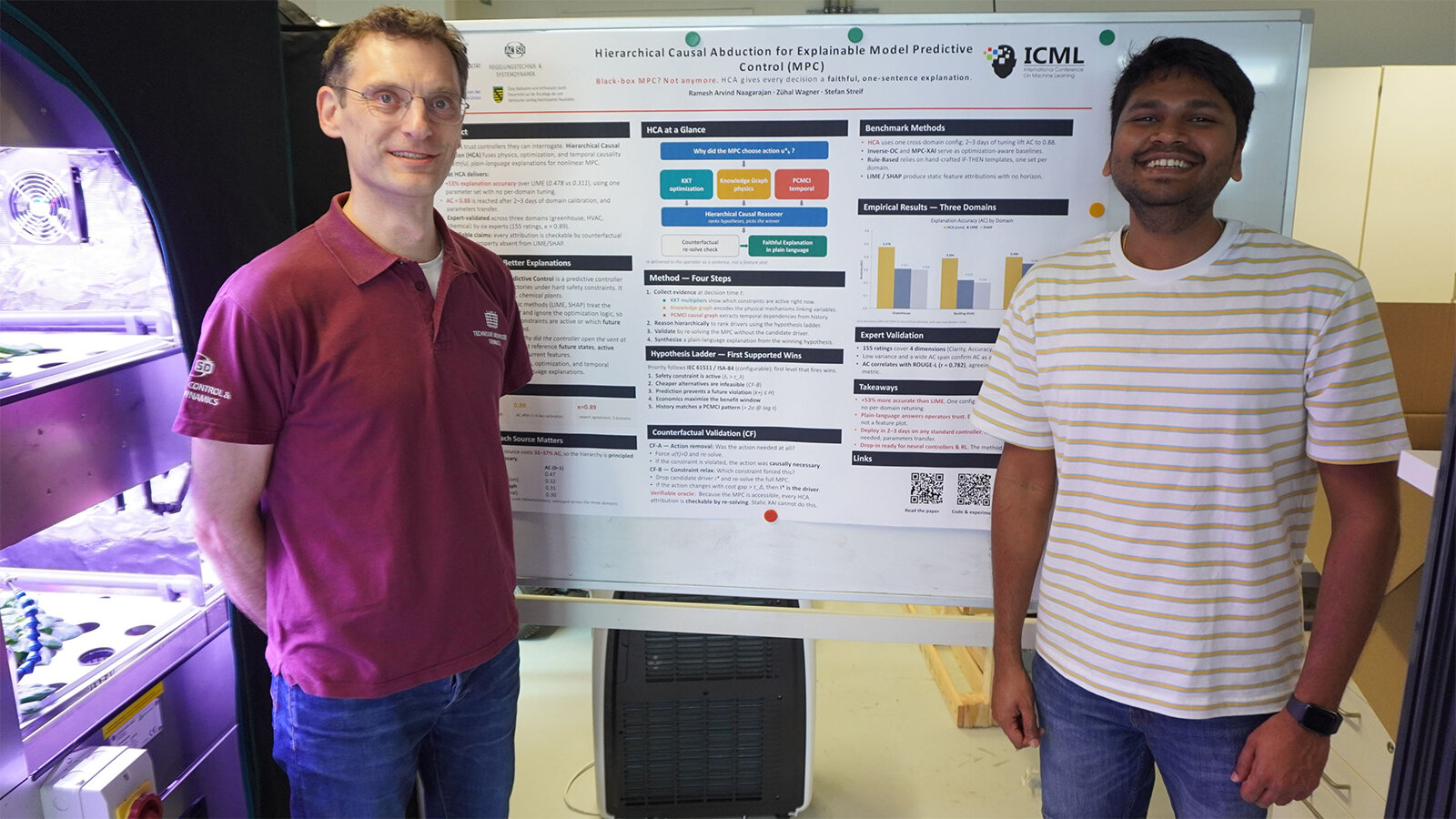
Prof. Dr. Stefan Streif (left), holder of the Professorship of Automatic Control and System Dynamic, and Ramesh Arvind Naagarajan, a member of the MORE-KIBA research group, are delighted that their paper has been accepted for presentation at the International Conference on Machine Learning (ICML) 2026. Photo: private -
The MORE-KIBA early-career research group is funded by the European Union and the Free State of Saxony. Graphic: Free State of Saxony
The International Conference on Machine Learning (ICML) is considered one of the most important international conferences in machine learning, a subfield of artificial intelligence. The conference is highly competitive: this year, only 6,352 out of 23,918 submitted papers were accepted. Among the accepted contributions is a paper from the ESF PLUS junior research group “Human-Understandable, Optimal Resource and Energy Management for Complex, Network-Integrated, Biogenic Production Systems” (MORE-KIBA) at Chemnitz University of Technology, led by Prof. Dr. Stefan Streif, Professorship of Automatic Control and System Dynamics.
Causally grounded and human-understandable explanations for optimal predictive control
The accepted paper, titled “Hierarchical Causal Abduction: A Foundation Framework for Explainable Model Predictive Control”, addresses a central question of MORE-KIBA. Model Predictive Control (MPC), widely used in control engineering, is applied in many domains where resource consumption must be optimized, such as energy systems, building climate control, and process or biotechnological systems.
“Due to nonlinear process dynamics, strict safety constraints, and the complexity of numerical optimization procedures, time-dependent control decisions are often very difficult for operators to understand,” says Streif. “This significantly reduces trust in the control system and often leads to it being switched off and replaced by manual operation. This, in turn, results in efficiency losses and unnecessary resource consumption.”
He continues: “With Hierarchical Causal Abduction, we present a framework that combines three complementary sources of evidence: physics-based knowledge from knowledge graphs of the underlying process model, auxiliary variables from the optimizer, and temporal causal dependencies. By integrating these sources, reliable and human-interpretable explanations for the decisions of nonlinear MPC can be derived.”
The approach was evaluated in three applications: greenhouse climate control, a heating and ventilation system for a residential building, and a process engineering system. Validated by domain experts, the method improves explanation quality by 53 percent compared to other AI-based explanation approaches. The quality of explanations can be further significantly improved with additional data and training. Moreover, the approach is easily transferable to other processes and applications controlled by predictive control methods.
“The acceptance of this Chemnitz contribution at ICML 2026 highlights the international visibility of the group’s research on trustworthy and explainable AI for engineering applications,” Streif concludes.
Background: Junior Research Group MORE-KIBA
The junior research group “Human-Understandable, Optimal Resource and Energy Management for Complex, Network-Integrated, Biogenic Production Systems” (MORE-KIBA) addresses a pressing challenge in sustainable industrial production. In times of limited resources, complex systems must be operated optimally, yet the underlying mathematical algorithms are often difficult for operators to understand. As a result, potential for sustainable operation is lost or promising technologies are not adopted.
The goal of MORE-KIBA is to make algorithmic decisions transparent and understandable using AI. The approach is demonstrated using a biorefinery coupled with an energy network simulator. Applicability is ensured through collaboration with various stakeholders from industry in Saxony.
The project is funded with more than € 2.13 million through the European Social Fund Plus program. Seven early-career researchers from four faculties at TU Chemnitz are involved.
Project homepage: www.tu-chemnitz.de/etit/control/research/CEA/index_MORE-KIBA.php
About ICML
The International Conference on Machine Learning (ICML) is a premier gathering of experts in machine learning, a branch of artificial intelligence research. It showcases cutting-edge research across all aspects of machine learning, including artificial intelligence, statistics, and data science, as well as key application areas such as computer vision, computational biology, speech recognition, robotics, and control engineering.
Preprint link: https://arxiv.org/abs/2605.10624
Contact: Prof. Dr. Stefan Streif, Professorship of Automatic Control and System Dynamics, Phone +49 (0)371 531-31899, Email stefan.streif@etit.tu-chemnitz.de
(Translation: Ramesh Arvind Naagarajan)
Mario Steinebach
04.06.2026