Rethinking Charge Transport: Donor Dilution Reshapes Limits of Organic Solar Cells
New Advanced Materials study led by Chemnitz University of Technology reveals how extreme dilution of the polymer donor preserves light conversion but triggers topology‑limited transport and a transition from Langevin to Smoluchowski‑type recombination in organic solar cells
-
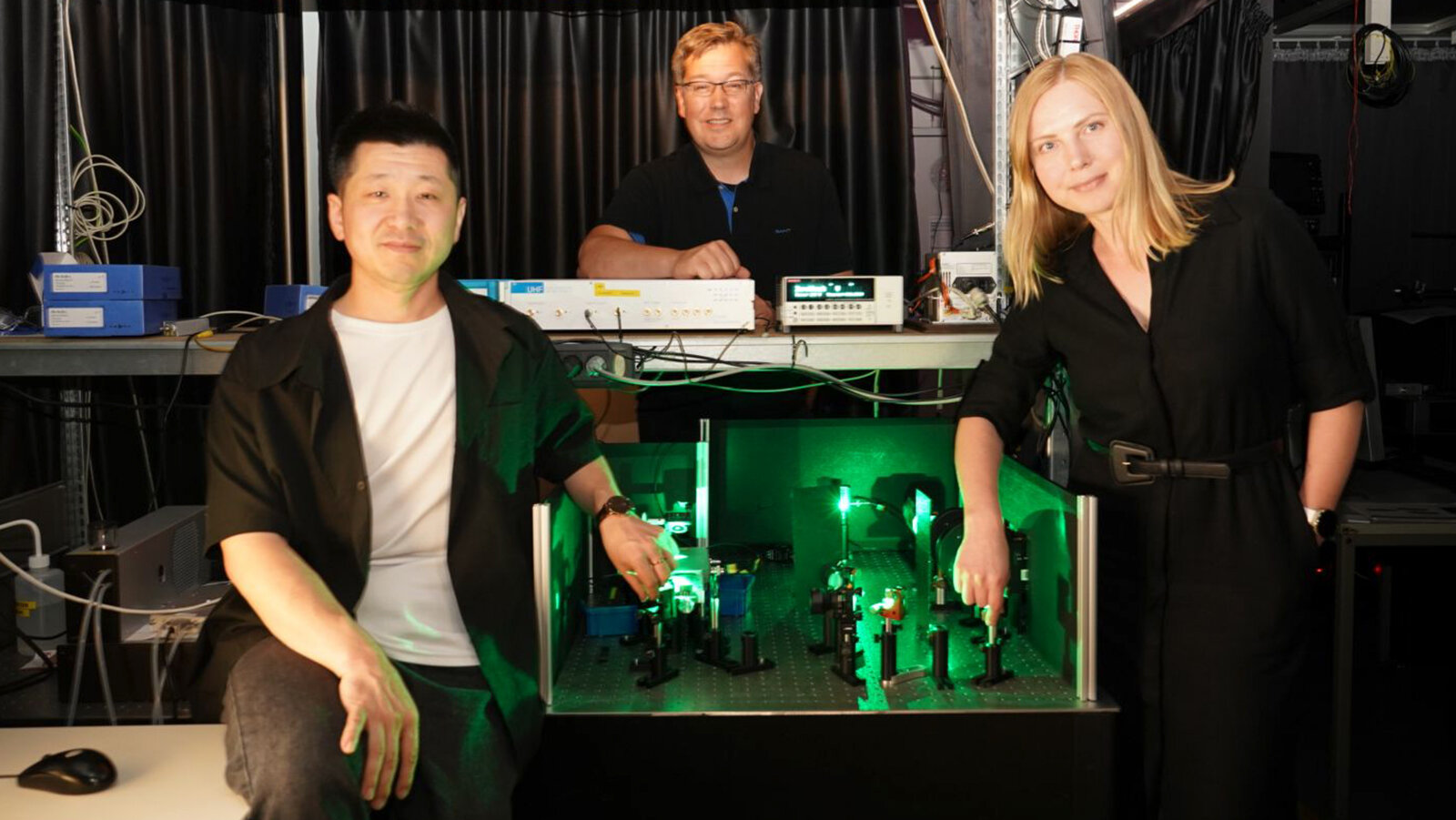
Maria Saladina, Carsten Deibel, and Chen Wang (right to left) from the Professorship of Optics and Photonics of Condensed Matte at TU Chemnitz. Photo: Fabio Le Piane -
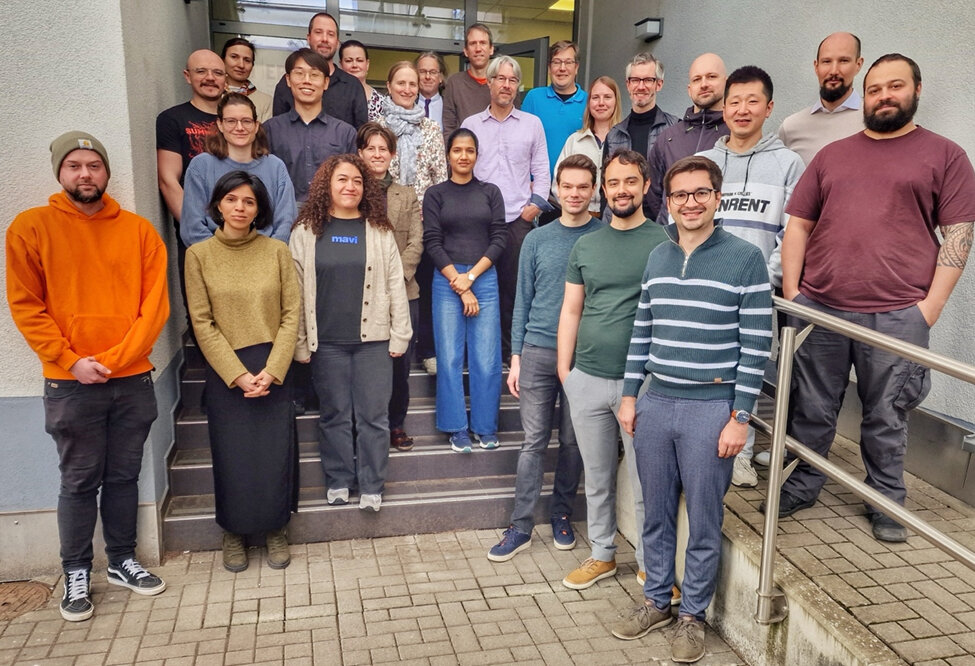
Pis, postdoctoral students and PhD students of the POPULAR research unit during a project meeting in Erlangen. Photo: Sekretariat Brabec
Researchers from the Professorship of Optics and Photonics of Condensed Matter (led by Prof. Dr. Carsten Deibel) at the Chemnitz University of Technology and several partner institutions have systematically investigated how organic solar cells behave when the usual donor–acceptor mixing ratio is pushed to the extreme – down to only 1 percent donor content. Using the well‑known PM6:Y12 material system, they link nanomorphology, charge transport, and recombination to device performance and provide a unified physical picture of “donor‑diluted” organic solar cells. This is taking place within the framework of the Research Unit "Printed & Stable Organic Photovoltaics with Non-Fullerene Acceptors - POPULAR", funded by the German Research Foundation, of which Prof. Deibel is the spokesperson.
Organic solar cells typically consist of two components: a donor, which tends to donate electrons, and an acceptor, which accepts electrons. When light is absorbed, electron–hole pairs are formed and then separated at the donor–acceptor interface, enabling the generation of photocurrent. “In recent years, dilute donor blends have reached surprisingly high efficiencies, but we lacked a consistent understanding of how morphology, transport, and recombination interplay in these systems,” says Prof. Dr. Carsten Deibel, head of the Chair of Optics and Photonics of Condensed Matter at Chemnitz University of Technology and corresponding author of the study. “Our work shows that donor dilution mainly reshapes the topology of the transport network – and that this topology, rather than a sharp percolation threshold, defines the performance limits.”
Continuous donor network even at low content
In their study, the team fabricated PM6:Y12 bulk‑heterojunction solar cells with donor fractions ranging from 1 to 45 percent and characterized them with a broad set of structural, optical, and electrical methods. Grazing‑incidence wide‑angle X‑ray scattering (GIWAXS) and resonant soft X‑ray scattering (RSoXS) reveal that even below 5 percent donor content, lamellar stacking enables charge extraction in the inverted device architecture used. Complementary ultraviolet photoelectron spectroscopy (UPS) depth profiling confirms that, apart from a thin donor-rich surface layer, the bulk composition closely follows the nominal donor–acceptor ratio across all blends.
To quantify charge transport, the researchers extract an effective active‑layer conductivity directly from current–voltage curves under illumination, based on a recently developed method that separates recombination and transport contributions near open‑circuit voltage. The resulting effective conductivity, that accounts for electron and hole conductivities, drops strongly towards low donor content but shows a robust, nearly temperature‑independent scaling with composition when evaluated at a fixed energetic depth in the density of states. The authors show that this dependence can be described by a classical three‑dimensional percolation model. “We find that the topology of the PM6 transport network controls conductivity and mobility, and that this network behaves like a three‑dimensional percolating system without a pronounced percolation threshold,” says Dr. Maria Saladina, co‑lead author of the study.
Exciton quenching experiments indicate nearly complete harvesting of PM6 excitons for all compositions, while the quenching of Y12 excitons and their effective lifetime improve with increasing donor content. “Even at very low donor fractions, we still observe a continuous, three‑dimensional PM6 network rather than isolated donor islands,” explains first author Dr. Chen Wang. This connectivity is crucial to maintain efficient charge extraction despite strong dilution.
From reduced Langevin to Smoluchowski‑type recombination
Nongeminate recombination is analysed by combining time‑resolved photoluminescence under 1‑sun‑equivalent excitation with time‑delayed collection field measurements. For higher donor fractions, the recombination kinetics can be described within a Langevin‑type framework with a pronounced Langevin reduction factor smaller than one, which the authors attribute mainly to redissociation of electron–hole pairs at the donor–acceptor interface before recombination.
At donor fractions below 5 percent, however, the situation changes qualitatively. The apparent recombination order and the time dependence of the recombination rate deviate from Langevin expectations, and the effective Langevin reduction factor extracted from experimental data can even exceed unity, i.e. the recombination rate becomes higher than predicted by the classical Langevin model. By analysing the long‑time dynamics, the authors identify a transition to a dispersive, Smoluchowski‑type recombination regime, where encounters of spatially distributed carriers lead to a characteristic power-law decay of the recombination rate. “In strongly diluted blends, charge carriers move in a topology‑limited network with spatially inhomogeneous fields, and the recombination kinetics become dispersive and scale‑free,” explains Saladina. “This Smoluchowski‑type regime goes beyond the conventional Langevin picture and helps explain why recombination can exceed Langevin predictions at very low donor contents.”
Publication in the Journal "Advanced Materials"
The study “Rethinking charge transport and recombination in donor‑diluted organic solar cells” appears as a research article in the renowned journal Advanced Materials. The work was led by Maria Saladina together with Carsten Deibel at the Institute of Physics, Chemnitz University of Technology, in collaboration with researchers from the University of Freiburg, Fraunhofer ISE, the University of Bayreuth, TU Dresden, IFW Dresden, and Durham University. The research builds on and extends earlier work by the Chemnitz group showing that transport resistance dominates fill‑factor losses in record organic solar cells and provides a quantitative framework to describe these losses via an effective conductivity and a transport‑related figure of merit. These results have been achieved within the framework of the DFG Research Unit POPULAR, which continues to work on understanding and improving printed organic solar cells.
Background: DFG Research Group "Printed & Stable Organic Photovoltaics with Non-Fullerene Acceptors - POPULAR" under the leadership of TU Chemnitz
The research group "Printed & Stable Organic Photovoltaics with Non-Fullerene Acceptors - POPULAR" (FOR 5387), funded by the German Research Foundation with around five million euros, is leading in the field of optoelectronic characterization of organic solar cells. Prof. Dr. Carsten Deibel, holder of the Professorship of Optics and Photonics of Condensed Matter at TU Chemnitz, is the spokesperson for the DFG Research Unit, which involves 14 scientists from several universities in Germany and the UK. The common goal is to produce organic solar cells using mass-production-compatible printing processes and to understand and improve them with complementary experiments and simulations.
Publication: Chen Wang, Maria Saladina, Carsten Deibel, et al: Rethinking charge transport: Donor dilution reshapes limits of organic solar cells. Advanced Materials e23681 (2026). DOI: https://doi.org/10.1002/aenm.202405889
For further information, please contact Maria Saladina, phone +49 (0)371 531-34046, email maria.saladina@physik.tu-chemnitz.de, and Prof. Dr. Carsten Deibel, phone +49 (0)371 531-34878, email deibel@physik.tu-chemnitz.de.
(Source: Professorship of Optics and Photonics of Condensed Matter)
Mario Steinebach
08.06.2026