
Kinetic Modelling for Cost-Efficient End-Effector Force and Torque Estimation (in Cooperation with Siemens)
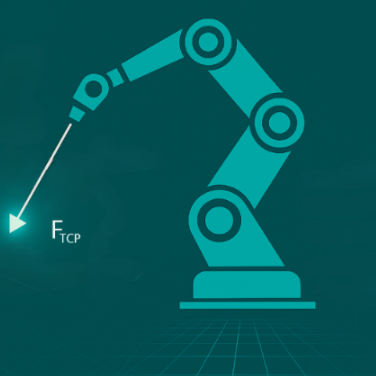
The growing adoption of industrial robots is driven by increasing demands for automation. Many high-quality applications rely on precise measurement of forces and torques at the end-effector. However, commercial 6D force-torque sensors are very expensive and quickly reach costs of several thousand euros.
A cost-efficient alternative is to estimate end-effector forces and torques indirectly by computing them from already available drive and motor sensing. Instead of installing a dedicated 6D sensor, the desired quantities are reconstructed using a kinetic model derived from drive data. This model is based on physical parameters such as geometry, masses, inertia tensors, friction, and stiffness. The modelling scope covers drives, gearboxes, joints, arms, tool, and workpiece.
While an initial approximation can be obtained for static cases, the dynamic case is crucial for real-world applications: estimating forces and torques for a moving robot with and without external load. Kinetic models for feedforward control in cascaded control loops already exist. For validation, several serial and parallel kinematic setups are available as real test platforms.
Tasks:
- Model the selected kinematic structure while considering relevant physical parameters.
- Develop a computation method to estimate end-effector forces and torques solely from existing drive sensor data (without a direct 6D sensor).
- Implement the model using a high-level user language in the SIMATIC S7-1500T control system.
- Acquire reference data using a direct measurement system to validate the computed estimates.
- Evaluate the quality and limitations of the approach through a systematic analysis.
Advisor:
- Lucas Schwarz, lucas.schwarz@…
Requirements:
- Mathematical foundations of kinematic transformations.
- Strong understanding of mechanical and physical principles.
- Programming skills.
- German (C1)
Recommendation:
A preparatory internship is recommended to become familiar with the involved systems, the control environment, and the available robot kinematics, ensuring an optimal start for the thesis.
pdf