Master Advanced Funtional Materials
A warm welcome to our new students of the winter semester 2025/2026. Please find useful information for beginners of the Advanced Functional Materials study program in this presentation.
Don't hesitate do contact the student advisor, Dr. Andreas Seifert: andreas.seifert@…, for help.
AFM Mentoring and Guiding Platform (OPAL): A new platform to connect students of the Advanced Functional Materials Master program at the TUC. This platform provides a forum to communicate with each other, a wiki with important information (in development) and an announcement board for urgent notifications.
Structure
The advanced chemical and physical aspects of modern materials and the thransfer of competences in the synthesis development, analysis and production of functional materials are the central topics of the Master's program Advanced Functional Materials. The research-oriented expansion and deepening of physical and chemical knowledge is based on practical advanced training in current research fields in a modern laboratory environment.
Study Content
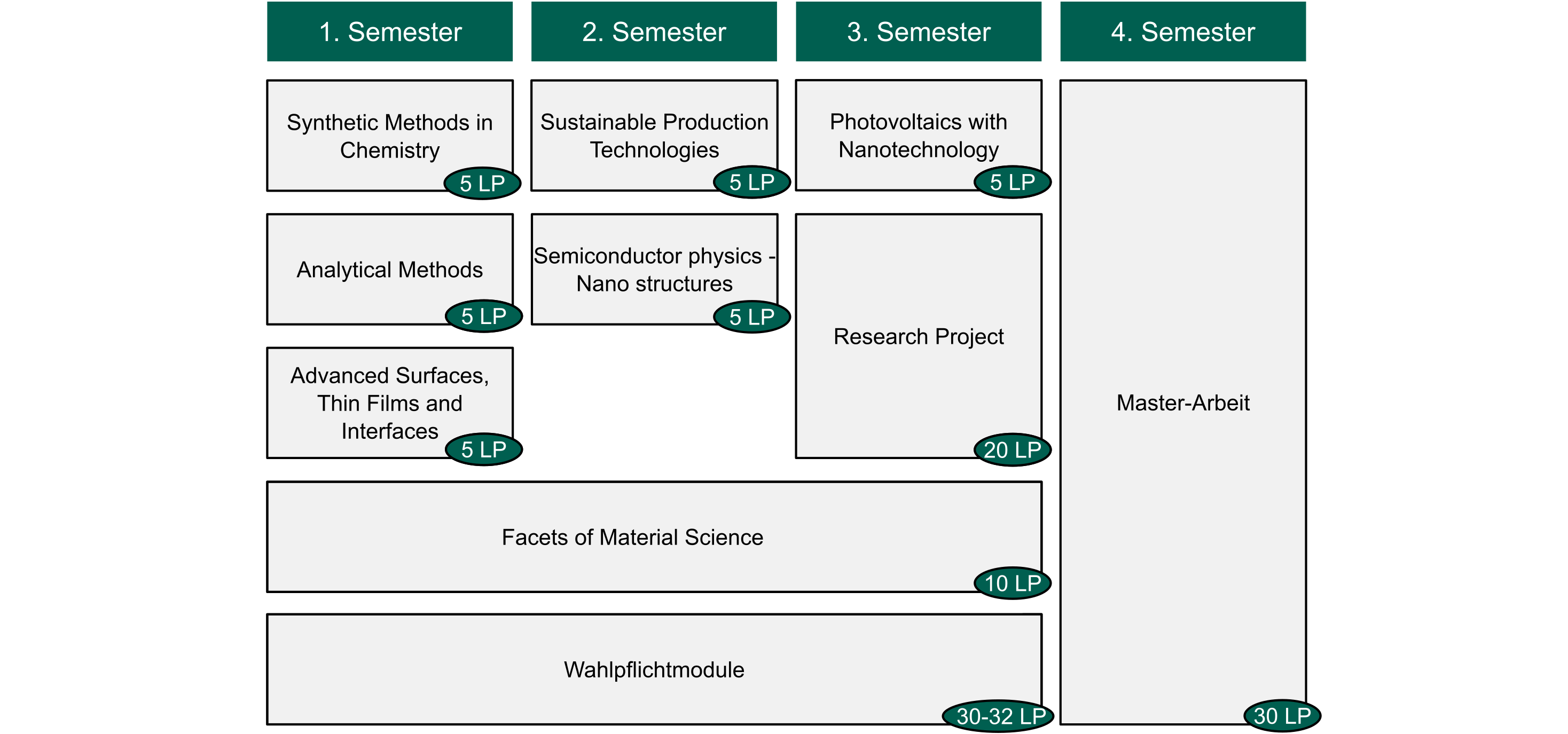
A total of 120 CP must be acquired during the Master's program. 40 CP are covered by the basic modules, 20 CP are contributed by the Research Project and 30 CP are chosen from the in-depth modules. The Master's thesis is worth 30 CP.
In order to expand the elective spectrum of the in-depth modules, up to 32 CP can also be selected. These additional credit points are not counted towards the degree program. Upon application and in individual cases, the examination board may approve the choice of other suitable modules.
Students whose native language is not German must note that a module "German as a Foreign Language" must be taken, as AFM students must prove at least A2 level in German at the time of graduation. Exactly which module is taken depends on the individual language level.
Study Documents
Timetables
Start of Studies and Orientation
Structure
The advanced chemical and physical aspects of modern materials and the thransfer of competences in the synthesis development, analysis and production of functional materials are the central topics of the Master's program Advanced Functional Materials. The research-oriented expansion and deepening of physical and chemical knowledge is based on practical advanced training in current research fields in a modern laboratory environment.

Study Content
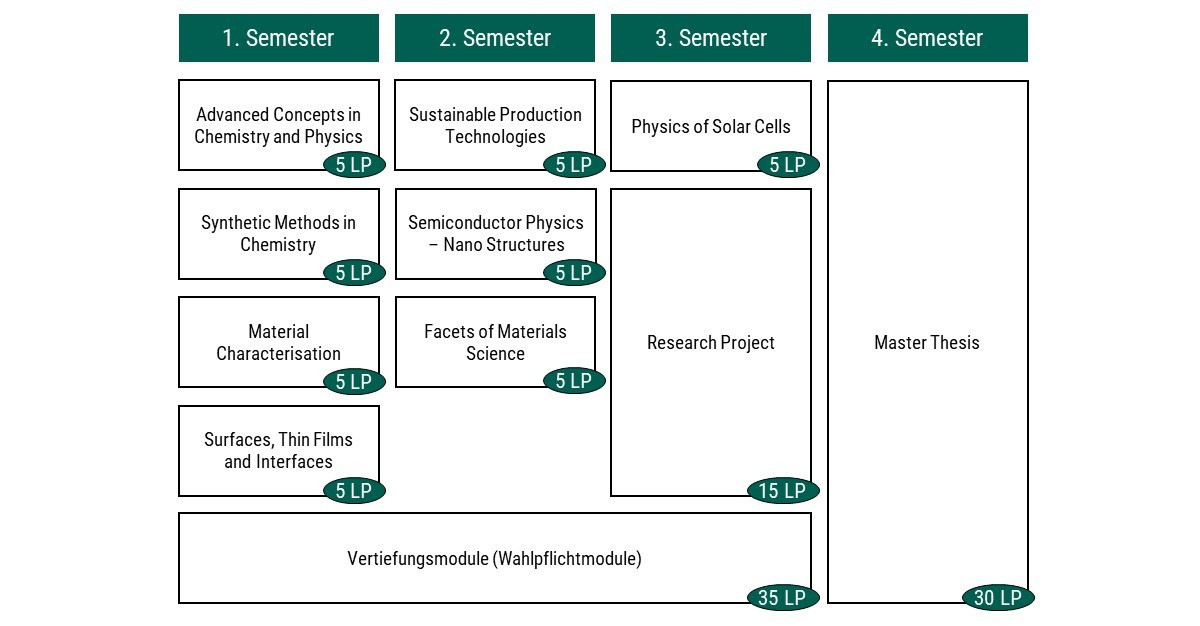
A total of 120 CP must be acquired during the Master's program. 40 CP are covered by the basic modules, 15 CP are contributed by the Research Project and 35 CP are chosen from the in-depth modules. The Master's thesis is worth 30 CP.
Students whose native language is not German must note that a module "German as a Foreign Language" must be taken, as AFM students must prove at least A2 level in German at the time of graduation. Exactly which module is taken depends on the individual language level.
Study Documents
Timetables
Start of Studies and Orientation
Career Prospects
Current trends in the labour market indicate an increasing demand for people who have successfully completed their Master's degree and understand natural science processes in their transdisciplinary origin. Fields of work are for example:
- Automotive industry
- Aerospace industry
- Semiconductor industry
- Chemical industry
- Energy sector
- Research institutes (e.g. Max Planck Institute, Fraunhofer Gesellschaft, Leibniz Institute)
PhD
The Master's degree also qualifies students for a doctoral program.
You can stay at the same university, but you can also change universities. A successful doctorate makes it possible, for example, to take up a postdoctoral position at a univeristy and thus continue to work in the field of research at a university. After the doctorate, it is also possible to enter professional life; the doctoral degree can be a qualification requirement and/or lead to higher starting salaries.
Modules
|
1. Base Modules (Compulsory Modules) Ʃ 40 CP
More information can be found in the study regulations [de].
|
|||||||||||||||||||||||||||||||||||||||||||||||||||||||||||
| 2. In-depth Modules Ʃ 50 to 52 CP The Research Project plus other modules totaling 30 CP must be selected from the following modules. In order to broaden the spectrum of choice, up to 32 CP can be selected. |
|||||||||||||||||||||||||||||||||||||||||||||||||||||||||||
|
Compulsory Module "Research Project" Ʃ 20 CP
The Research Project is a scientific, materials science-oriented work in a working group of a professorship / junior professorship of the Faculty of Natural Sciences, a professorship / junior professorship of the TU Chemnitz or another university, a non-university research institution or a research and development department of an industrial company in Germany or abroad. The module can be taken in the winter semester and in the summer semester.
More information can be found in the study regulations [de].
|
|||||||||||||||||||||||||||||||||||||||||||||||||||||||||||
|
Compulsory Modules (Languages)
Only for students whose native language is not German. Students whose native Language is not German and who do not have the language level A1 of the Common European Framework of Reference for Languages (level A1) must take the following module:
Students whose native language is not German and who do not have the language level A2 of the Common European Framework of Reference for Languages (level A2) must take the following module:
More information can be found in the study regulations [de].
|
|||||||||||||||||||||||||||||||||||||||||||||||||||||||||||
|
Elective Modules
Teaching in English
Modules with a grey background have a practical component.
More information can be found in the study regulations [de].
|
|||||||||||||||||||||||||||||||||||||||||||||||||||||||||||
|
Elective Modules
Teaching in German
Modules with a grey background have a practical component.
More information can be found in the study regulations [de].
|
|||||||||||||||||||||||||||||||||||||||||||||||||||||||||||
|
Elective Modules (Languages)
Elective only for students whose native language is not English and whom already taken one of the modules "Deutsch als Fremdsprache I (Niveau A1)" or "Deutsch als Fremdsprache II (Niveau A2)". One of the following modules may be chosen:
Elective only for students whose native language is not German and whom have not already took "Deutsch als Fremdsprache I (Niveau A1)" or "Deutsch als Fremdsprache II (Niveau A2)". One of the following modules can be chosen:
More information can be found in the study regulations [de].
|
|||||||||||||||||||||||||||||||||||||||||||||||||||||||||||
|
4. Module "Master-Thesis" (Compulsory Module) Ʃ 30 CP
Contents:
More information can be found in the study regulations [de].
|
|||||||||||||||||||||||||||||||||||||||||||||||||||||||||||
According to the study/examination regulations [de] of 10.07.2015.
Modules
|
1. Base Modules (Compulsory Modules) Ʃ 40 CP
More information can be found in the study regulations [de].
|
||||||||||||||||||||||||||||||||||||||||||||||||||||||||||||||||||||||||||||||||||||||||||||||||||
| 2. In-depth Modules Ʃ 50 CP The Research Project plus other modules totaling 30 CP must be selected from the following modules. |
||||||||||||||||||||||||||||||||||||||||||||||||||||||||||||||||||||||||||||||||||||||||||||||||||
|
Compulsory Module "Research Project" Ʃ 15 CP
The Research Project is a scientific, materials science-oriented work in a working group of a professorship / junior professorship of the Faculty of Natural Sciences, a professorship / junior professorship of the TU Chemnitz or another university, a non-university research institution or a research and development department of an industrial company in Germany or abroad. The module can be taken in the winter semester and in the summer semester.
More information can be found in the study regulations [de].
|
||||||||||||||||||||||||||||||||||||||||||||||||||||||||||||||||||||||||||||||||||||||||||||||||||
|
Compulsory Modules (Languages)
Only for students whose native language is not German. Students whose native Language is not German and who do not have the language level A1 of the Common European Framework of Reference for Languages (level A1) must take the following module:
Students whose native language is not German and who do not have the language level A2 of the Common European Framework of Reference for Languages (level A2) must take the following module:
More information can be found in the study regulations [de].
|
||||||||||||||||||||||||||||||||||||||||||||||||||||||||||||||||||||||||||||||||||||||||||||||||||
|
Elective Modules
Teaching in English
Modules with a grey background have a practical component.
More information can be found in the study regulations [de].
|
||||||||||||||||||||||||||||||||||||||||||||||||||||||||||||||||||||||||||||||||||||||||||||||||||
|
Elective Modules
Teaching in German
Modules with a grey background have a practical component.
More information can be found in the study regulations [de].
|
||||||||||||||||||||||||||||||||||||||||||||||||||||||||||||||||||||||||||||||||||||||||||||||||||
|
Elective Modules (Languages)
Elective only for students whose native language is not English and whom already taken one of the modules "Deutsch als Fremdsprache I (Niveau A1)" or "Deutsch als Fremdsprache II (Niveau A2)". One of the following modules may be chosen:
Elective only for students whose native language is not German and whom have not already took "Deutsch als Fremdsprache I (Niveau A1)" or "Deutsch als Fremdsprache II (Niveau A2)". One of the following modules can be chosen:
More information can be found in the study regulations [de].
|
||||||||||||||||||||||||||||||||||||||||||||||||||||||||||||||||||||||||||||||||||||||||||||||||||
|
4. Module "Master-Thesis" (Compulsory Module) Ʃ 30 CP
Contents:
More information can be found in the study regulations [de].
|
||||||||||||||||||||||||||||||||||||||||||||||||||||||||||||||||||||||||||||||||||||||||||||||||||
According to the study/examination regulations [de] of 17.06.2024.
FAQ
General
This course is offered not only but mostly for the new AFM students. Here, students will learn more about the course, the university itself, on workshops offered, how to use some software, how to write a CV, whom to contact, how to get information, and much more.
Although often called AFM, the officially used abbreviation is AM. This is used for example in the timetable and by the examination office.
The timetable can be found in the course catalog [de]. Please click on the lectures for more information. Most lectures need registration via OPAL.
KW is the German abbreviation for calendar week (Kalender Woche). You can find it the current calendar week in a normal calendar. Also, you can use the TU Chemnitz App [de], which shows exactly which class you have on the calendar.
Simply use your University Computer Center (URZ) login data, which you received with your enrollment in the study program, to log in to OPAL. To do so, first select the TU Chemnitz as the corresponding university.
In addition, the Faculty of Natural Sciences has launched a web page providing contacts in order find the best contact person or institution in case of problems or specific concerns.
International Students are additionally supported by the International Office.
-
Phone:+49 371 531-13500
-
Email:
-
fax:13509
-
Visitor Address:Bahnhofsstraße 8, 09111 Chemnitz
-
Rooms:G101, G101a, G102, G103 (1. Etage links), G206 (2. Etage)
-
Visiting Hours:Tuesdays: 10:00 am to 12:00 pm & 2:00 pm to 4:00 pm
and by prior appointment
Enquiries by phone: If possible outside visiting hours.
Students have to attend a safety instructions before working in a lab. The procedure of the safety instruction lecture might change and might depend on the responsible institution. Please check for information e.g. on the AFM NEWS page.
Most Professors provide these kind of information on their web pages. All professors can be found on the page of the Faculty of Natural Sciences [de], including links to their web pages.
First, look for a line of research that you are interested in, then look for the professor's e-mail address and send an e-mail expressing your interest with information on your motivation to work in the professor's research group, your academic background and qualifications. A polite request will surely be answered. In one of the tutorial sessions for new students the tutor gives some advice on how to write a formal e-mail addressing these topics.
Hiwi stands for the German word “Hilfswissenschaftler”, it means “help scientist” or in common English terms research assistant. The conditions of acceptance depend on the professor that is offering the Hiwi position. Each professor has his own criteria on how to select the students. The best way to find out is to ask and to show interest. The maximum number of hours allowed to work as Hiwi is 20h/week.
Yes, students can do a Master thesis outside the University, but they need a supervisor from the university and in the company/research center. The topic must be related with the AFM study field. To further inform yourself about this, contact the chairman of the examination board [de].
AFM is a research-oriented science course mixing physics, chemistry and material sciences that provides a quite general view on advanced materials. It is a great gateway to PhD studies offering many possible areas of R&D. The course does not offer official contacts to the industry. Job opportunities rely on own initiative, however, the career service at TUC offers several services and information.
Yes, the AFM program supports participation in Erasmus+ and other international exchange opportunities offered by TU Chemnitz, although it does not specifically offer its own exchange program.
Students can take advantage of university-wide exchange agreements by applying through the International Office (IUZ). The AFM examination board supports such exchanges, provided the chosen courses abroad are academically compatible and approved in advance.
To participate, students should begin planning early - ideally in their first semester and consult both the AFM study program coordinator and the International Office to ensure proper credit recognition and academic alignment.
The University Computer Center compiled a list of Software licences [de] that are for private use. The list is only in german but you will be fine with the google translator.
One of the most important and that you will need in the course is the OriginPro and MATLAB/Simulink.
The university VPN is a tool that allows you to access web pages and tools that you could otherwise only access within the university network (access to some journals, some software, etc.). If you are not physically close to the university, the VPN will make your connection looks the same as from the university one. Thus, providing you access to web pages, tools etc. that the university connection does provide.
The University Library has a detailed website for borrowing a book from the library.
Yes, students can provide feedback through two main channels:
- TUCpanel - the official evaluation platform of TU Chemnitz. Once a year, students receive an invitation via email to complete anonymous surveys regarding teaching quality, module content, and examination formats. This feedback is reviewed by faculty and is used to improve the academic structure and learning experience.
- Direct Communication with the Dean of the Study Program - Students are also encouraged to personally contact the Dean of the AFM study program to report specific concerns, suggestions, or issues related to courses, instructors, or examination procedures. This allows for more immediate and targeted responses where needed.
Both channels play an important role in maintaining high educational standards and ensuring that student voices are heard...
The Faculty of Natural Sciences and the TU Chemnitz offer several contact addresses in case that you need help concerning equality, equal opportunities, discrimination, advancement of women, diversity and integration. The contacts can be found on the page for information and contact persons of the Faculty of Natural Sciences.
Study Program Organization
The most reliable way to stay updated on module content, examination formats, and other academic details is by:
- Attending lectures regularly, as instructors often communicate important changes or clarifications regarding assessments and course structure during class sessions.
- Regularly checking the designated OPAL page for each module, where instructors upload updated lecture slides, announcements, and examination information.
- Referring to the official Study Regulation document, which outlines the general structure, credit points, and examination types for each module.
Staying active across all three sources ensures you don’t miss any important updates.
You should attend all obligatory courses that are offered. All courses are summarized and described in detail in the study regulations [de]. Information whether the course is obligatory or of elective nature and on the language of instruction (English or German) is given therein. In general, you can attend all the lectures of your choice. You must take exams for the credit points to be awarded. (You can but you don't have to do the exam by attending lectures!) In sum 120 credit points have to be acquired for the Master’s degree program. With this I mind, you should aim for 30 CP each semester.
In theory you can register anytime for the Research Project, there is no pre-requisite or minimum CP required, but it is highly recommended to follow the study program.
For the master thesis, a minimum of 80 CP required if you are studying under Study regulation 2018 and a minimum 85 CP required if you are studying under Study regulation 2024 in order to be allowed to register. Please check following FAQs for the workflow of "How to register".
The general procedure to register is described on the web pages of the Central Examination Office [de].
Please be aware that this step has to be carried out before you start the master thesis!
Step 1: For a master thesis in AFM, you have to consider that the Prüfungsordnung (Examination Regulations) [de] §19 (2) states that the topic of the master thesis must be related to the content of the AFM course. This condition is verified by the Prüfungsausschuss (examination board). Therefore, either together with your registration at the Central Examination Office (see above), or before, please hand in the following information to the head of the examination board (e.g. by email):
- Outline of the master thesis topic (1/2 to 1 page); the topic needs to be scientifically related to the AFM course program and the outline should contain information on main synthetic and analytical methods to be used (alternatively theoretical methods in case of theoretical work). It must be approved by the two supervisors
- Contacts of two supervisors who agreed to supervise your Master Thesis and to act as examiners; at least one of them has to be a TU Chemnitz Professor related to the AFM course; the other examiner must have provable, substantial and qualified experience on the research topic of the Master Thesis, which is usually attested by a doctorate in the subject area.
- The examination board will check these documents with respect to the condition described above, and the head of the examination board will reply (usually within a few days) if the master thesis topic was approved or rejected.
If approved, the registration in step 2 is still required.
Step 2: Fill up the thesis registration form (available on examination office webpage) mentioning required registration information and get it signed by the supervising TU Chemnitz Professor, then send it to the representative for AFM in the examination office via email - zpa3@verwaltung.tu-chemnitz.de .
The standardized process for registering a research project is given bellow and must be carried out before starting of the research project work.
Step 1: Get the topic approved by writing an email to the Head of Examination board for AFM - Prof. Dr. Carsten Deibel. The e-mail must contain following details:
- Outline of the Research Project topic (1/2 to 1 page); the topic needs to be scientifically related to the AFM course program and the outline should contain information on main methods and analytics to be used.
- Name of two supervisors, one must be a TU Chemnitz Professor related to the AFM course, the other examiner must have provable, substantial and qualified experience on the topic of the Research Project, which is usually attested by a doctorate in the subject area.
- The examination board will check these documents with respect to the condition described above, and the head of the examination board will reply (usually within a few days) if the Research Project was approved or rejected.
If approved, the registration in step 2 is still required.
Step 2: Fill up the examination registration form (available on examination office webpage) mentioning required registration information and send it to the representative for AFM in the examination office via email - zpa3@verwaltung.tu-chemnitz.de . Alternatively, you can register during the examination registration period.
According to the official study regulations:
- Study Regulation 2018
- The Research Project is allocated 20 credit points (CP), which corresponds to approximately 600 working hours or 15 weeks of full-time work.
- The Master Thesis is worth 30 CP, equating to about 900 working hours, which corresponds to approximately 23 weeks of full-time work.
- Study Regulation 2024:
- The Research Project has been revised to 15 CP, corresponding to around 450 working hours or approximately 11-12 weeks of full-time work.
- The Master Thesis remains unchanged at 30 CP, requiring about 900 working hours or 23 weeks of full-time work.
These time frames include planning, experimental work, data evaluation, documentation, and the final presentation or defence.
AFM students must demonstrate at least A2 level in German at the time of graduation. This is intended as an incentive to develop language skills beyond the minimum level required for a Master's degree, but it should be kept in mind that the actual content of the AFM degree program is scientific. In order to achieve this, in the current study documents the option is given to take language courses as part of the compulsory elective modules.
If the student cannot prove German A1 and A2, both courses can be taken from the Foreign Language Centre and have to be successfully finished. For the graduation certificate, either just A2, or both A1 and A2 can be shown. This can be discussed with the Central Examination Office (ZPA). (For language courses of B1 or higher, only one language module can be used for the elective modules on the certificate). Please note that:
- Only courses from the Foreign Language Centre can be credited for the AFM course graduation certificate
- If you have an external certificate for German of at least A2 level, while this course cannot be recognized for the graduation certificate and will not gain you any credit points, it might be possible to accept it for the proof that you have at least A2 level in German at the time of graduation. To show A2 level is mandatory for all AFM students for final graduation.
If A1 (A2) is accepted students might register directly for A2 (B1). Please contact the chairman of the examination board [de] to clarify.
Yes, students in the AFM program may take additional elective modules beyond the required 120 credit points (CPs), provided they manage their workload within the standard duration of the program.
However, it's important to note:
- Only 120 CPs will be officially counted towards the degree and listed on the final transcript.
- Any additional modules completed beyond the required CPs may be listed separately or may not appear on the degree certificate unless specifically approved by the examination board.
- Taking extra electives does not grant an extension of the study duration or any official academic advantage.
Students interested in taking extra modules are advised to consult the examination board.
The grades are available on the SBService, under the topic examination service - Grades achieved.
You can find the academic calendar on the page of the Student Service.
Exams
If you want to do an exam, a registration at the Central Examination Office (ZPA) is necessary before. This can be done directly in your SBservice. The university will announce time slots for registration.
Usually, the exams are held from February to March in the winter semester and from July to August in the summer semester within a 4-week exam period after the lecture period. In some cases, exams are offered outside of this period, but the lecturer has to inform the students in time. Most written exams can be found in the examination schedule, if not otherwise announced by the lecturer. Oral exams most often are announced by the lecturer only.
The examination schedule will be updated on a non-regular basis.
Students will have to take the exam again within one year. If they fail again, they can apply for a third exam which has to be taken at the next offered date.
In this case, an official medical certificate must be submitted to the Central Examination Office (ZPA). The medical certificate must arrive within three days at the ZPA and must prove the sickness at the time of the exam. Then, the trial will be excluded. Please note that the ZPA accepts only medical certificate! See study regulations [de] and information given on the homepage of the ZPA (see https://www.tu-chemnitz.de/zpa/formulare/index.php.en).
Concerning compliance with deadlines for the first-time application to an examination, repetition of examinations, reasons for the absence from examinations, and compliance with time limits for the completion of examination papers, a candidate’s illness equals the illness of a child for whom the candidate is the predominantly sole carer.
Yes, until one week before the examination date without giving reason. If this period is missed, the student must provide valuable reasons for not attending the exam. Please note that "being not well prepared" or "not feeling comfortable" is not a valuable reason! In case of illness a medical certificate is needed.
Please note that the notice must have been arrived at the Central Examination Office (ZPA) one week before (!) the exam, thus it is advised to send it in time, at best two weeks before the examination date. Also, if you made an individual appointment for the exam with a Professor, they must be informed separately by you.
A retake is not possible.
Most subjects do not have prerequisites to register for the exam, but some modules have pre-requisites such as a presentation or a practice. These are announced in the study regulations [de] and by the lecturer.
This is a very personal and unique question; each person has their own learning strategies. Often the assessments at the TUC are different from your home country, so try to talk to students who are more advanced in the course and find out what works best for you and don't forget that an important point is to attend the lectures and to learn based on these lectures.