Chair of Microeconomics
The Subject
The course Microeconomics deals with economic behaviour and decisions of individuals. Important branches are the theory of the firm and the theory of the household. Furthermore, questions on which results are genrated by competitive processes are analysed and evaluated. In addition, macroeconomic aspects are examined which result from the complex relationships among individuals typical for a capitalistic system.
News
December 12 2025 - New research article published
Baumann, M. H. & Janischewski, A. (2025): "What are Asset Price Bubbles? A Survey on Definitions of Financial Bubbles", Journal of Economic Surveys, in: Competition & Change, https://doi.org/10.1111/joes.70040".
July 15 2025 - Seminar (M.Sc. Economics) in the winter term 2025/26
We offer a seminar (M.Sc. Economics) on "Innovation and technological progress: Measurement, Prediction, Policy" this winter term. Please see the page of the seminar in OPAL for more details.
Please note: As the projects will almost always involve data analysis or modeling, basic knowledge in programming is mandatory. We would recommend that you have some working knowledge in either R or Python, although other programming languages are also acceptable. Basic knowledge would be attained if you have for example passed any one of the following courses: Computational Economics I or II, Empirical Economics I or II, Introductory Empirical Economics (Grundlagen der Empirischen Wirtschaftsforschung) or the seminar on Agent-Based Modeling. If you have doubts about this point, please get in touch with the lecturers.
Interested students can enroll directly on the page of the seminar in OPAL until Oct 20 2025.
February 21 2025 - New research article about productivity dispersion and firm growth in Canada published
The research article Jangho Yang, Brian Cozzarin and Torsten Heinrich ("Productivity dispersion and firm growth in Canada", Journal of Evolutionary Economics, DOI) was published earlier this month. Using data for Canada, the paper finds some a negative relation of growth and productivity dispersion (NIQR) and inverted U-shape relation for growth and productivity. The two results are connected and have important implications for firm dynamics and economic policy.
Oct 02 2024: GENED 2024 meeting at TU Chemnitz
With 21 contributed talks, almost 40 participants, and an extended tutorial by Jean-Philippe Bouchaud (ENS Paris, CFM, ICL) on "Topics in Complexity Economics", the annual meeting of the GENED (German Network for New Economic Dynamics) took place at TU Chemnitz this week from Sep. 30 to Oct 2.


July 31 2024 - Research article on the distribution of productivity across firms
J. Yang, T. Heinrich, J. Winkler, F. Lafond, P. Koutroumpis and J. D. Farmer ("Measuring productivity dispersion: a parametric approach using the Lévy alpha-stable distribution", Industrial and Corporate Change, DOI) characterize the distribution of productivity among 7 million European firms and find strong evidence for a Lévy alpha-stable distributional model with an infinite second moment, which has implications for the debate about productivity dispersion and misallocation.
February 06 2024 - New research article published
Rochowicz, N.: "Planning progress: Incorporating innovation and structural change into models of economic planning", in: Competition & Change. The full text can be found here.
January 18 2024 - Publications of the Chair of Microeconomics in the years 2022/23
2023
Torsten Heinrich, Yoojin Jang, Luca Mungo, Marco Pangallo, Alex Scott, Bassel Tarbush, Samuel Wiese: "Best-response dynamics, playing sequences, and convergence to equilibrium in random games", in: International Journal of Game Theory, DOI.
2022
Dressler, G., Groeneveld, J., Hetzer, J., Janischewski, A., Nolzen, H., Rödig, E., Schwarz, N., Taubert, F., Thober, J., Will, M., Williams, T., Wirth, S. B., & Müller, B.: "Upscaling in socio-environmental systems modelling: Current challenges, promising strategies and insights from ecology", in: Socio-Environmental Systems Modelling, DOI.
Janischewski, A.: "Inequality, non-linear consumption behaviour, and monetary growth imperatives", in: European Journal of Economics and Economic Policies: Intervention, DOI.
December 11 2023: Learning bridge Chemnitz-Lviv: Dr. Larysa Zomchak as guest researcher in Chemnitz
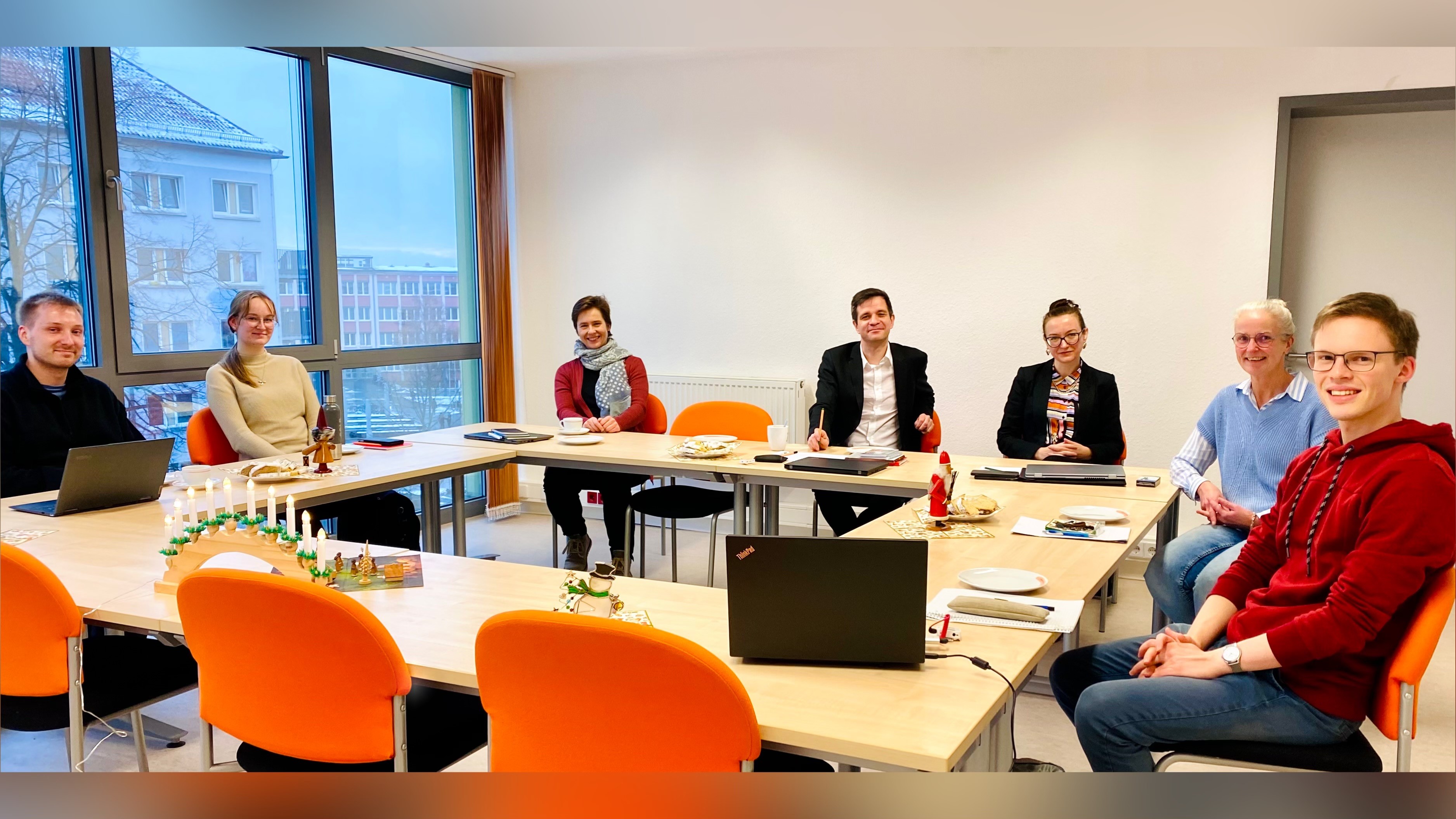 Dr. Larysa Zomchak (third from right) und Prof. Dr. Torsten Heinrich (fourth from right) discussing with the team of the Chair for Microeconomics.
October 04 2023 - Prof. Dr. Heinrich gives lecture on Computational Economics for students from Lviv, Ukraine
In the context of the learning bridge Chemnitz-Lviv, Prof. Dr. Larysa Zomchak (Ivan Franko National University Lviv), Prof. Dr. Torsten Heinrich (Chemnitz University of Technology), and Anja Janischewski (also Chemnitz University of Technology) are teaching a course on Computational Economics for students in Lviv this term. The course started off with the first lecture given by Prof. Heinrich via the BBB video conferencing system of the Chemnitz University of Technology last week. The course covers an introduction to Python programming and computational methods and their application in economics. Lecture videos and other materials compiled by Prof. Heinrich at Chemnitz University of Technology are used in this course.
Link to the course.
Oct 14 2022 - Makronom: Economist for Future - new article by Torsten Heinrich published
Here you can find a current article on the topic "Innovationspolitik in Zeiten des Klimawandels" by Torsten Heinrich.
Oct 20 2021 - New research article on the frequency of convergence and divergence in n-player strategic games published
Samuel Wiese and Torsten Heinrich, "The Frequency of Convergent Games under Best-Response Dynamics", published in "Dynamic Games and Applications" - the full text can be found here.
Sep 16 2021 - New research article on the micro level of structural change published
Torsten Heinrich, Jangho Yang, and Shuanping Dai ("Levels of structural change: An analysis of Chna's development push 1998-2014", Journal of Evolutionary Economics) consider structural change at the firm level using the example of China's economic development 1998-2014.
Further information is available here.
March 19 2021 - New research article on systemic risk in insurance published
Torsten Heinrich, Juan Sabuco, Doyne Farmer "A simulation of the insurance industry: the problem of risk model homogeneity", Journal of Economic Interaction and Coordination. Further information is available here.
Several insurance trade publications reported: ARTEMIS, InsuranceERM and Reinsurance News.