Enhanced Surgical Training Simulator Passes Clinical Practice Test
Scientists from the Professorship of Production Systems and Processes at Chemnitz University of Technology, together with surgeons, have successfully tested their advanced virtual reality simulation for hip surgeries – the use of hip prostheses in surgical training can be practiced safely and repeatedly
-
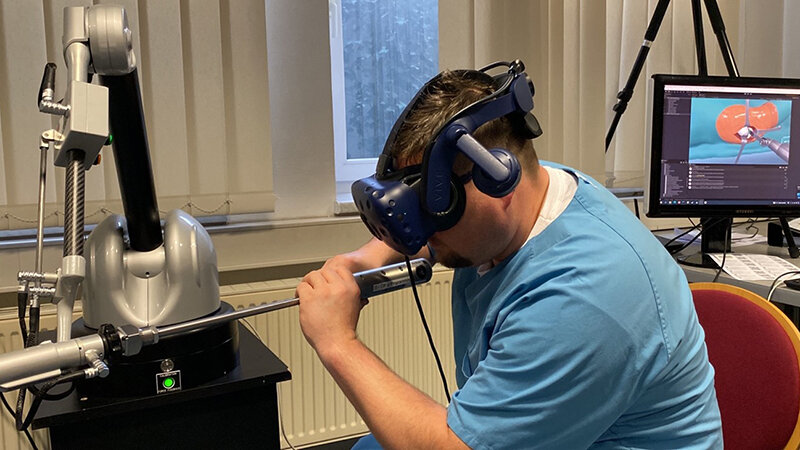
PD Dr. med. habil. Dirk Zajonz, senior consultant at the Zeisigwaldkliniken Bethanien Chemnitz, evaluates the newly developed training system for hip replacement operations. He saws the joint head of the femur in the virtual world and feels the real resistance of the bone. Photo: Nina Pillen
During hip surgeries, physicians often have to exert significant force. At the same time, precision is crucial at the operating table. Dr. Mario Lorenz and Sebastian Knopp, research associates at the Professorship of Production Systems and Processes (headed by Prof. Dr. Martin Dix) at Chemnitz University of Technology, have further developed a virtual operation simulator that allows surgeons to realistically train the necessary force and precision for hip implant procedures. The researchers aimed to provide sensory perceptions to the surgeons as close as possible to those experienced during a real surgery, such as the resistance of bone during sawing and scraping. The combination of virtual reality and specialized haptic devices now makes this possible. "The technical base used has the potential to revolutionize the entire areas of training and further education for joint replacement surgeries," says Lorenz.
Surgeons can feel real forces and resistances during the virtual operation
"We can simulate not only the milling of the hip socket but all five main steps of the hip implant surgery," adds Knopp. These include sawing off the femoral head, milling and inserting the hip socket implant, rasping the inside of the femur, and finally, implanting the stem. The haptic feedback is provided by a haptic device specially developed for this application by HAPTION GmbH. For sawing and milling, the Chemnitz scientists built a handpiece that realistically simulates the vibrations during processing. Additionally, the researchers developed their own impaction device and have applied for a patent, as the surgeons need to exert such great forces during implant insertion, bone rasping, and stem implantation that neither a robot nor the haptic device would have been suitable.
"We conducted biomechanical measurements and found that the impaction device must withstand impulses of 22 kilonewtons during surgical training," says Lorenz. For these experiments on body donors, both the experimental setup and the measuring technology had to be completely redeveloped. This work was carried out in collaboration with researchers from the Centre for Research on Musculoskeletal Systems(ZESBO) at University of Leipzig and the Division of Macroscopic and Clinical Anatomy at Medical University of Graz. The University of Bremen developed new haptic rendering methods for two-handed tasks in the various surgical steps and adapted them for the operation of the impaction device.
Experts can be connected remotely
The finished training system can now be used either as a complete training or in individual modules with three different difficulty levels. Moreover, there are multiplayer modes for the collaboration of remotely located physicians, where one person operates, another instructs, and more viewers can attend the same virtual operation room. In the VR simulation, texts and images guide through the individual surgical steps. These were designed and implemented by FAKT Software GmbH with support from YOUSE GmbH based on the clinical knowledge of Zeisigwaldkliniken Bethanien Chemnitz. In addition, FAKT Software GmbH has created the possibility to record the surgical training, play it back later, and practice the surgical steps again with audio commentary. CAT Production GmbH, under the guidance of private lecturer Dr. med. habil. Dirk Zajonz, senior consultant at Zeisigwaldkliniken Bethanien Chemnitz, visually optimized the 3D models of a virtual patient.
Comprehensive user study ensures acceptance of the medical VR application
Orthopedic surgeons were involved in the entire development process. They formulated detailed requirements and evaluated the final training simulator in a comprehensive user study to ensure the acceptance of the medical VR application. Seventeen participants – from medical students to chief physicians – took part in the evaluation. "We are very pleased that the evaluation of our application at the Zeisigwaldkliniken in Chemnitz went so well and that the test persons assess our system as useful, meaningful, and realistic, even though there is still potential for improvement," says Lorenz.
The "DynamicHIPS" project was funded by the Federal Ministry of Education and Research with approximately 442,000 euros from May 2020 to April 2023 at Chemnitz University of Technology and received two Science Awards from the German Institute for Virtual Realities.
Multimedia: A video about "DynamicHIPS – Haptic Virtual Reality Training for Hip Implant Surgery" can be found here: https://youtu.be/4dWUv43BF_8
For more information, contact Dr. Mario Lorenz, tel. +49 (0)371 531-39366, e-mail mario.lorenz@mb.tu-chemnitz.de.
(Author: Mario Steinebach / Translation: Brent Benofsky)
Matthias Fejes
13.11.2023