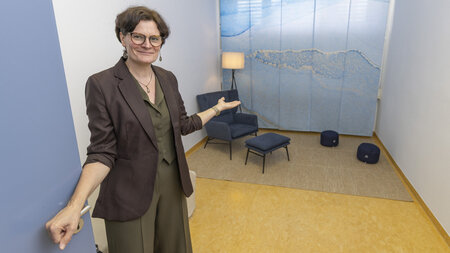
Dr. habil. Franziska Bocklisch

Dr. habil. Franziska Bocklisch
Head of department: Human-Cyber-Physical Systems
-
Telefon:+49 371 531-36530
-
E-Mail:
-
Adresse:Erfenschlager Straße 73, 09125 Chemnitz
-
Raum:
-
Sprechzeiten:nach Vereinbarung, bitte per Mail anmelden
Research Interest
- Cognition-based human-machine interaction and human-machine teaming
- Combined data- and knowledge based modelling of cognitive and technical processes using transparent artificial intelligence (e.g., fuzzy pattern classification)
- Cognitive engineering (e.g., analysis, formalization and representation of domain expert knowledge)
- Human-cyber-physical systems and cognitive production assistant systems
- Uncertainty and vagueness in expert knowledge (e.g., technical/medical linguistic expressions, verbal anchors in questionnaire scales, intercultural communication of risk)
- Diagnostic reasoning and decision-making (e.g., in technical/medical domains)
- Traffic psychology, driver modelling and recognition of driver intention or state
- User experience research
Short CV
- Since 04/2023: Head of department "Humand production" at Fraunhofer Institute for Machine Tools and Forming Technology, IWU
- Since 04/2022: Head of department "Human-cyber-physical systems", Professorship “Materials and Surface Engineering”, Department of Mechanical Engineering, Technische Universität Chemnitz (TUC)
- 04/2022 – 10/2022: Head of research group "Cognition-based human-machine interaction", Professorship “Cognitive Psychology and Human Factors”, Department of Human and Social Sciences, TUC
- 06/2020 – 02/2023: Project leader "Privacy analysis and user specific privacy recommendations for apps and mobile devices" (BMBF)
- 10/2019 - 03/2022: W3 Stand-in professor for "Cognitive Psychology and Human Factors", Department of Human and Social Sciences, TUC
- 07/2019 – 03/2023: Project leader "Cognition-based human-machine interaction" (BMBF)
- 07/2019: Habilitation in psychology: Bocklisch, F. (2019): „Analyse und Modellierung psychologischer Verstehens- und Schlussfolgerungsprozesse in den Bereichen Diagnostisches Schließen, Sprache und Mensch-Technik-Interaktion“
- 02/2012 – 09/2019: Head of research group “Abductive and diagnostic reasoning”, Professorship “Cognitive and Engineering Psychology”, Department of Human and Social Sciences, TUC
- 01/2012: Dissertation in psychology (Dr. rer. nat.): Bocklisch, F. (2012): Die Analyse und Bewertung vager linguistischer Terme mittels fuzzy Methodik. http://nbn-resolving.de/urn:nbn:de:bsz:ch1-qucosa-83410
- 11/2008 – 12/2021: Freelance psychologist with focus on work analysis, risk assessment, stress prevention and workplace health promotion
- 10/2006 - 01/2012: Research assistant, Professorship “Cognitive and Engineering Psychology”, Department of Human and Social Sciences, TUC
- 2000−2006: Study in psychology (Diploma) at TUC
Selected Publications
- Kreißig, I., Hartwich, F., Todtermuschke, M., & Bocklisch, F. (2025). Integrating expertise into automation – Formalising expert knowledge for a human-centred design of industry 5.0 applications. In D. de Waard, L. Onnasch, M. Liebherr, A. Dettmann, F. Siebert, K. Karrer-Gauß, S. Winkler, A. Toffetti, and M. De Angelis. Proceedings of the Human Factors and Ergonomics Society Europe Chapter 2025 Annual Conference. ISSN 2333-4959 (online). https://www.hfes-europe.org/wp-content/uploads/2025/05/Kreissig2025.pdf
- Bocklisch, F. & Lampke, T. (2024). Human-CoMo: A combination of cognitive knowledge engineering and data modelling for human-cyber-physical systems in intelligent manufacturing. Journal of Integrated Design and Process Science. https://doi.org/10.1177/10920617241295887
- Morgenstern, T., Klichowicz, A., Bengler, P., Todtermuschke, M., & Bocklisch, F. (2024). Towards a Cognition-Based Framework Describing Interdisciplinary Expert Team Processes for Cognitive Robotics in Industry 5.0 Technologies. Applied Sciences; 14(10):4121. https://doi.org/10.3390/app14104121
- Bocklisch, F., Bocklisch, S.F., Grimm, M., Lampke, T., & Joshi, S. (2024). Hybrid decision-making in atmospheric plasma spraying enables human-machine teaming. International Journal of Advanced Manufacturing Technology. https://doi.org/10.1007/s00170-024-13595-8
- Bocklisch, F. & Huchler, N. (2023). Humans and cyber-physical systems as teammates? Characteristics and applicability of the human-machine-teaming concept in intelligent manufacturing. Front. Artif. Intell. 6:1247755. https://doi.org/10.3389/frai.2023.1247755
- Bocklisch, F. & Lampke, T. (2023). Mensch und Maschine als Teampartner? Neue Wege zur menschzentrierten Digitalisierung in der Produktion. WOMAG 07/08 2023, DOI: 10.7395/2023/bocklisch2
- Klichowicz, A., Morgenstern, T., & Bocklisch, F. (2023). Using Conceptual Chunking to Support Information Processing While Solving Complex Industrial Tasks. In International Congress on Information and Communication Technology (pp. 33-49). Singapore: Springer Nature Singapore.
- Eich, A., Klichowicz, A., & Bocklisch, F. (2023). How Automation Level Influences Moral Decisions of Humans Collaborating with Industrial Robots in Different Scenarios. Frontiers in Psychology. https://doi.org/10.3389/fpsyg.2023.1107306
- Heubeck, L., Hartwich, F., & Bocklisch, F. (2023). To Share or Not to Share—Expected Transportation Mode Changes Given Different Types of Fully Automated Vehicles. Sustainability. https://doi.org/10.3390/su15065056
- Darnstaedt, D., Ahrens, A., Richter-Trummer, V., Todtermuschke, M., & Bocklisch, F. (2021). Vorgehen zur Beschreibung von menschlichem Expertenwissen und kognitiven Prozessen beim Teach-in von Industrierobotern. Zeitschrift für Arbeitswissenschaft. https://doi.org/10.1007/s41449-021-00284-5
- Bocklisch, F., Drehmann, R., & Lampke, T. (2020). Kognitionsbasierte Mensch-Technik Interaktion in Cyber-Physischen Systemen am Applikationsbeispiel „Thermisches Spritzen“. MONARCH TU Chemnitz, https://nbn-resolving.org/urn:nbn:de:bsz:ch1-qucosa2-389299
- Bocklisch, F. (2019). Different or the Same? Determination of Discriminatory Power Threshold and Category Formation for Vague Linguistic Frequency Expressions. Frontiers in Psychology, 10. https://doi.org/10.3389/fpsyg.2019.01559
- Bocklisch, F., & Hausmann, D. (2018). Multidimensional Fuzzy Pattern Classifier Sequences for Medical Diagnostic Reasoning. Applied Soft Computing, 66, 297-310. https://doi.org/10.1016/j.asoc.2018.02.041
- Bocklisch, F., Bocklisch, S.F., Beggiato, M. & Krems, J.F. (2017). Adaptive Fuzzy Pattern Classification for the Online Detection of Driver Lane Change Intention. Neurocomputing. https://doi.org/10.1016/j.neucom.2017.02.089
- Bocklisch, S.F., & Bocklisch, F. (2015). Fuzzy-Pattern-Klassifikatoren als Modelle. Informatik Spektrum 38 (6), 510-522. https://doi.org/10.1007/s00287-015-0922-9
- Rebitschek, F. G., Bocklisch, F., Scholz, A., Krems, J. F. & Jahn, G. (2015). Biased processing of ambiguous symptoms favors the initially leading hypothesis in sequential diagnostic reasoning. Experimental Psychology, 62(5), 287-305. https://doi.org/10.1027/1618-3169/a000298
- Bocklisch, F., Bocklisch, S. F., & Krems, J.F. (2012). Sometimes, often, and always: Exploring the vague meanings of frequency expressions. Behaviour Research Methods, 44(1), 144-157. https://doi.org/10.3758/s13428-011-0130-8
- Bocklisch, F. (2011). The Vagueness of Verbal Probability and Frequency Expressions. International Journal of Advanced Computer Science, 1(2), 52-57.