Research
Port-Hamiltonian systems
Port-Hamiltonian modelling encodes energy storage, dissipation and interconnection directly in the system structure, which makes it a natural language for coupled and multiphysics problems. Our work covers the formulation of such models, their analysis, numerical methods for their simulation and approximation, and energy-optimal control with minimal energy supply. A guiding theme is to preserve the underlying structure both in the analysis and in the numerical approximation.
Koopman operators and data-driven control
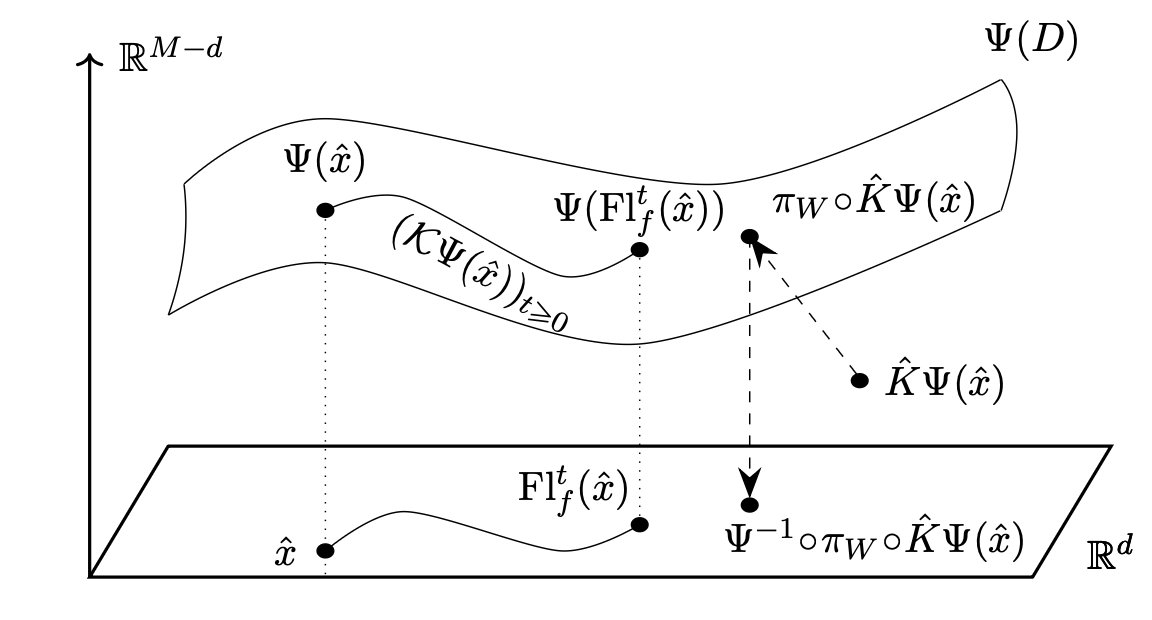
The Koopman operator turns nonlinear dynamics into a linear, but infinite-dimensional, object that can be approximated from data. Our work focuses on rigorous guarantees for this approximation: finite-data error bounds for Koopman-based prediction and control, error estimates for kernel-based approximations in reproducing kernel Hilbert spaces, and the question of how such bounds translate into closed-loop stability and performance guarantees for the resulting controllers.
Optimal control
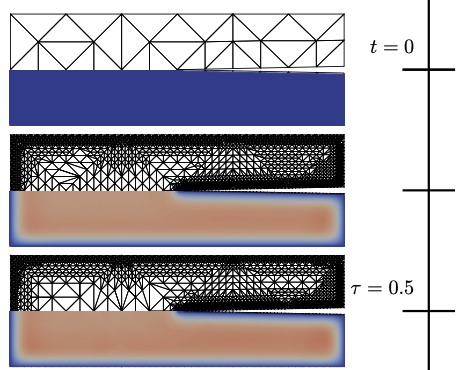
We analyse optimal control problems for finite- and infinite-dimensional systems, with an emphasis on structural properties of their solutions: turnpike behaviour, and the exponential decay of the influence of perturbations in time and in space. Such properties can be exploited numerically, for instance in adaptive discretisations with goal-oriented error estimation and in efficient schemes for model predictive control of partial differential equations.