Nanoelectrodeposition
Electrodeposition, compared to physical vapor deposition, is an appealing synthesis method for a multitude of functional materials due to the operation at ambient conditions, its one-step nature, and the possibility to achieve complex 3D geometries.However, to fabricate defined nanoscale structures by electrodeposition, the fundamental nucleation and growth processes must be very well understood and controlled.
Our group focuses on the nanoelectrodeposition of transition metal and alloy structures, which are of broad interest for numerous applications, such as in the fields of magnetic data storage, spintronics, biosensing and catalysis.
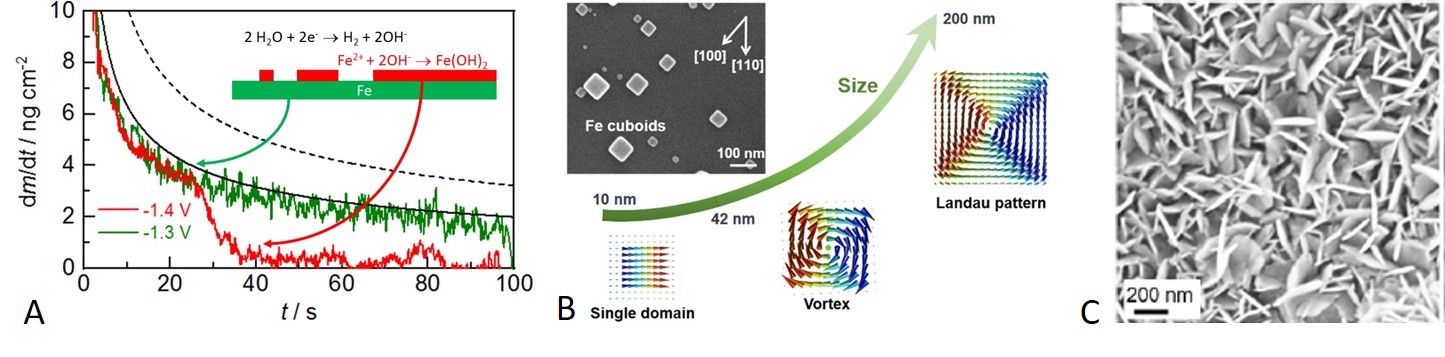
Recent highlight results (A-C) are:
(A) Self-terminated electrodeposition of ultrathin iron/iron hydroxide layers with defined thickness and enhanced stability. The underlying mechanism is revealed by electrochemical quartz crystal microbalance measurements and model calculations based on diffusion theory. Quantitative analysis elucidates the decisive role of the pH increase due to water reduction and the associated formation of ultrathin or bulk Fe(OH)2. During self-termination, a catalytic effect on the hydrogen evolution reaction is evident.
- Stabilization of nanoscale iron films by self-terminated electrodeposition in sulfate electrolyte, Electrochim. Acta 415, 140170, 2022. doi.org/10.1016/j.electacta.2022.140170
(B) Iron nanocuboids by epitaxial nanoelectrodeposition. Here, by progressive nucleation on GaAs(001), aligned single-crystal iron nanocuboids with sizes ranging 10 to 200 nm are achieved on one sample. In cooperation with the IFW Dresden and the Université de Toulose we verified experimentally and theoretically a sequential transition from Landau pattern to vortex and finally single domain state when decreasing the sizes of the nanocuboids. This combinatorial-like approach leads to a quantitative understanding of the magnetic configurations of the nanomagnets in a broad size range.
- Size-Specific Magnetic Configurations in Electrodeposited Epitaxial Iron Nanocuboids: From Landau Pattern to Vortex and Single Domain States, Nano Lett. 2022. https://doi.org/10.1021/acs.nanolett.2c00607
- Aligned cuboid iron nanoparticles by epitaxial electrodeposition, Nanoscale 9, 5315, 2017. doi.org/10.1039/C7NR00908A
- Role of Hydrogen Evolution during Epitaxial Electrodeposition of Fe on GaAs, J. Electrochem. Soc. 165, H3076, 2017. DOI: 10.1149/2.0071804jes
(C) Electrodeposition of FeOOH-nanoplatelets, which are of interest due to their catalytic nature and as starting material for magneto-ionic ON/OFF switching.
- Voltage-controlled ON switching and manipulation of magnetization via the redox transformation of β-FeOOH nanoplatelets, J. Phys. D: Applied Physics. 53, 084001, 2019. https://doi.org/10.1088/1361-6463/ab5bca