Wasserstoff-Magneto-Ionik
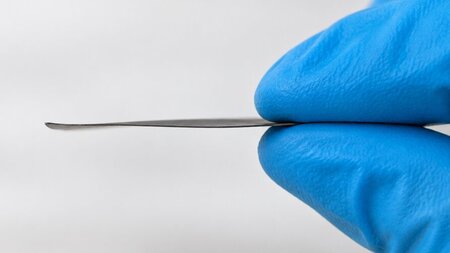
Die Wasserstoff-Magneto-Ionik nutzt die elektrochemische Wasserstoffbeladung von Metallen zur Kontrolle deren magnetischer Eigenschaften. Wir konnten in einer Arbeit zur Wasserstoff Magneto-Ionik in Palladium/Cobalt Multilagen zusammen mit der AG Hellwig nachweisen, dass die Wasserstoffkonzentration in solchen Multilagen deren magnetische Eigenschaften, vor allem die Koerzitivfeldstärke, direkt beeinflusst. Außerdem konnten wir zeigen, dass die Ausbreitungsgeschwindigkeit magnetischer Domänenwände durch Wasserstoff deutlich reduziert wird und das komplette Abstoppen einer wandernden Domänenwand durch Wasserstoffbeladung so möglich wird. Das könnte für magnetische Speichermedien, die Information in der Position der Domänenwand speichern, neue Funktionalitäten bringen. Dazu gibt es einen Pressebericht der TU Chemnitz.
- M. Bischoff, R. Ehrler, F. Engelhardt, O. Hellwig, K. Leistner, M. Gößler, Magneto-Ionic Control of Coercivity and Domain-Wall Velocity in Co/Pd Multilayers by Electrochemical Hydrogen Loading, Advanced Functional Materials 34, 2405323 (2024), https://doi.org/10.1002/adfm.202405323
Magneto-Ionik an Spin Valves
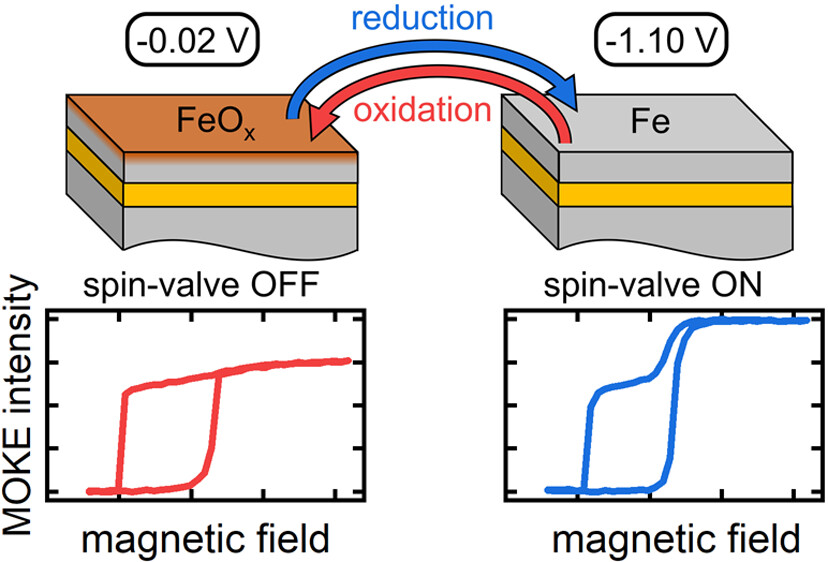
In einer Kooperation mit der Universität Kassel (AG Ehresmann) konnten wir einen magneto-ionischen Effekt an einer Spin-Valve Struktur zeigen. Solche Stukturen bestehen aus zwei ferromagnetischen Schichten, die durch eine nicht-magnetische Schicht getrennt sind. Die Magnetisierung der unteren ferromagnetische Schicht wird durch den Exchange Bias Effekt zusätzlich fixiert. Der magneto-ionische Effekt in diesen Strukturen basiert auf der elektrochemischen Reduktion/Oxidation einer dünnen Oxidschicht auf der oberen ferromagnetischen Schicht, durch die magnetische Kopplung beider Schichten lässt sich jedoch die gesamte Struktur magneto-ionisch kontrollieren. Dadurch konnten wir eine reversible Kontrolle des Exchange Bias Effekts erzielen und magneto-ionisch zwischen ein- und zweistufiger Hysteresekurve umschalten. Dieser neue Schichtaufbau könnte die magneto-ionische Kontrolle komplexer magnetischer Strukturen durch magnetische Kopplung erlauben und für magnetische Feldsensoren eingesetzt werden.
- M. Gößler, J. Zehner, R. Huhnstock, F. Röder, R. Ehrler, O. Hellwig, A. Ehresmann, K. Leistner, Reversible magneto-ionic control of exchange bias in spin-valve-like heterostructures, ACS Applied Materials & Inferfaces, 17, 49671–49682 (2025), https://doi.org/10.1021/acsami.5c10187
Kontakt:
Dr. Markus Gößler
Tel.: +49 (0) 371 531 37533
E-Mail: markus.goessler@…
Raum: 1/150