BOLD fMRI signals
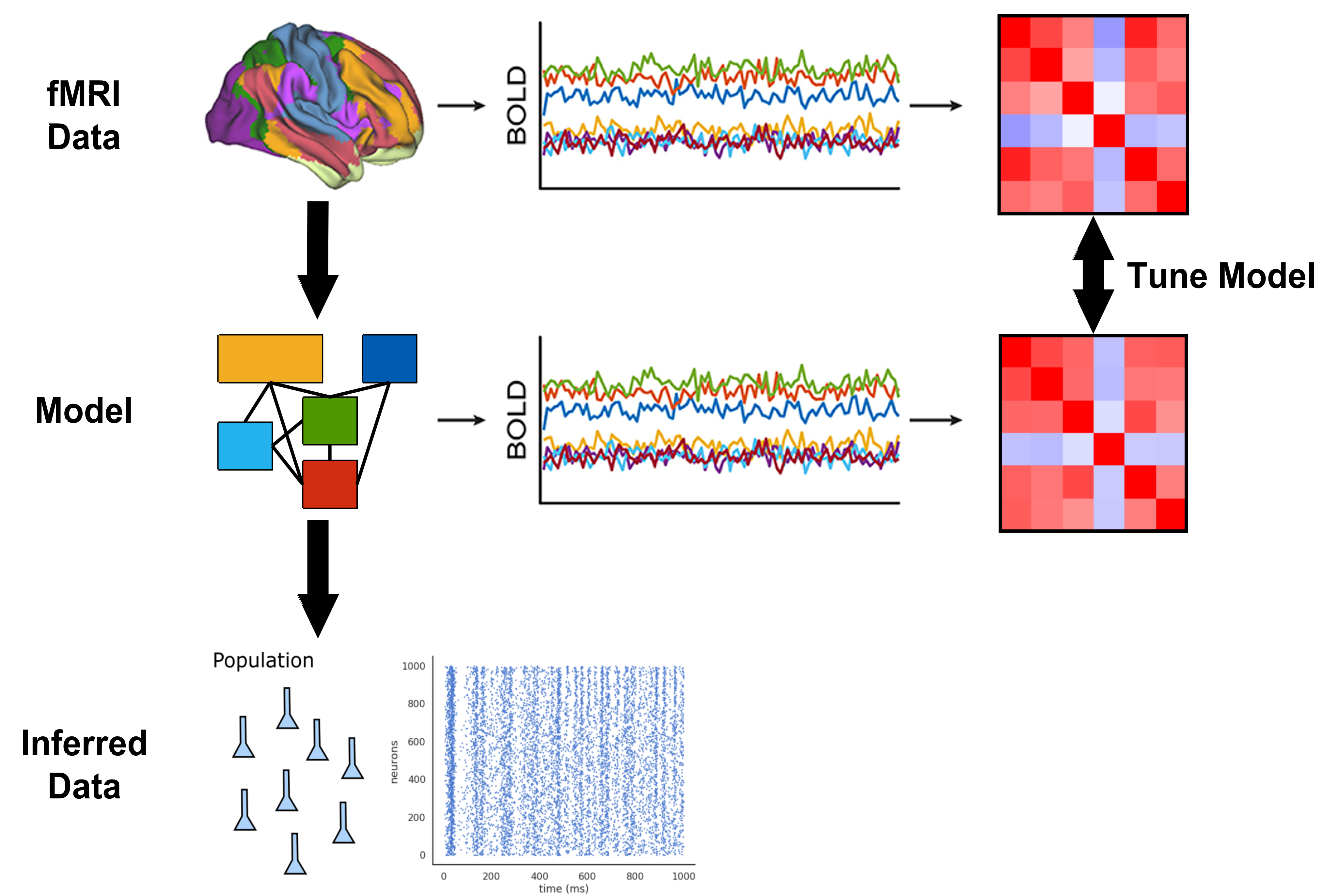
To validate computational models and make meaningful predictions with them, the models must be able to simulate data that can be compared to experimental data. Models that can simulate data on various scales, from detailed membrane processes to brain-wide imaging data, are particularly valuable. In this regard, we recently implemented a BOLD monitor in the neurosimulator ANNarchy, which allows to simulate functional magnetic resonance imaging (fMRI) data, i.e. the so-called Blood-Oxygen-Level-Dependent Signal (BOLD), using ANNarchy models.
BOLD simulation enables model-based analysis of non-invasive experimental fMRI data, allowing to infer underlying neuronal mechanisms. This approach is particularly promising for investigating neural mechanisms in humans, where invasive neurophysiological methods are usually not ethically feasible.
We used this approach to tune our basal ganglia model with patient-specific fMRI data from Parkinson's disease patients and healthy controls. In doing so, we were able to infer spiking activities and connectivity of the underlying simulated nuclei.
Associated projects
DFG Schwerpunktprogramm Clinical Connectomics: A network approach to deep brain stimulation. DFG HA2630/11-2 (2018-2024)
Selected Publications
Maith, O., Dinkelbach, H.U., Baladron, J., Vitay, J., Hamker, F.H. (2022)
BOLD Monitoring in the Neural Simulator ANNarchy
Frontiers in Neuroinformatics, 16. doi:10.3389/fninf.2022.790966
Meier, J.M., Perdikis, D., Blickensdoerfer, A., Stefanovski, L., Liu, Q., Maith, O., Dinkelbach, H.U., Baladron, J., Hamker, F.H., Ritter, P. (2022)
Virtual deep brain stimulation: Multiscale co-simulation of a spiking basal ganglia model and a whole-brain mean-field model with The Virtual Brain
Experimental Neurology, 354:11411. doi:10.1016/j.expneurol.2022.114111
Maith, O., Escudero, F.V., Dinkelbach, H.U., Baladron, J., Horn, A., Irmen, F., Kuehn, A.A., Hamker, F.H. (2021)
A computational model-based analysis of basal ganglia pathway changes in Parkinson's disease inferred from resting-state fMRI
European Journal of Neuroscience, 53(7):2278-2295. doi:10.1111/ejn.14868