Basal ganglia: Function and dysfunction
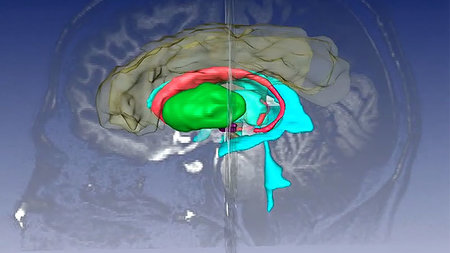
The basal ganglia are a set of nuclei located in the forebrain. Several experiments have associated this brain area to action selection, reinforcement learning and behavioral flexibility.
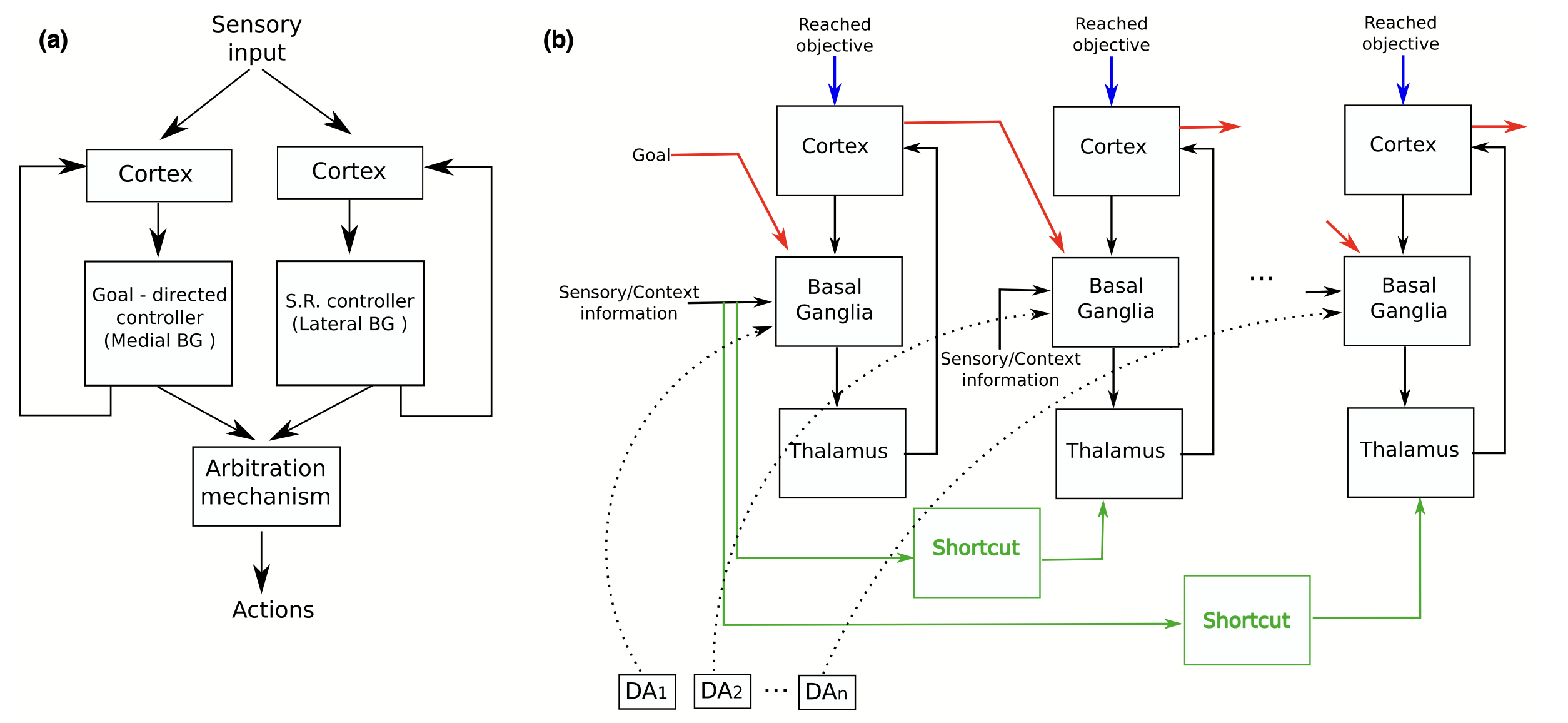
The basal ganglia are composed of several cortico-thalamic loops that start in the cortex and via different pathways converge in the internal globus pallidus, an output structure which projects through the thalamus back to the cortex. Further, the output of the basal ganglia projects to subcortical regions in the brainstem. All loops include either the striatum or the subthalamic nucleus, areas that are considered as input stages of the basal ganglia. In the basal ganglia each loop is composed of typically three different pathways, a direct pathway, an indirect pathway and a hyperdirect pathway.
To allow the simulation of behavioral experiments, we have proposed multiple rate-coded and spiking neuro-computational models containing the main neuronal compartments of the basal ganglia and synaptic plasticity. These models have allowed us to demonstrate various potential functions and mechanisms of the basal ganglia. They are continuously updated with respect to the latest neurophysiological and behavioral findings. Further, we have used these models to provide insights into the basal ganglia dysfunctions underlying Parkinson's disease, Huntington's disease, Tourette's syndrom and dystonia.
Associated projects
DFG Schwerpunktprogramm Clinical Connectomics: A network approach to deep brain stimulation. DFG HA2630/11-2 (2018-2024)
Sonderforschungsbereich „Hybrid Societies„ - Learning Flexible Decision: Making and Motor Control in Robots for Human-Robot Interaction. (SFB 1410) INST 270/321-1
BMBF „CRCNS US-German-Israeli collaboration on computational neuroscience” : Multilevel neurocomputational models of basal ganglia dysfunction in Tourette syndrome. BMBF 01GQ1707 (2018-2021)
DFG Clinical research group : Dopaminerge Einflüsse auf subkortikale Oszillationen beim Belohnungslernen. Teilprojekt 4 der klinischen Forschergruppe „Tiefe Hirnstimulation: Wirkmechanismus, Kortex-Basalganglien-Physiologie und Therapieoptimierung”. Charieté Berlin. DFG HA2630/7-2 (2014-2016).
DFG German-Japanese Collaboration Computational Neuroscience : The function and role of Basal Ganglia Pathways: From single to multiple loops. DFG HA2630/8-1 (2013-2016).
Selected Publications
Scholl, C., Baladron, J., Vitay, J., Hamker, F.H. (2022)
Enhanced habit formation in Tourette patients explained by shortcut modulation in a hierarchical cortico-basal ganglia model
Brain Structure & Function, 227(3):1031-1050. doi:10.1007/s00429-021-02446-x.
Read Article
Maith, O., Schwarz, A., Hamker, F.H. (2021)
Optimal attention tuning in a neuro-computational model of the visual cortex–basal ganglia–prefrontal cortex loop
Neural Networks, 142:534–547. doi:10.1016/j.neunet.2021.07.008.
Read Article
Goenner, L., Maith, O., Koulouri, I., Baladron, J., Hamker, F.H. (2021)
A spiking model of basal ganglia dynamics in stopping behavior supported by arkypallidal neurons
European Journal of Neuroscience, 53(7):2296–2321. doi:10.1111/ejn.15082.
Read Article
Maith, O., Escudero, F.V., Dinkelbach, H.Ü., Baladron, J., Horn, A., Irmen, F., Kühn, A.A., Hamker, F.H. (2021)
A computational model-based analysis of basal ganglia pathway changes in Parkinson's disease inferred from resting-state fMRI
European Journal of Neuroscience, 53(7):2278–2295. doi:10.1111/ejn.14868.
Read Article
Villagrasa, F., Baladron, J., Vitay, J., Schroll, H., Antzoulatos, E. G., Miller, Earl K., Hamker, F.H. (2018)
On the role of cortex-basal ganglia interactions for category learning: A neuro-computational approach
Journal of Neuroscience, 38(44):9551-9562. doi:10.1523/JNEUROSCI.0874-18.2018.
Read Article
Neumann, W.-J., Schroll, H., de Almeida Marcelino, A.L., Horn, A., Ewert, S., Irmen, F., Krause, P., Schneider, G.-H., Hamker, F.H., Kühn, A. (2018)
Functional segregation of basal ganglia pathways in Parkinson's disease
Brain, 141(9):2655-2669. doi:10.1093/brain/awy206.
Read Article
Baladron, J., Nambu, A., Hamker, F.H. (2017)
The subthalamic nucleus - external globus pallidus loop biases exploratory decisions towards known alternatives: A neuro-computational study
European Journal of Neuroscience, 1460-9568. doi:10.1111/ejn.13666.
Read Article
Schroll, H., Hamker, F.H. (2016)
Basal ganglia dysfunctions in movement disorders: What can be learned from computational simulations
Movement Disorders, 31:1591-1601. doi:10.1002/mds.26719.
Read Article
Baladron, J., Hamker, F.H. (2015)
A spiking neural network based on the basal ganglia functional anatomy
Neural Networks, 67:1-13. doi:10.1016/j.neunet.2015.03.002.
PDF-Document
Schroll, H., Vitay, J., Hamker, F.H. (2014)
Dysfunctional and Compensatory Synaptic Plasticity in Parkinson's Disease.
European Journal of Neuroscience, 39:688-702. doi:10.1111/ejn.12434.
PDF-Document