
Hakki-Paoli gain measurements
 Dominic Kunzmann phD Thesis (2025)
The Hakki–Paoli technique is a well-established spectroscopic method for determining the optical gain spectra of semiconductor laser structures. It is based on the analysis of Fabry–Pérot mode modulation in emission spectra recorded below the lasing threshold.
Light propagating within the laser cavity undergoes multiple reflections at the cavity facets, resulting in a characteristic modulation of the emitted spectrum. By evaluating the intensity contrast of adjacent longitudinal modes, the wavelength-dependent modal gain can be extracted with high spectral resolution. This approach enables direct characterization of the optical amplification properties of semiconductor materials and active regions without the need for external optical probing.
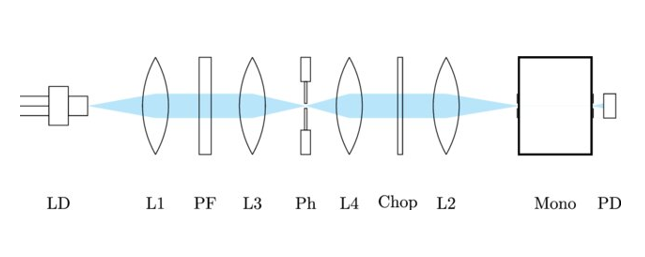
A schematic illustration of the experimental setup is shown in Figure 1. The emitted light is collected using an optical system and analyzed with a high-resolution spectrometer capable of resolving individual longitudinal cavity modes. The recorded spectra are subsequently processed to determine modal gain spectra and characterize the optical properties of semiconductor laser devices.
Due to its high sensitivity, accuracy, and non-destructive nature, the Hakki–Paoli technique has become a standard tool for the characterization and optimization of semiconductor lasers
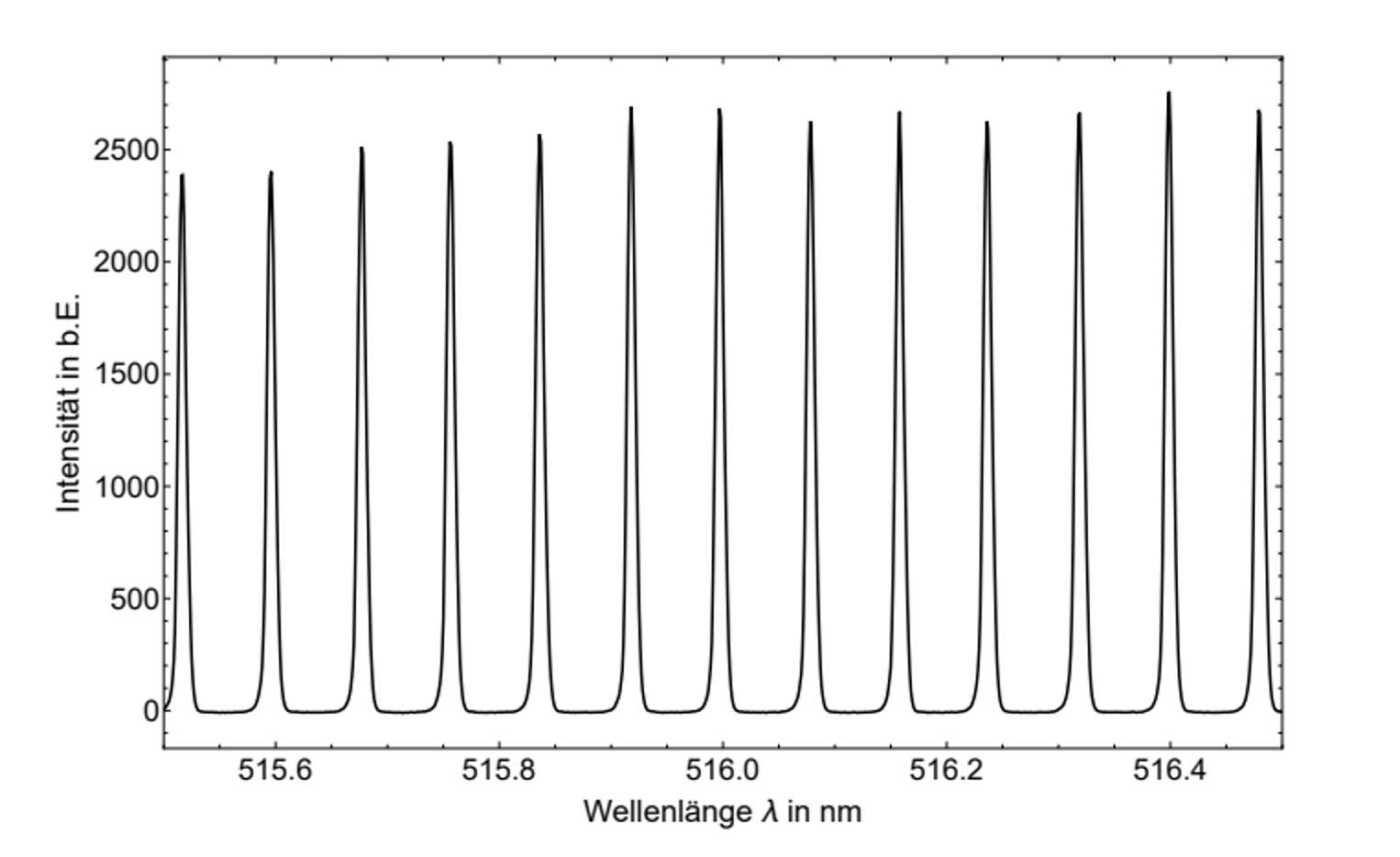
measurement example:
longitudinal modes
latest theses:
D. Kunzmann: Hochauflösende Spektroskopie an (Al,In)GaN Laserdioden, Dissertation (2025)
R. Kohlstedt: Charakterisierung eines gitterstabilisierten Lasers in Littrow-Konfiguration mit einem Fabry-Pérot-Etalon, Masterarbeit (2022)
latest publicationen:
L. Uhlig, et al., IEEE Journal of Selected Topics in Quatum Electronics (2024), "Mode Competition Between Longitudinal and Lateral Modes in III-Nitride Broad-Ridge Laser Diodes"
D. Kunzmann, et al., pss(a) (2024), "High-Resolution Spectroscopy of Blue High-Power Laser Diodes with a Fabry–Pérot Interferometer"