Research Project "Monetary Policy and Energy Prices"
Cooperation project between the Professorship of Macroeconomics and the Vienna Institute for International Economic Studies (wiiw) on the effects of monetary policy and energy prices. The project is funded by the European Macro Policy Network, an international research network led by Dezernat Zukunft.
The project aims to develop well-founded statements, based on the current state of scientific knowledge, on two topical and interrelated economic policy issues: the effect of energy price changes on consumption and the associated CO2 emissions, and the effect of (conventional) monetary policy on growth, prices and employment.
Winner of the SaxFDM Open Data Award 2025
Context
There is an extensive empirical literature on the effects of policy rate changes on macroeconomic variables. The effects found in individual studies vary widely and are partly contradictory. Against this background, the project examines the entirety of the empirical effects of conventional monetary policy shocks on output, prices and employment.
Our meta-study sets new standards for transparency and reproducibility. We document and publish the entire research process, from pre-registration through literature search and data extraction to the final analysis.
In our comprehensive research synthesis, we examine in particular to what extent p-hacking, publication bias as well as different identification methods and other study characteristics of the heterogeneous literature influence the results. Using modern meta-analytic methods, we determine bias-corrected macroeconomic average effects of conventional monetary policy.
In addition to the relevance of our results for central banks and economic policy institutions, our project thus also provides an empirical benchmark for the further development of macroeconomic models.
Research papers:
The overstated effects of conventional monetary policy on output and prices
Enzinger, M., Gechert, S., Heimberger, P., Prante, F. & Romero, D. F. (2025).
OSF Preprint: https://osf.io/preprints/osf/72cen.
Abstract: We build a dataset of output and price effects of conventional monetary policy containing 146,463 point estimates and confidence bands from 4,871 impulse-response functions in 409 primary studies. Simple average responses suggest that interest rate hikes substantially dampen output and prices. However, we find robust evidence for publication bias. Bias corrections reduce effect sizes by half or more: in response to a 100 basis points rate hike, output and prices are unlikely to fall by more than 0.5 and 0.25 percent, respectively. Shock identification choices and publication characteristics correlate with effect sizes but are quantitatively less important than publication bias.
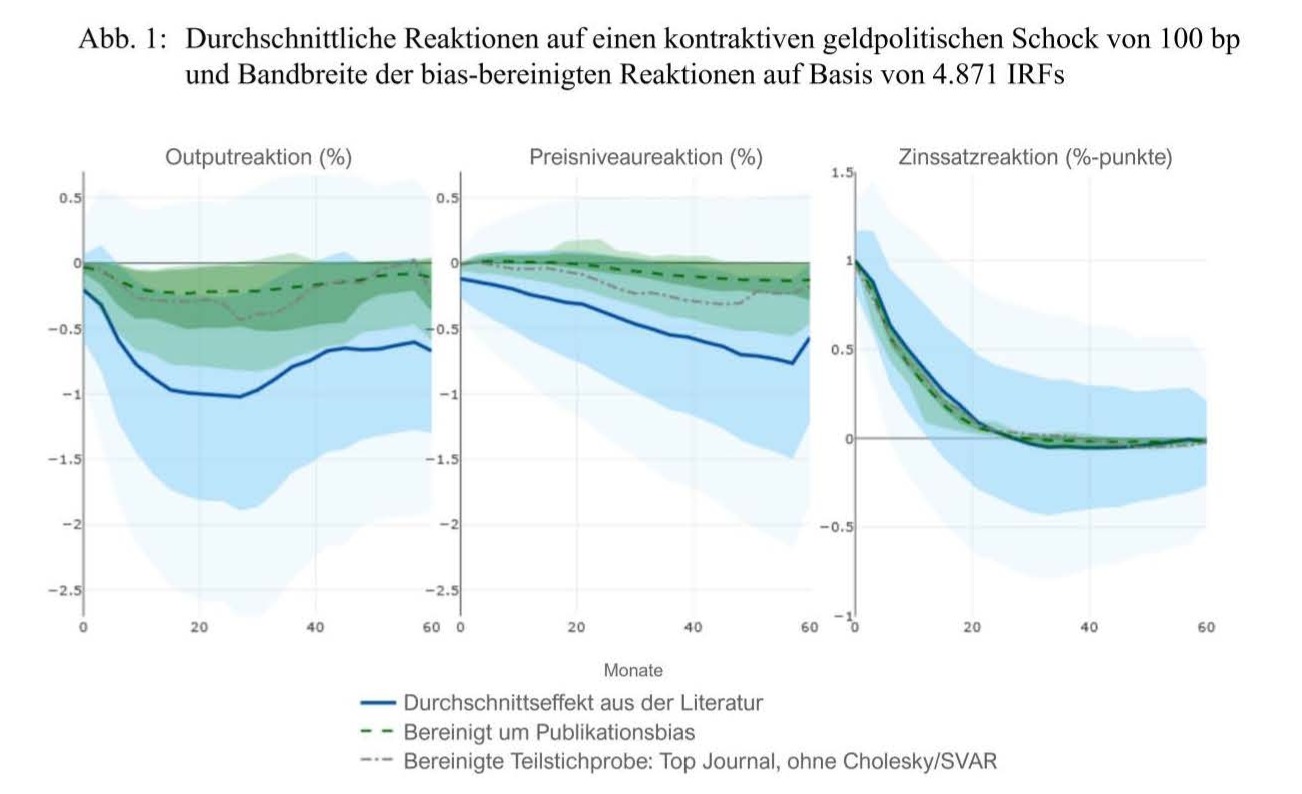
Description: The figure shows the responses of output, the price level and the interest rate to a contractionary interest rate shock of 100 basis points, synthesised from the entire literature. The blue lines show the average paths of these responses, while the blue shaded areas represent the corresponding upper and lower 68% and 95% confidence intervals. In addition, the green area shows the range of bias-corrected estimates, based on the 16-84 and 2.5-97.5 percentile ranges from up to 42 meta-regression estimates. The green areas should be interpreted in relation to the blue average lines and are not directly comparable with the blue confidence intervals. The dark green dashed line marks the average bias-corrected effect path. Source: https://osf.io/preprints/osf/72cen, Figure 1.
Interpretation: The simple average responses (blue lines) point to a clear negative response of output and the price level after a contractionary monetary policy shock. However, we find robust evidence that these results are distorted by p-hacking and publication bias. After bias correction (dark green dashed line), the effects are considerably smaller. Based on the corrected values, it is unlikely that output and prices fall by more than 0.5% and 0.25%, respectively, in response to an interest rate increase of 100 basis points.
Further publications:
Empirical benchmarks for ESCB models: A quantitative assessment of the macroeconomic impact of the 2022-23 monetary policy tightening
Bobasu, A., Ciccarelli, M., Gechert, S. & Prante, F. (2025).
SUERF Policy Note No, 381
Interest rate hikes are less powerful in reducing inflation than conventional wisdom suggests
Enzinger, M., Gechert, S., Heimberger, P., Prante, F. & Romero, D. F. (2025)
SUERF Policy Brief No, 1287
Media coverage
The overstated effects of conventional monetary policy on output and prices
Enzinger, M., Gechert, S., Heimberger, P., Prante, F. & Romero, D. F. (2025).
European Macro Policy Network
Project documents and repositories
- Pre-registration: https://osf.io/cduq4
- Data/replication materials: https://github.com/META-CMP/data
Context
Heating and cooling energy in buildings, including natural gas, liquefied petroleum gas (LPG), coal, heating oil and electricity, accounts for around a quarter of global final energy consumption and about 20% of energy-related CO2 emissions. At the same time, global demand for cooling energy is rising due to higher temperatures and the increasing spread of cooling appliances.
Against this background, the price elasticity of demand for heating and cooling energy is a key parameter for understanding the strength of self-correcting market mechanisms after energy price shocks as well as the steering effects of CO2 prices.
To this end, we conduct a comprehensive meta-analysis of the empirical evidence on the price elasticity of energy demand in buildings. The meta-analysis systematises the widely dispersed estimates of demand elasticities, identifies potentially distorting and influencing factors (e.g. p-hacking, publication bias, data/modelling choices, other study characteristics) and derives bias-corrected statements on the effectiveness of price changes based on a broad data basis.
We are particularly interested in:
- how price-elastic the demand for (various) fossil fuels is and
- which factors systematically influence the price elasticity.
The results indicate that the demand-side effects of price changes are smaller than previously assumed. Further analyses and policy recommendations should therefore take into account a potentially lower demand elasticity.
Research papers:
The Price Elasticity of Heating and Cooling Energy Demand
Gechert, S., Mey, B., Prante, F., & Schäfer, T. (2025).
OSF Preprint: https://osf.io/preprints/osf/4sjy5.
Abstract: We create a large meta-dataset of price elasticities of energy demand for heating and cooling in buildings, comprising close to 5000 price elasticity estimates including study and observation characteristics from more than 400 primary studies. We find robust and strong signs of p-hacking and publication bias with insignificant or positive elasticities being underrepresented. Correcting for this bias, the price elasticities range from -0.05 to -0.2 for the short run and from -0.1 to -0.3 for the long run. This holds for all relevant fossil fuels and electricity, poor and rich countries, residential and business usage, and aggregate and survey data.
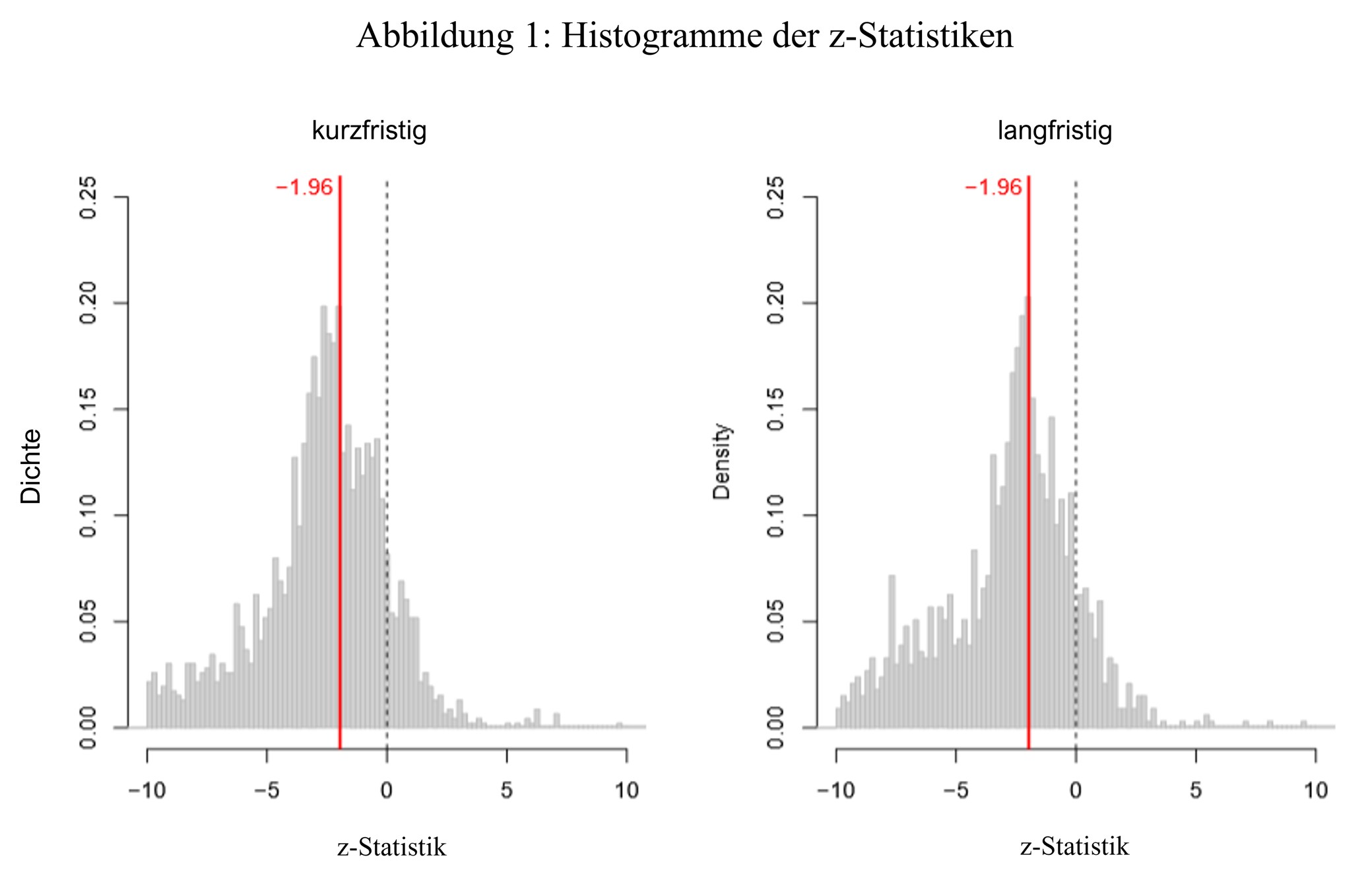
Description: The figure shows histograms of the z-statistics of the short-run (left panel) and long-run (right panel) price elasticities of demand for heating and cooling energy. The vertical red lines mark the conventional statistical significance threshold for negative elasticities at the 5% level (z < −1.96). Source: https://osf.io/preprints/osf/4sjy5, Figure 1.
Interpretation: The histograms reveal two striking discontinuities: first, estimates cluster just to the left of z = 0, suggesting that results with negative elasticities are preferentially reported. Second, values occur more frequently just to the left of the usual 5% significance threshold for negative effects (z < −1.96), which points to p-hacking. This two-stage pattern is more pronounced in the short-run histogram but is also visible in the long-run one.
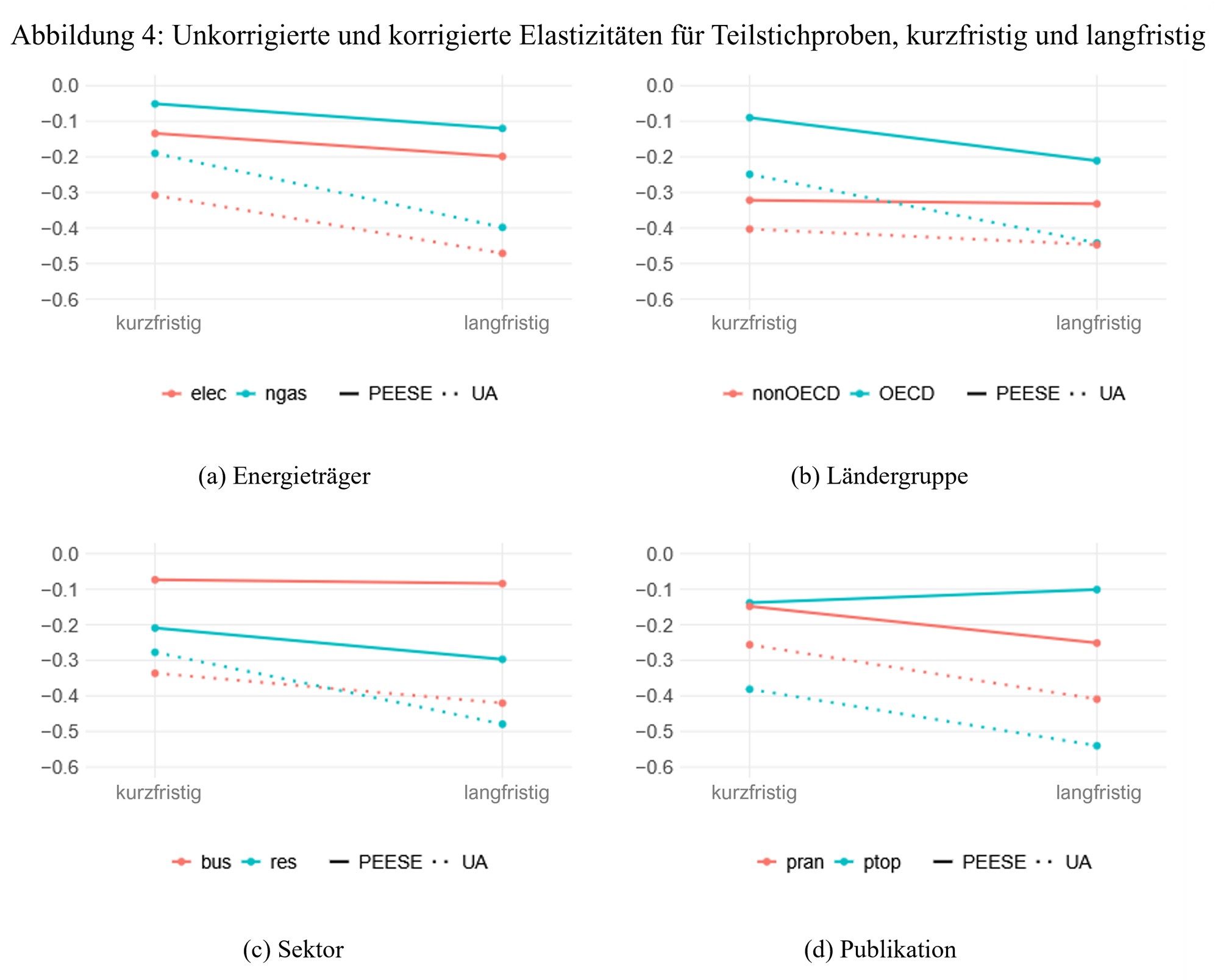
Description: The figures show the unweighted averages (UA, dashed lines) and the effect sizes corrected for publication bias (PEESE method, solid lines) of the short-run and long-run elasticities for key subsamples: energy carrier (electricity and natural gas), country group (non-OECD and OECD), sector (business and households) and publication type (top journals vs. others). Source: https://osf.io/preprints/osf/4sjy5, Figure 4.
Interpretation: Publication bias leads to exaggerated effect sizes in all subgroups. Moreover, the corrected elasticities within the subgroups considered are considerably more homogeneous than the uncorrected values.
Media coverage
Emissionshandel die Zweite: Füße stillhalten!
Henze, L., & Illenseer, N. (2025).
Dezernat Zukunft (German)
Project documents and repositories
- Pre-registration: https://osf.io/zdche
- Data/replication materials: https://github.com/META-Energy/data
In both subprojects, meta-analysis forms the basis of the data evaluation. More details on the application of this tool can be found here. In our project, we proceed as follows:
- Collection of the literature
- Online libraries (e.g. Google Scholar or EconLit)
- previously published studies
- Snowballing
- Title and abstract screening
- Full-text screening
- Extracting data from the studies
- Data analysis
- Publication of the results
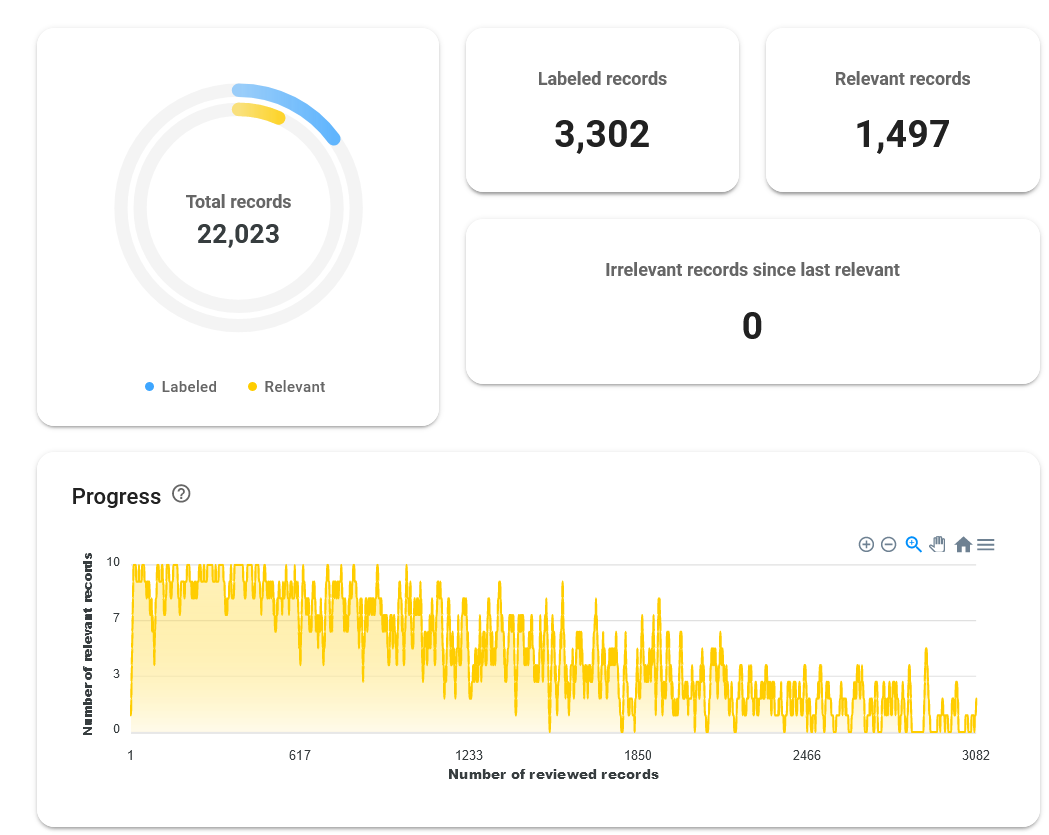
Illustration of the abstract screening process with the open source software ASR-Review
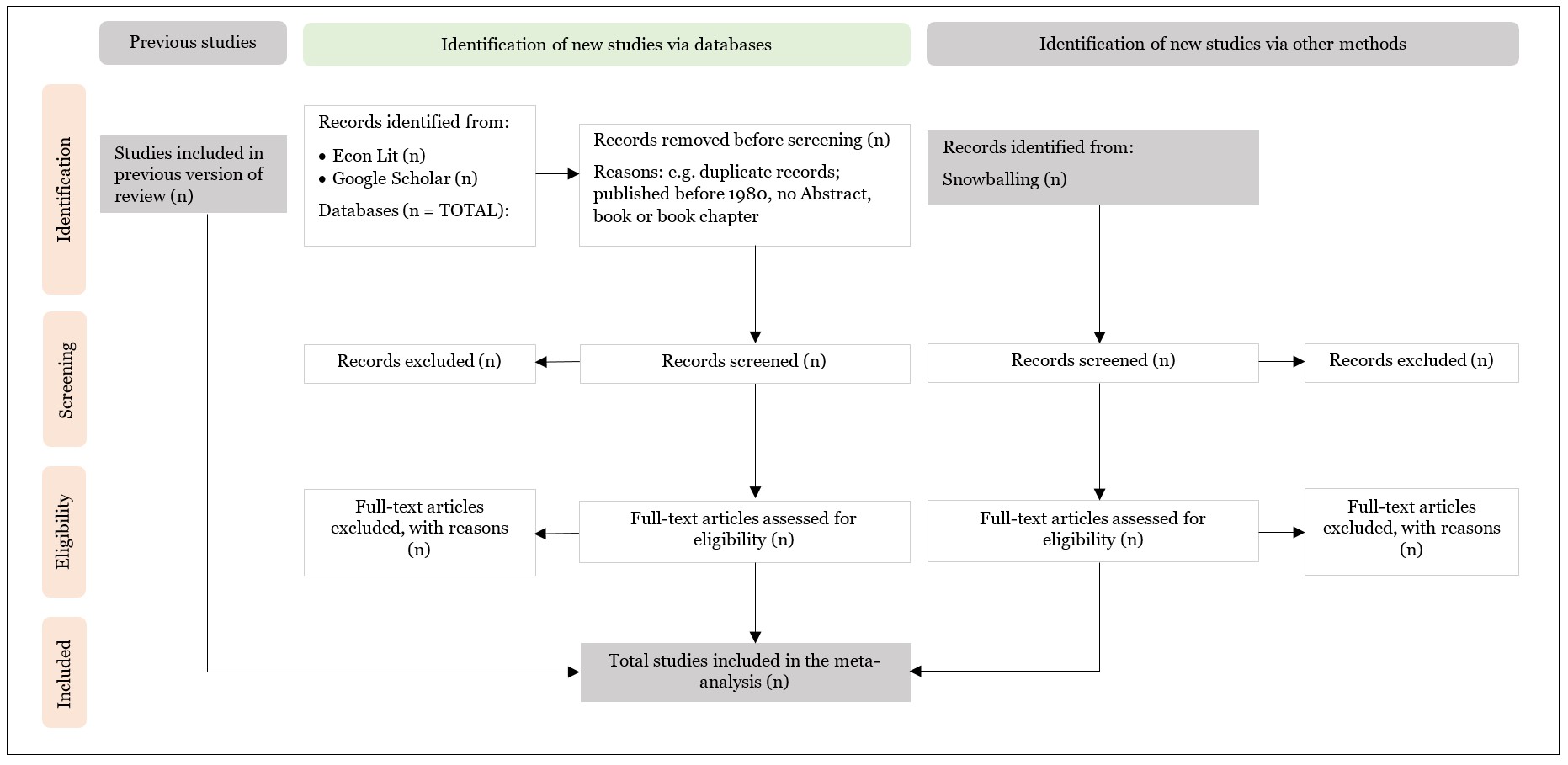
The literature collection process based on the PRISMA flow chart
We want to use our results and findings to
- develop policy recommendations for decision-makers,
- write policy papers or blog posts,
- participate in conferences (academic exchange), and
- make the topics accessible to an interested public
Interested students are always welcome to contribute to the project as part of their thesis.
TUCaktuell: “European Macro Policy Network funds for the first time a research project led by Chemnitz University of Technology on the effects of monetary policy and energy prices” (German)