Gutachter: Prof. Dr. Wolfram Hardt (Technische Universität Chemnitz), Prof. Dr. Martin Grüttmüller (Hochschule für Technik, Wirtschaft und Kultur Leipzig)
Abstract:
Der Vortrag befasst sich mit der Entwicklung und Evaluierung eines individualisierten E-Mentoring-Empfehlungssystems für die Hochschulbildung.
Das Ziel ist es, der zunehmenden Vielfalt der Studierendenpopulationen und der daraus resultierenden Notwendigkeit systematischer, individuell zugeschnittener Unterstützung der Lernprozesse durch die Bereitstellung skalierbarer Lernumgebungen gerecht zu werden.
In solchen Lernumgebungen werden Lehrende im Zuge einer als ideal angesehenen Hochschul-Mentoringbeziehung systematisch dabei unterstützt, Studierende durch die individualisierte Empfehlung relevanter Lernobjekte zu fördern.
Im entwickelten E-Mentoring-Empfehlungssystem wird die systematische Unterstützung durch die Berücksichtigung bildungswissenschaftlicher Theorien wie dem Constructive Alignment und der Nutzung von anerkannten Lernzieltaxonomien ermöglicht.
Die Relevanz von Lernobjekten bezieht sich dabei neben diesen fachlichen Auswahlaspekten auch auf affektive Zustände von Studierenden. Dazu werden im Empfehlungssystem psychophysiologische Daten und daraus abgeleitete Erregungsniveaus verarbeitet.
Kern des Empfehlungssystems ist ein Reinforcement-Learning-Agent, der über die Auswahl relevanter Lernobjekte entscheidet.
Theoretisches Fundament ist die Modellierung als Markov-Entscheidungsprozess, in dessen Zustandsraum die dynamische Entwicklung der Wissensstände der Lernenden, elektrodermale Erregungsniveaus sowie durch Hochschullehrende variabel vorgegebene Lernziele integriert werden.
Der Aktionsraum repräsentiert die Lernobjekte, deren Auswahl durch den Entscheidungsprozess entsprechend der zu erwartenden Relevanz belohnt wird.
Auf Basis dieser Modellierung werden die Parameter eines Reinforcement-Learning-Agenten trainiert, um eine möglichst optimale Strategie zur Auswahl relevanter Lernobjekte zu entwickeln.
Die Arbeit untersucht hierbei sowohl diskrete als auch kontinuierliche Aktionsräume und nutzt mehrere Teilbelohnungsfunktionen, die es Lehrenden gestatten, das Systemverhalten an ihre jeweiligen didaktischen Prioritäten anzupassen.
Empirische Studien mit synthetischen und realen Daten einschließlich eines Datensatzes aus einem Erstsemesterkurs der HTWK Leipzig zeigen, dass der diskrete Aktionsraum durchweg besser abschneidet als der kontinuierliche Ansatz. Das System erreicht insgesamt eine robuste Leistung in der Empfehlung relevanter Lernobjekte, die auf die Kompetenzen der Lernenden und die aktuellen Teillernziele abgestimmt sind.
Die Ergebnisse unterstreichen das Potenzial von adaptiven Systemen in der Hochschulbildung und bilden eine Grundlage für skalierbare, datengesteuerte Interventionen, die darauf abzielen, individuelle Lernverläufe zu verbessern.
Der präsentierte Ansatz zeigt dabei einen konkreten Nutzen, indem Hochschullehrende im täglichen Lehralltag durch die automatisierte Auswahl und Bereitstellung geeigneter Lernobjekte entlastet werden, während Studierende zugleich von einem auf ihre Lernbedürfnisse abgestimmten Lernprozess profitieren.
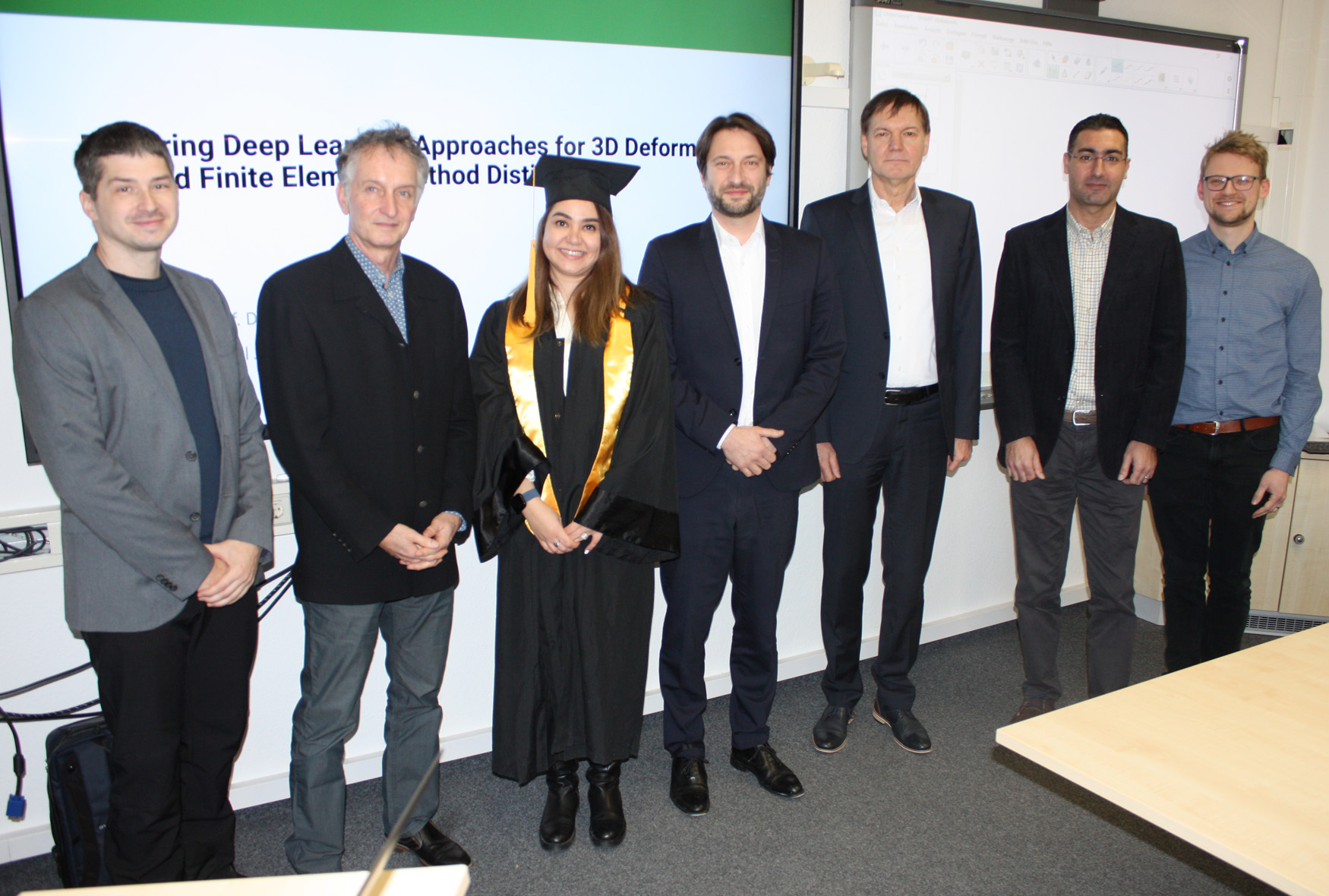
Gutachter: Prof. Dr. Fred Hamker (Technische Universität Chemnitz), Prof. Dr. Alexander Hasse (Technische Universität Chemnitz)
Abstract:
The thesis introduces neural frameworks for modeling 3D deformations with the goal of enhancing the predictive accuracy and computational efficiency of traditional Finite Element Method (FEM) simulations. It explores two complementary approaches: a single-step deformation model that employs implicit neural representations and signed distance fields to approximate FEM-based deformations up to 400× faster than conventional simulations, and a multi-step deformation model that formulates deformation as a sequential decision-making process within a deep reinforcement learning framework. Supported by two custom datasets, DefBeam and DefCube, the study demonstrates that AI-driven methods can effectively complement FEM by accelerating simulations and improving accuracy in applications such as material design, virtual prototyping, and industrial forming.
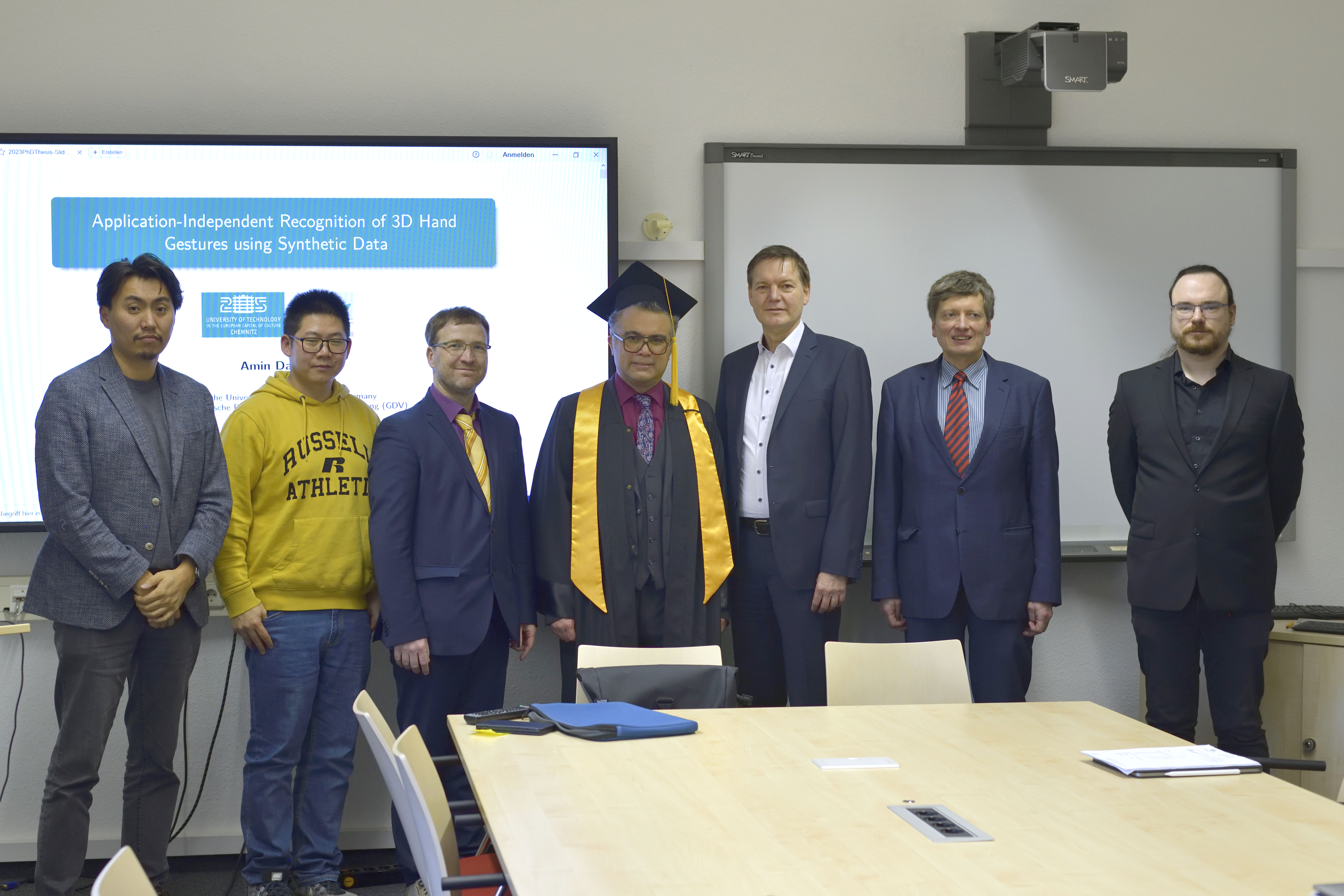
Gutachter: Prof. Dr. Guido Brunnett (Technische Universität Chemnitz), Apl. Prof. Dr. Danny Kowerko (Technische Universität Chemnitz)
Abstract:
This dissertation introduces several novel approaches for an overarching context of vision-based application-independent 3D hand gesture recognition using a single RGB image as input. The focus is to leverage synthetic data and to address key challenges in hand detection, segmentation, pose estimation, and dynamic gesture modeling. It proposes a fully hierarchical, layered-based, and flexible hand data structure with a comprehensive one-dimensional PoseDescriptor grounded in finger kinematics to efficiently represent and formulate diverse postures, reducing high degrees of freedom while enabling classification of diverse hand postures and expensive searches (e.g., exhaustive search for 3D pose estimation). It introduces a comprehensive Markovian system that incorporates evolutionary topological constraints to enrich the model of temporal relationships between postures and to enhance the real-time performance and accuracy of the 3D Pose estimation of fingers and hand movement across varied gestures. Finally, it proposes training methodologies for deep neural networks using simplistic synthetic image generation, exploiting the invariancy concept, and mitigating premature saturation to achieve robust results in real-world scenarios with convolutional networks like YOLO for detection and Mask-RCNN for segmentation. The results of this dissertation represent a selection of the successful research undertaken during the PhD period and also include several ideas that light promising directions for future work in this domain.
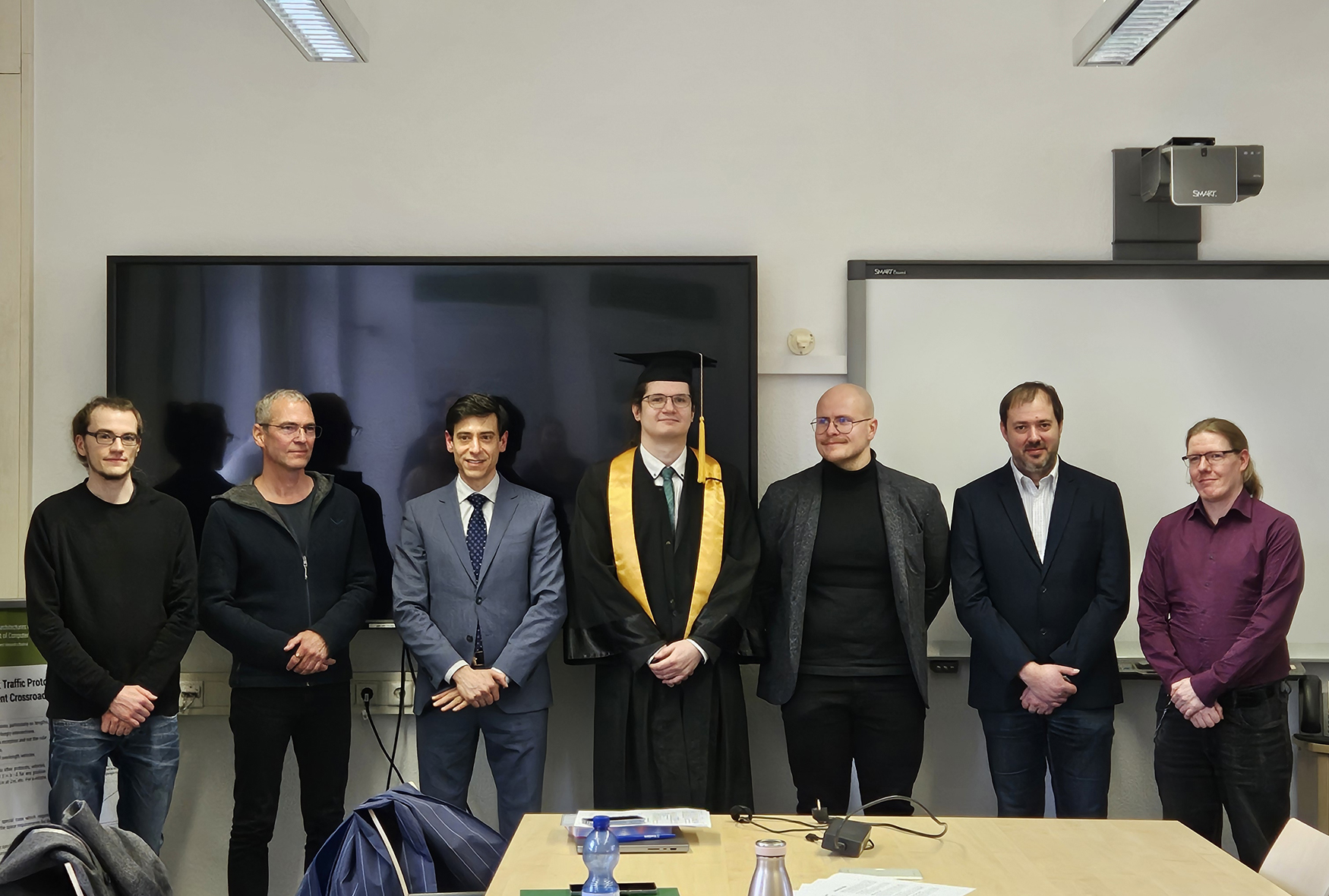
Gutachter: Prof. Dr. Alejandro Masrur (Technische Universität Chemnitz), Jun.-Prof. Dr. Stefan Reitmann (Technische Universität Chemnitz)
Abstract:
Summary of Findings
Confining strategies for intelligent intersections to a specific type of traffic or infrastructure greatly restricts their applicability in the real world. To alleviate this, this thesis proposes several techniques with the goal of bridging these gaps and making these protocols applicable to a wider range of settings. Specifically, this thesis proposed a probabilistic modeling of communication reliability to reduce deterministic pessimism, as well as three traffic protocols: i) SV-LTR to increase space efficiency, ii) PB-LTR to apply the concept of platooning to intelligent intersections and iii) FleXS-TP to increase flexibility towards traffic composition.
Reducing Deterministic
Pessimism Ensuring communication reliability between vehicles and the corresponding road side unit (RSU) requires knowledge of the maximum number of vehicles in the system to assess interference. By using a realistic, probabilistic vehicle length distribution instead of assuming langest possible vehicle allows for a reduction in deterministic pessimism and the following overdesign by using stepwise, probabilistic warst cases.
lnfrastructure-Agnostic
Design Treating extraordinarily large vehicles as exception instead of the norm leads to an uncoupling of the traffic protocols sector size S from the actual traffic, as introduced in the space-efficient traffic protocol SV-LTR and also used later in PB-LTR and FleXS-TP. Instead, the existing infrastructure now provides the sector size S, allowing for infrastructure-agnostic design where the traffic protocol can be applied to any given infrastructure with the existing geometry parameterizing the protocol, alleviating the need for great modifications of existing intersections, while providing competitive or even greater throughput.
Platooning for Well-Behaved Traffic
The traffic protocol PB-LTR extends SV-LTR's single-vehicle maneuvers to platoons consecutively performing the same maneuver, enabling shorter inter-vehicle distances and reducing downtime from maneuver transitions. To ensure all vehicles eventually cross the intersection, a maximum blocking time regularly enforces maneuver changes, guaranteeing fairness across all directions. Under well-behaved traffic, PB-LTR can further increase throughput.
Increasing Flexibility towards Traffic Composition
By maintaining a synchronous strategy at heart, but scheduling vehicles on a vehicle-by-vehicle basis while still allowing for situational synchronicity, the traffic protocol FleXS-TP can harness both the benefits of synchronous traffic protocols for well-behaved traffic, as well as the flexibility of asynchronous traffic protocols under randomized traffic, achieving substantial throughput in both settings - combining the best of asynchronous and synchronous strategies.