
ARCHIVE
November 2023 - Dezember 2024
In everyday encounters with important places and landmarks in a
modern city like Chemnitz, their historical and cultural
significance often remains hidden. Historically meaningful
artifacts and sites are no longer visible after destruction and
reconstruction, no longer exist or have been removed from their
original context.
ARCHIVE is the akronym for Augmented Reality in Chemnitz for
Historical, Inclusive, and Virtual Experiences. The aim of this
project is to create a platform that makes historical content both
accessible and easy to understand using augmented reality (AR). In
the medium term, the platform will form the basis for the
development of new, interdisciplinary teaching formats and for
research into accessibility for people with visual impairments.

© Shane Aldendorff
Local Publics and Social Conflicts around AI Security Technologies (LoKI)
Philipp Knopp
02/2025 – 02/2026
Local civil societies are increasingly faced with the emergence of AI security systems. Against this background, the participatory project LoKI focuses on the negotiations in public spaces in which AI systems are used. Studying the case of an AI-based police CCTV system at Hansaplatz in Hamburg (Germany), the project develops resources that will support local civil societies to stipulate an informed engagement with AI technologies their opportunities and risks. The project examines (1) socio-technical surveillance practices and their effects in the specific context, (2) how relationships between socio-spatially anchored groups and state actors change with the use of AI and (3) how local disputes about AI technologies change their implementation (feedback processes). LoKI is a cooperation of the Department of Media Studies at the TU Chemnitz and the Department of Criminological Social Research at the University of Hamburg. The project is funded by the Mercator Stiftung.
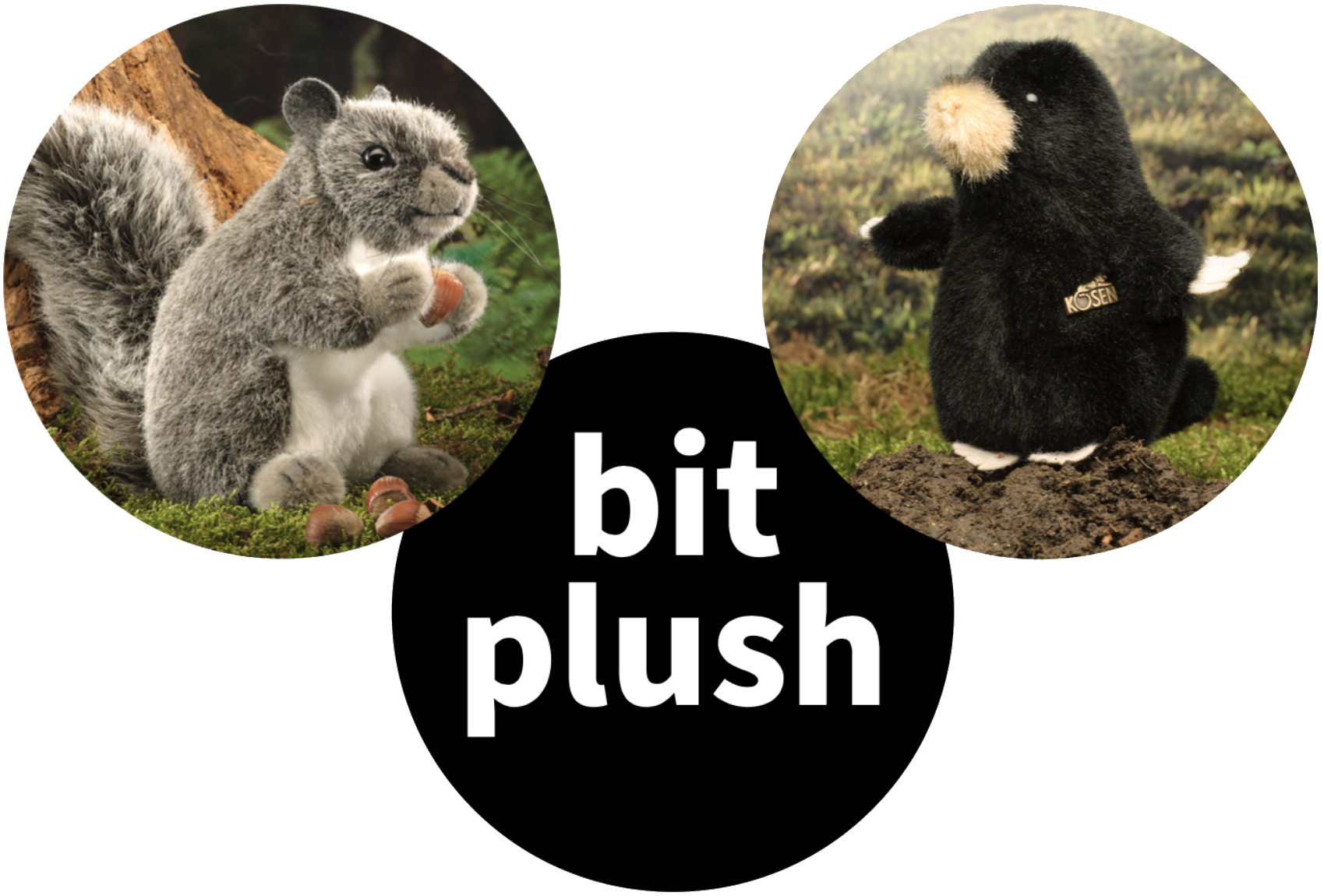
bitplush
June 2023 - June 2026
Haptically and aesthetically sophisticated smart soft toys that enable spatially separated family members to interact implicitly and imaginatively to express nuanced and multimodal interpersonal connectedness are a suitable use case for proximity over distance. The interdisciplinary network of Anhalt University of Applied Sciences, Chemnitz University of Technology, TITV Greiz - Institute for Special Textiles and Flexible Materials, Kösener Spielzeugmanufaktur is researching this design space with the aim of opening up and making available the technical, social and design facets of multimodal and low-threshold interaction for individual soft toys. At the core of the socio-technical innovation are multimodal and low-threshold communication channels that offer a data-saving alternative to surveillance technology, supplementing emotional bonds between separated family members with multimodal and implicit forms of expression without replacing other forms of social interaction. The network links Germany's rich craft tradition of producing soft toys with the technology field of smart textiles, multimodal interactions and the Internet of Things. In addition to these craft, technical, informatics and design competences, there are also competences in the sound psychological investigation of the effect and cause of proximity over distance. Our network integrates specific expertise from the Central German region.
Technisierung von Wissen
25.-26. January 2024
A conference of the Section for the Sociology of Knowledge. The
"certainty" that things "are real and have determinable
properties" (Berger/Luckmann), in short: knowledge, is a social
and communicative production that shapes the historical form of
social institutions and worlds of meaning. In addition to language
and material objectifications, artefacts of the digitalized world
are increasingly essential for the historical transmission of
knowledge, but also for the subjective and meaningful
appropriation and modification of such certainties. At the latest
at the moment when automated machine systems, platform
technologies, synthetic interaction situations, knowledge graphs,
global mediascapes, artificial intelligence systems and the like
become relevant in everyday practice, the question arises as to
what part processes of mechanization play in the social
processing, change and production of reality. The conference
explores the question of how and with which concepts current
experiences of technologized social reality(ies) and processes of
the technologization of knowledge can be described, understood and
explained in terms of their genesis, preconditions and
consequences.
official
website


When will XR (finally) become as common as smartphones? Recent years have brought significant technological AR and VR progress as well as significant industry investments in platforms, devices, and applications. Still, this technological progress and widespread availability are yet to be met with individual and societal acceptance and adoption. XR4all has been a full day event on the puzzle of fast progress and slower adoption – bringing together stakeholders from academia, industry, arts, and grassroots associations to discuss and understand user needs and potential barriers to public acceptance. The focus of this event was to bring XR to individuals and society.

Limits of Understanding Socio-technical Constellations. Desiderata of Transdisciplinary Collaboration
Workshop
27/28.03.2025
The workshop aims to foster trans- or interdisciplinary
understanding between the humanities and technology-oriented
disciplines in order to identify common research desiderata.
Against the background of the current technicalization of
knowledge in many areas of everyday life, we want to discuss
socio-technical phenomena and case studies in which the social
sciences and humanities come up against the limits of
understanding technological systems and, conversely,
technology-oriented disciplines come up against the limits of
understanding social forms, processes and relevancies. Our
discussion will be based on short problem-oriented inputs (15-20
minutes), which ideally also illustrate a respective
socio-technical research subject or a respective socio-technical
problem using material examples. The workshop is part of our
research cooperation “Tec:kno - Technisierung von Wissen”.
Moderators: Lewis Chuang, Michael Müller, Organization: Anne Sonnenmoser

Hermeneutics of Digital Images
Summer School Qualitative Religious Studies,
5./6. September 2024
The workshop is aimed at theologians who deal with the significance of digital image technologies in the world of religious communication and faith. It will provide an opportunity to discuss general aspects of image theory as well as questions of methodology and research design. Participants study current digital image phenomena and practice analyzing large image data corpora. The aim is to develop confidence in dealing with image data and in drafting research designs.
Exploring Computational Ontologies
Workshop-Series
started December 2023
We encounter technologies not only mediated and guided by people, but also as knowledge reified in machines, interfaces or tools. It is entirely possible to use or operate such devices without knowing or mastering the forms of knowledge on which they are based. Digital technologies in particular largely conceal the forms of knowledge underlying their modes of operation and usually present themselves to their users in the form of 'intuitive' interfaces and smart designs. In the workshop series led by Dr. Anne Sonnenmoser, together with AI experts, we will address the genesis and structure of computational ontologies and thus an essential element of the computer-related and expert-led constitution of knowledge orders of the Semantic Web, which is largely invisible in everyday practice. The first workshop was led by Dr. Anne Sonnenmoser on December 15, 2023.
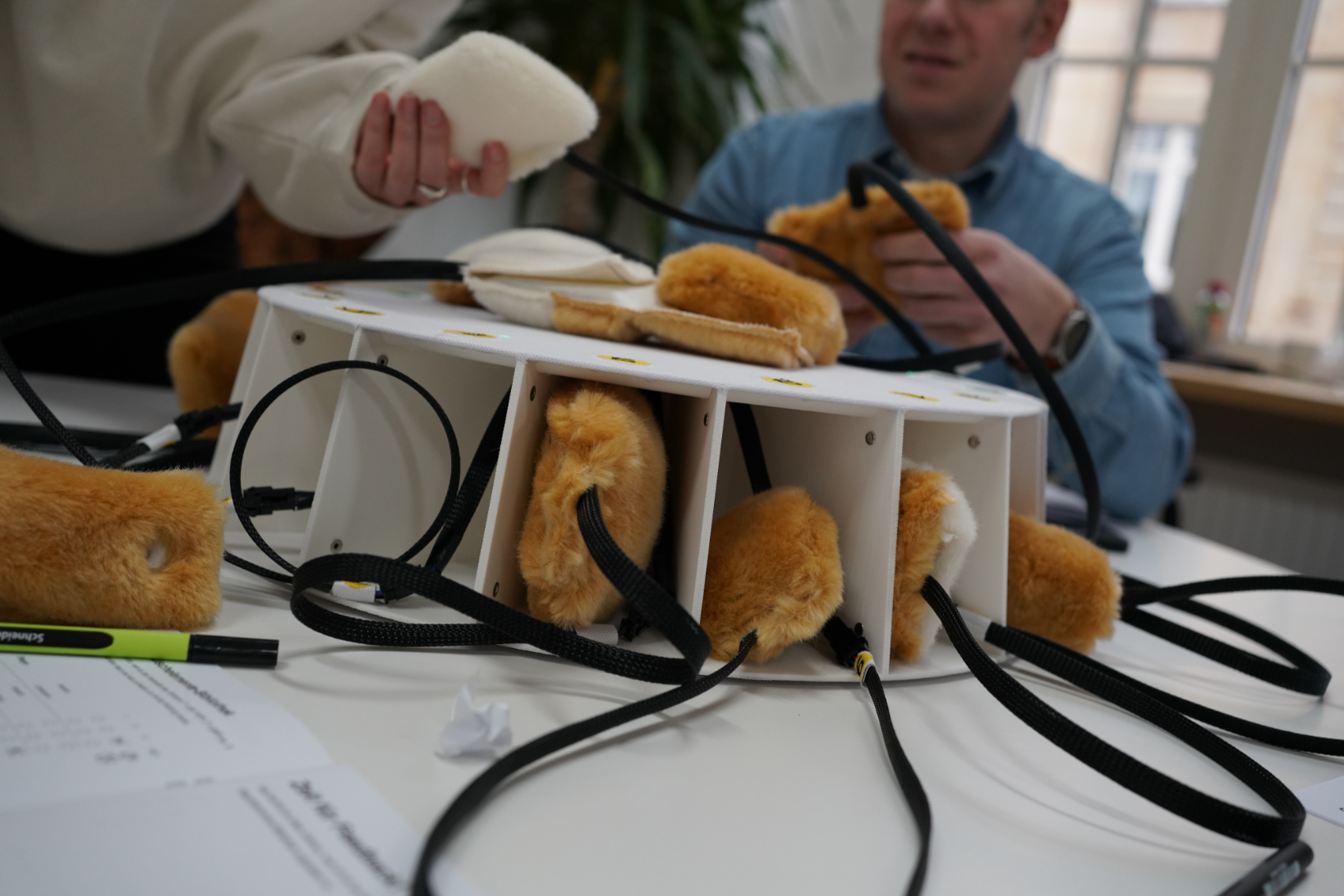
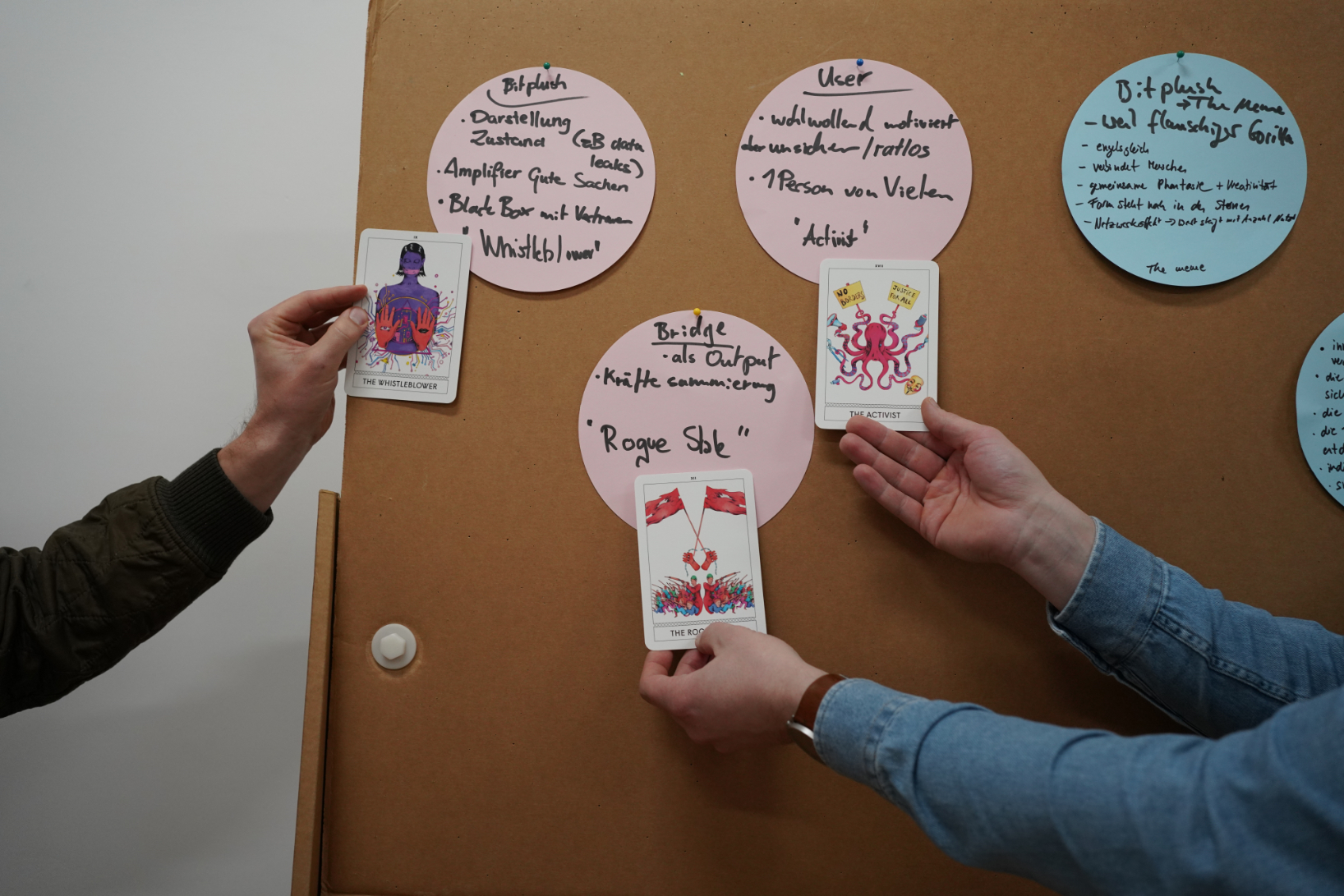


The bitplush workshop was a milestone in the project at the end of
the year. Here, the plush library was put through its paces, the
use of various sensors and actuators was examined, visions for the
coming year were spun at the Instant Archetype Tarot Reading and
we examined potential conference contributions. The plush version
of our popular Loaded Dice was also presented, and of course there
was a lot of cuddling with samples from our partner the Bad
Kösener Spielzeugmanufaktur.
official website

Bridging Realities
29. November 2023
We inhabit a physical environment governed by the rules of nature, e.g. gravity, friction, time etc. Advances in digital technology allows us to experience virtual environments that are "free" of such constraints. Should these two worlds - physical and virtual - be so clearly detached from one another? In this tutorial we introduced participants to a bidirectional Input-Output pipeline, based on open-source software and hardware, to enable them create intuitive interfaces between the two worlds.

Symposium „Künstliche Intelligenz und qualitative Forschung“
with Kai Dröge, Michael Müller, Stefan Rädiker, Hella von Unger,
Moderation: Günther Mey
Berliner Methodentreffen (BMT) 2024
27. July 2024
Despite all the skepticism and debate about limitations and
dangers, current discussions in the field of qualitative research
deal less with whether AI technologies can be used at all and more
with the “how”. There do exist proposals on how AI can be used as
an element in data interpretation, evaluation software integrates
functions and there are attempts to use AI as a co-interpreter in
research workshops/groups. This gives the impression of an
infinite wealth of possibilities. However, there are also initial
sobering experiences from research practice that show that the
development of useful application scenarios for AI in qualitative
research is still in its infancy. Against this background, the
symposium will comment on the developments and discuss the
challenges, whereby the focus is not limited to AI in data
analysis, but includes all other phases of research: from
researching the current state of research, formulating the
research question and developing “instruments” (guidelines etc.)
to the presentation of research results (including visual
animations). Aspects of research ethics and questions of “good
scientific practice” in general are also examined.

"Technisierung von Wissen – Eingriffe in die Gewissheitsquellen alltäglichen Handelns“
Lecture by Michael R. Müller
5. July 2024
“Technicalization of knowledge – Interventions in the
sources of
certainty of everyday action”: Sociology of knowledge does not use
the concept of knowledge to address epistemological problems. Its
subject are the pragmatic and social-communicative sources of
certainty on which our actions are based, as well as the
problematic nature of these sources of certainty and, not least,
their social processing and transformation. In this sense, it is
necessary to describe the extent to which the sources of certainty
of everyday actions change not only in the context of religious or
political processes, but also in the context of the development
and use of complex digital technologies.
Tagung:
Die Zukunft der Tradition

Sieh dir die Maschinen an!
Bildentwürfe des Menschlichen und Sozialen im Technologiedesign
Lecture,
26. June 2024
As part of the exhibition „Sieh dir die Menschen an! Das neusachliche Typenporträt im Kontext der Weimarer Zeit“, the Gunzenhauser Museum, the Kunstsammlungen Chemnitz and Chemnitz University of Technology are organizing a lecture series on the subject of "Measurement, Normalization, Classification". In our lecture, we will look at concepts of ‘the human’ and ‘the social’ in technological design. We will trace the paths and aberrations of anthropomorphism and discuss current developments towards a sociomorphic technology design.


The German Summer School for Human Factors 2023 had the theme
“Technology for Good”. All contributions consider how their
research could serve the “greater good” of individuals and
society.
The event was organized for postgraduate students
(Masters & PhD) and postdoctoral researchers interested in how
humans perceive, reason and feel about, and behave with technical
systems. The objective of the Summer School for Human Factors was
to offer a space for early-career researchers (ECRs) to connect
with one another and to help each other with planning,
interpreting, and handling problems encountered during one’s early
scientific career. Beside the support from other ECRs, the summer
school has been attended by invited late-career researchers to
provide constructive scientific and career feedback This was a
free event for all members of the
DGPs
(and affiliates).
official
website
FQS Special Issue "Digital Images and Visual Artifacts in Everyday Life: Changing Media— Changing Uses—Changing Methods"
Call for Papers
20 July 2023
The spread of digital media has brought about new everyday uses of
images and other visual artifacts and is
significantly changing social life and social communication.
Consequently, face-to-face relationships are
medialized, and bodily references are transformed, not least in
technical interfaces such as interaction
with robots. In digital and especially social media, photographs
become a means of expression of personal
self-presentation and social self-location. Videos are not only
presented to document experiences and events
but, in their use on portals such as YouTube or TikTok, also prove
to be a way of participating in public
discourses against the background of visual media. All this has
consequences for the theoretical
understanding of the interplay of communication, interaction and
action. The challenge of developing
adequate concepts in view of new social realities is accompanied
by the methodological challenge of
designing appropriate social science analyses of these constantly
changing and newly emerging phenomena.
www.qualitative-research.net
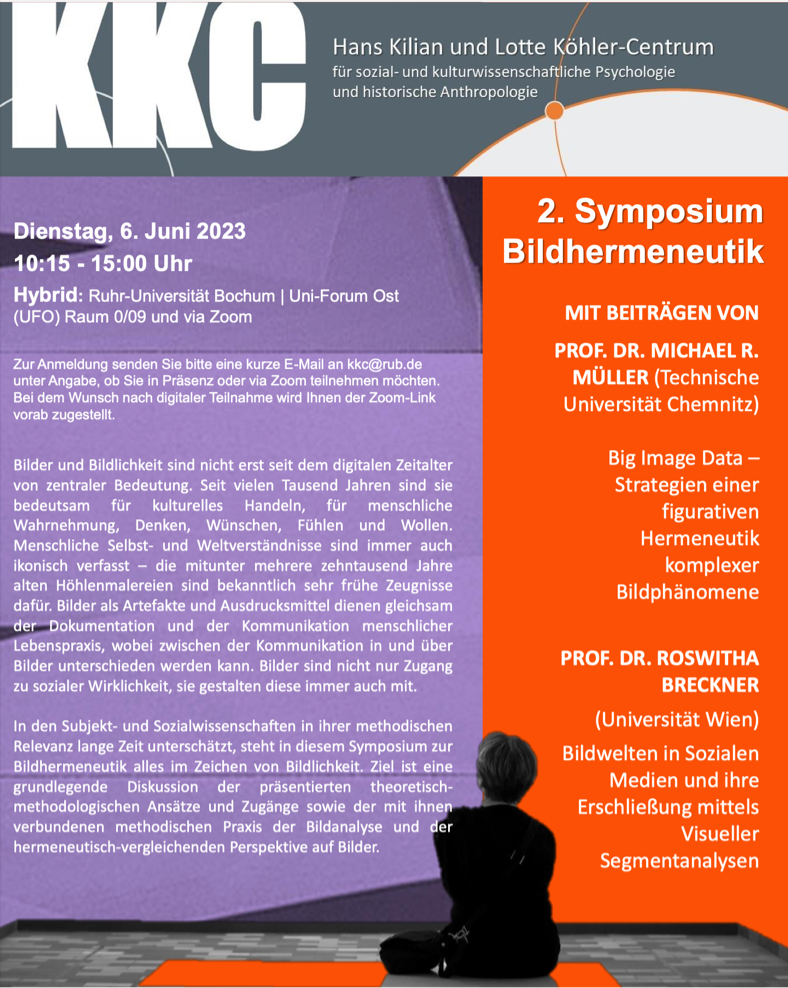
Big Image Data
2. KKC-Symposium Bildhermeneutik,
6. June 2023
The methodology of figurative hermeneutics is highly applicable to the analysis of large digital image data. As part of the KKC symposium, the participants discussed the challenges and potential of a hermeneutics of technologized forms of communication with images.


Embodied digital technologies (EDTs) are increasingly prevalent,
even in public spaces. We encounter non-human agents that serve as
teleconference avatars, delivery drones, and even in our own
households, vacuum cleaners that can find their way around. How do
they sense the environment? How do they "know" what to do and how
to carry out these plans? More importantly, how can their behavior
be designed that they are not merely automated behavior with
physical bodies but co-agents in shared environments, whose agency
we accept as we go about our daily business.
The goal of this one-day hackathon was to help better understand
how EDTs function and to co-create the culture of tomorrow's
hybrid societies.
official
website

Open day Humans & Technology
3. February 2023
Technology is developed by people for people and is used by
individuals for their own goals, for cooperating in organizations
for common goals and the goals of others, for communication, as an
instrument of discovery, and for technically mediated access to
the world. Technology is a cultural achievement that has human
society as a prerequisite while having an impact on human
societies and changing the world as a living space. The area of
Humans and Technology is one of three Core Competencies of the
Chemnitz University of Technology and the one in which the Faculty
of Humanities plays a key role.
This was a one-day retreat to demonstrate the potential of good
collaboration and develop new research strategies, hosted by the
eponymous professorship of Humans and Technology in the Virtual
Environment Learning Lab.

© Sabrina Tietz, TU Chemnitz
Social Displays
2020 - 2024
Social Displays. On the Accountability of Embodied Digital
Technologies in Everyday Life (SFB 1410 “Hybrid Societies”, DFG)
Within this project we investigate the communicative integration
of embodied digital technologies (EDTs) such as driverless cars or
artificial companions into the social world’s routines of action
and cooperation. Our micro-sociological hypothesis is that a
reliable cooperation of humans and EDTs, in which EDTs have to
decide and act autonomously to some degree, presumes the human
cooperation partners to be informed clearly about the EDTs’
alignment in the situation and the EDTs’ overall accountability.
We therefore analyze different anthropomorphic, zoomorphic,
fictional, and purely functional displays used in the development
of EDTs. The project systematically asks about the
(meta-)communicative constitution of accountability seeking to
reconstruct different social types and taxonomies of (non-human)
accountable others.