

The Loaded Dice Travel Pack is part of the interdisciplinary research project Miteinander at Chemnitz University of Technology, Germany and the professorship Human Computer Interaction at HS Anhalt. Miteinander creates places, tools, and methods for people to have a say in designing future smart technology in the context of the home.The team of Miteinander past and present are Albrecht Kurze, Leonie Witte, Andreas Bischof, Sören Totzauer, Michael Storz, Teresa Denefleh, Fan Zhang, Verena Traubinger, Mira Freiermuth, Kevin Lefeuvre and Arne Berger. We are deeply thankful for the magnitude of support we received from Maximilian Eibl, Will Odom, Alessandro Soro, Aloha Ambe, Margot Brereton, Alexandra Deschamps-Sonsino, Dries DeRoeck, and Julia Weller. If you write about this probe study, please use the hashtag #LoadedDiceGo
About
The Loaded Dice Travel Pack is a probe study aimed at expanding the scope of our bespoke Internet of Things Toolkit Loaded Dice for co-design on ‘the home’ and beyond. We distribute a small batch of Loaded Dice with fellow designers-researchers to 1) inquire, how other designers-researchers employ this ambiguous toolkit; 2) to gather a broad and culturally diverse range of research on ‚smart home‘; and 3) to enable designers-researchers using the probe to connect to each other through the probe.
Mission
Getting Started
Frequently Asked Questions
Using the Loaded Dice Travel Pack
What is this Travel Pack? The Loaded Dice Travel Pack is a design research project, aimed at connecting international designer‑researchers in the context of Internet of Things / Smart Objects / Future Technology through exploring, using, and appropriating, Loaded Dice Internet Of Things Toolkit. The Travel Pack contains one pair of Loaded Dice, and also six different inspirational tasks in the tradition of cultural probes.
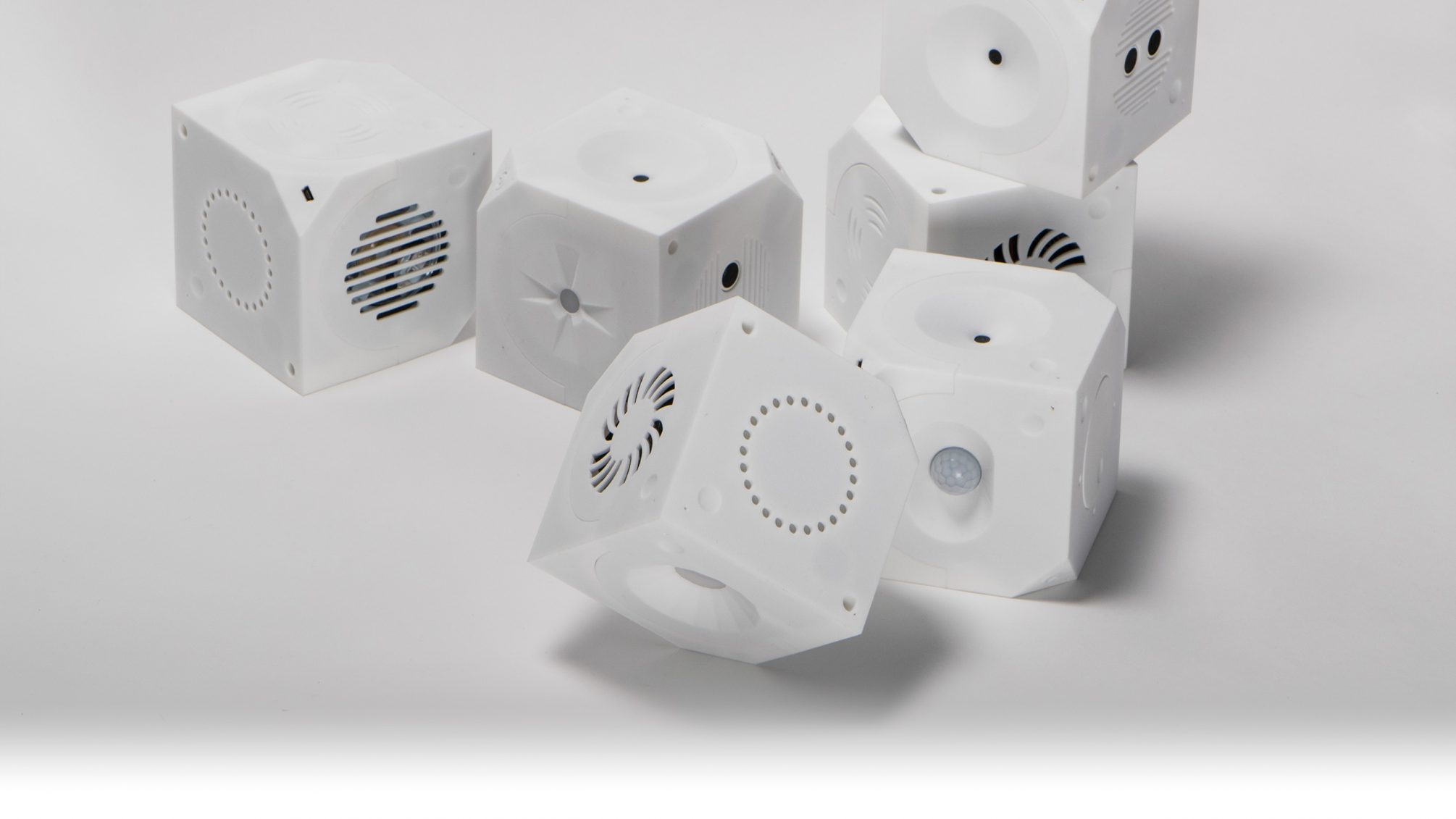
What is Loaded Dice? Loaded Dice are two wirelessly connected cube‑shaped devices that inherit the main interaction properties of the IoT through sensors and actuators. The first is a sensor cube with a different sensor on each of its six sides, while the second is an actuator cube with a different actuator on each of its six sides. Both devices interact with each other: the face of the sensor cube that shows upwards will sense and communicate the accrued sensor data to the face of the actuator cube that is showing upwards. The ability to re‑configure a sensor–actuator pairing with the simple turn of a cube allows for a tangible exploration of sensor and actor couplings and immediate prototyping of scenarios with sensory qualities.
General Advice We have taken all known measures to prevent accidents from happening when using Loaded Dice. However, both cubes contain rechargeable Lithium‑Ion batteries. Lithium‑Ion batteries are potentially hazardous and can present a serious fire hazard if damaged, defective or improperly used. By using Loaded Dice you are accepting full responsibility for proper battery care and usage. Please make yourself familiar with the risks of Lithium‑Ion batteries. Also, take special care in using the thermosurface, because there is a chance of accidentally burning humans or things. Take special care to not switch on the thermosurface by accident. We do not take any responsibility for the potential danger arising from these circumstances and ask you to immediately return the probe to us if you do not consent.
Dealing and Handling
Keep Loaded Dice clean and dry! Loaded Dice exhibit a slightly rough and non‑slippery surface which is porous and easy to soil. Before handling Loaded Dice, please clean your hands and the surface on which you plan to use Loaded Dice. Keep them away from snacks, chocolate and liquids. Please pay attention to our tips on cleaning and maintenance.
Avoid mechanical stress – Loaded Dice are fragile. Please avoid any stress like dropping or severely shaking them. Our Loaded Dice are not made to be rolled. Mechanical stress can damage Loaded Dice exterior and fragile interior.
Avoid severe thermal stress! Severe thermal stress may damage the surface material, casing, the built‑in Lithium‑Ion battery or the integrated electronics. Do not heat, freeze or expose Loaded Dice to sunlight or strong light sources for longer periods of time! Please also avoid exposure to fast‑changing temperatures, as this may lead to condensation and therefore water damage to the interior.
What to do if Loaded Dice got dirty or wet? Loaded Dice are made of Polyamide (PA12/PA2200). Depending on the kind of pollution choose an appropriate cleaning agent, e.g. water, mild detergent solution, cleaning alcohol, etc. Use a soft cleaning cloth with the cleaning agent and dab it on Loaded Dice to avoid smearing. After cleaning, let Loaded Dice dry before using them again. Do not use inappropriate chemicals for cleaning, as this may damage the material. Refer to the data sheet for more information.
Technical Details
On which frequency do Loaded Dice operate? Loaded Dice use the licence‑free 2.4 GHz ISM band.
How far can Loaded Dice be placed apart? The range is the usual ZigBee range of about 20 m free range. Depending on the construction of rooms, the communication may range from one room to the next. Walls and other building components may influence the communication of Loaded Dice and reduce the communication range.
How can I see if Loaded Dice are (still) connected wirelessly or if they are out‑of‑range? The ‘Mode’ LED (green or blue) will signal the connection status of Loaded Dice. A constant light from the LED means the cubes are connected. Otherwise the LED will slowly blink (≈ 1 Hz, 500 ms on / 500 ms off).
What are the specifics of the sensors / actuators? Note: All specific measures are given in metric system units (SI).
– Sensors –
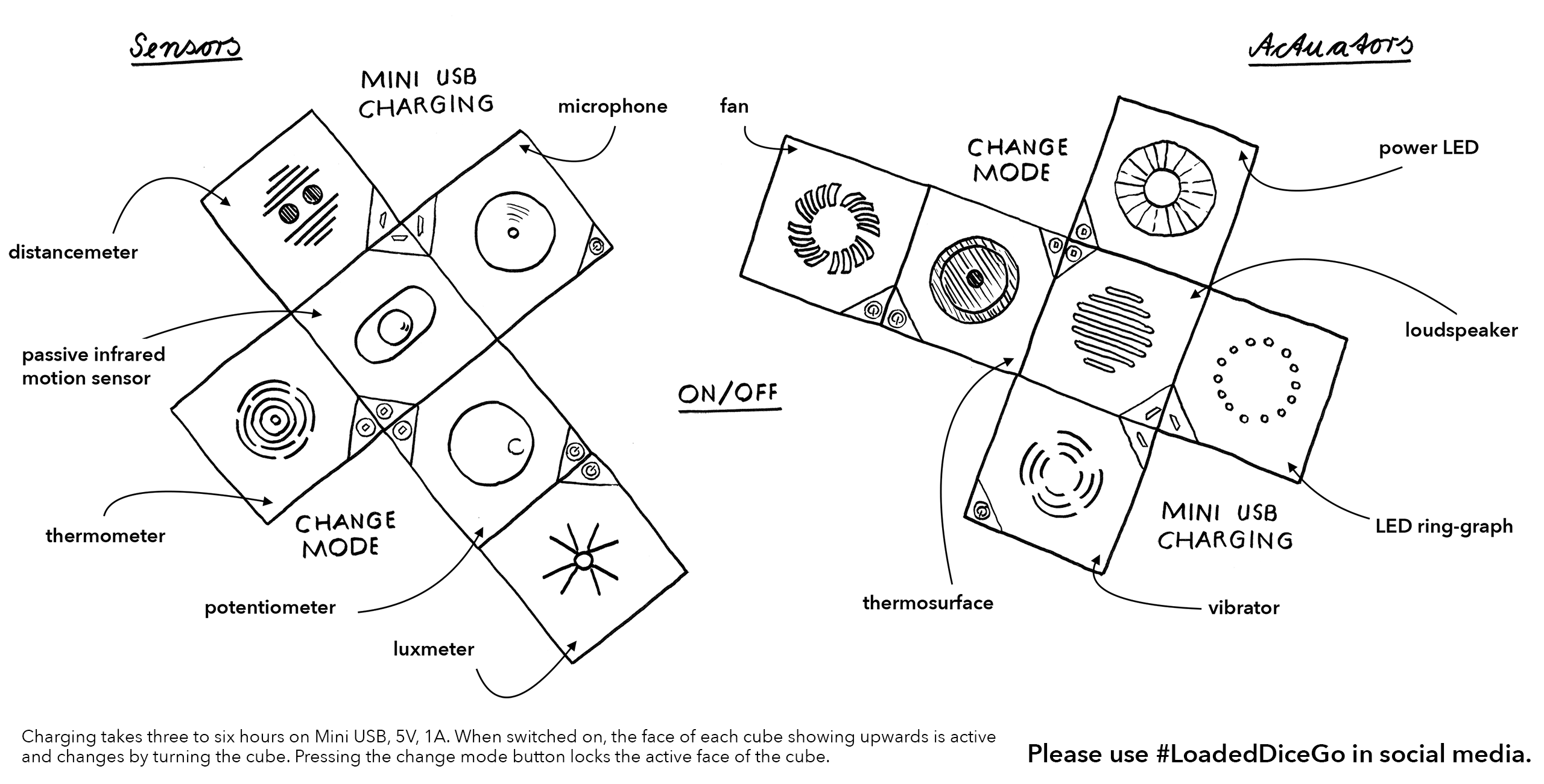
- Thermometer (IR‑thermometer) – detects infrared heat up to 15‑20 cm. Mapping: 0 °C → 0 … 100 °C → 24 (linear).
- Ultrasonic distance – max 1 m. Mapping: >100 cm → 0, ~72 cm → 1, ~3 cm → 24 (linear).
- Potentiometer (turn‑dial) – 0 ° → 0 … 270 ° → 24 (linear).
- Acoustic sensor (microphone) – measures max amplitude in ~50 ms. Mapping: ~0 → 0 … max → 24 (linear).
- Luxmeter – measures luminance. Mapping: ~0 → 0 … max → 24 (linear).
- PIR motion sensor – detects motion of warm objects up to 3‑4 m. Mapping: ~0 → 0, else → 24.
– Actuators –
- LED ring‑graph – visualises the measured value with 24 LEDs, colour‑coded per sensor.
Sensor Measured Quality Color Code IR‑thermometer Temperature red luxmeter Luminance yellow ultrasonic distance Distance violet microphone Sound / Volume green PIR motion detection Heat + Motion cyan manual turn‑dial Position of dial blue battery – by powering on Voltage red (empty) → green (fully loaded) - Thermosurface (Peltier) – heats on touch, activated by a capacitive sensor (LED on the side lights up). CAREFUL! DANGER OF BURNING!
- Power‑LED – brightness proportional to the measured value (non‑linear).
- Loudspeaker – pitch proportional to the measured value.
- Vibrator – vibration strength proportional to the measured value.
- Fan – rotation speed proportional to the measured value.
Can I modify the current sensor / actuator functions? Currently you cannot change the sensor‑actuator mapping or parameters. Higher sensor values will always produce higher/faster actuator effects. If you need a different behaviour, let us know – we are interested in your use‑case.
Charging
General advice – Loaded Dice use built‑in Lithium‑Ion battery packs (1 cell per cube, 3.7 V, 2600 mAh, < 10 Wh). Charge via the Mini‑USB slot using the supplied spiral cable or any Mini‑USB cable. Use a 5 V, 1 A power adapter. The first charge should be a full 6 h to balance the cells. An integrated protection circuit prevents over‑charging and deep discharge.
Universal charging tips for Li‑Ion devices: Do not leave the device unattended while charging. Place the cubes on a non‑combustible surface and keep flammable objects away. For transport, follow the advice in the “Transportation” section.
How long does it take to charge? Approximately 3‑6 h depending on the charger.
How do I know if they are fully charged? There is no external indicator. After a full charge (≈ 6 h) you can assume they are full. An internal orange LED (visible through the casing in a dark room) turns off when the battery is full.
How do I read the state of charge?
- Place the Actuator cube with the LED‑ring facing upwards.
- Power it on.
- After a few seconds the ring shows the charge level for ~2 s.
The Sensor cube uses the same ring on the Actuator cube (place the Sensor cube next to a powered‑on Actuator cube).
Colour/number of lit LEDs:
- Green – fully charged
- Yellow – ~50 % charge (start planning a recharge)
- Orange / Red – low charge, recharge immediately
Operating time – depends on usage, typically 1‑several hours.
How to discharge safely? Keep the cubes powered on until the battery is empty. Do **not** use the Peltier element to speed up discharge – it can cause overheating.
Transportation
General advice – Loaded Dice contain Li‑Ion batteries and ZigBee radios. Whenever possible transport them **powered off** and **discharged**.
Carry‑on luggage – Follow IATA regulations for devices with Li‑Ion batteries. Keep the cubes in your carry‑on bag and ensure they are not switched on during the flight. The batteries should be below the 100 Wh limit (our packs are ~10 Wh).
Postal delivery – Use sturdy packaging, preferably with shock‑absorbing material. Insure the package (value ≈ €1 000 per pair). If the battery is damaged, **remove it** before shipping and contact us first.
Useful links:
Defects and Loss of Function
I cannot turn on Loaded Dice – Make sure they are fully charged (first charge = 6 h). If they still do not power up, contact us.
Self‑diagnosis – On power‑up the cubes run a self‑check. If a sensor/actuator fails, the LED on that face blinks fast (≈ 5 Hz). If the internal accelerometer fails, the green ‘Mode’ LED blinks fast.
Fast‑blinking green ‘Mode’ LED – Accelerometer error.
One sensor/actuator stopped working – Fully charge the cubes and try again. If the problem persists, email us.
Vibration actuator stopped – The motor may be blocked. A gentle tap from the side often frees it.
Physical damage – Do **not** attempt to open the cubes yourself. Contact us with a description and your location. We will arrange repair or replacement.
Opening the cubes – PLEASE DO NOT OPEN LOADED DICE YOURSELF! The internal wiring is delicate and soldered for minimal size. If you need to see the internals, refer to our RtD 2017 article.
Problem persists after following the FAQ? – Send both cubes back (see “Transportation”). Include a short description of the issue and your contact details.
Contact Us
If you have technical difficulties, general questions, or just want to say »hi«, you can reach us at:
Dr.-Ing. Albrecht Kurze & Prof. Dr. Arne Berger (HS Anhalt)
The Miteinander group is funded by the German Ministry of Education and Research under grant number FKZ 16SV7116.