The wavelength-dependent (monochromatic), Rosseland mean and Planck
mean opacities are computed for temperatures between  K and
K and
 K and gas density ranges
  g cm
g cm and
and
 g cm. The opacity model is described in more
details in the paper by Semenov et al. [1]. The main
advantage of our model is that works well for a wide range of
the gas temperatures as well as gas densities, where diversity of
the relevant physical processes causes the many recent models to
fail.
g cm. The opacity model is described in more
details in the paper by Semenov et al. [1]. The main
advantage of our model is that works well for a wide range of
the gas temperatures as well as gas densities, where diversity of
the relevant physical processes causes the many recent models to
fail.
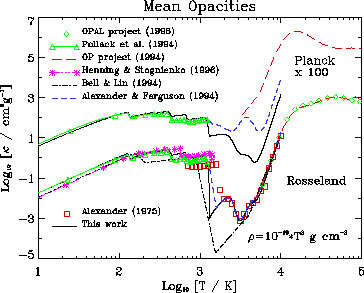
To illustrate the results of our investigations, we compare Rosseland and Planck mean opacities calculated by the recent opacity models in Fig. 1.
Additionally, we study how different Rosseland mean values may
affect the thermal structure of active accretion disks. We use
a full 2D hydrodynamical code designed to simulate the
interaction of the protoplanetary disk matter with a protoplanet
and apply three various opacity tables to compute the disk midplane
temperature (courtesy to G. D'Angelo). It is plotted in
Fig. 2, where the corresponding disk models parameters are
indicated. One may figure out immediately that the midplane
temperature values can differ by up to  . This tells us about
the importance of a proper opacity modelling.
. This tells us about
the importance of a proper opacity modelling.
Another aim was to make the opacity tables together with representative figures, tables and data easily accessible to the scientific community. We created a corresponding web-page and put it on the Internet: http://www.astro.uni-jena.de/Users/henning/Opacities/opacities.html.
The results of this work were reported in the NATO advanced workshop ''On the Optics of Cosmic Dust'', Bratislava, 16-19 November 2001 and presented in a poster during ``Stellar Atmosphere Modelling'' workshop, Tübingen, 8-12 April 2002 [2].