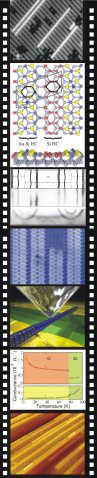
Atomic wires have received much experimental and theoretical attention during the last few years. The physical properties of a material depends strongly on its dimensionality. One-dimensional systems are especially interesting because they exhibit a wealth of exotic physical phenomena such as the quantization of conductance, Peierls instability, spin and charge density waves, magnetism and Luttinger liquid behavior.
Using both experimental and theoretical surface science based approaches, the ultimate limit for the fabrication and description of metallic quantum wires, with widths of single atoms, has become accessible. Growing these quantum objects by self-assembly on surfaces as templates, their interactions can be controlled, manipulated and studied selectively. E.g. towards technological applications, accompanied instabilities, typical for low dimensional structures, can be studied as well.