Energy and material savings through simulation-based process chain optimisation
In the project “Simulation-based property design along the combined primary and forming technology process chain -SiPro“, funded by the Federal Ministry for Economic Affairs and Energy (BMWE), the researchers addressed the question of how production-related resource expenditure and CO2 emissions in metal processing can be minimised through optimally designed process chains. In the now completed joint project, this question was examined in detail for successive and combined primary and forming processes.
The key point was to use commercial and therefore „industry-compatible“ software solutions to map the process steps and energy expenditure consistently and across all process stages and to optimise their potential energy savings. An important boundary condition was that the products manufactured in this way should have the same properties as those resulting from conventional process chains.
The research and development work in the „SiPro“ project was strongly interlinked between the participating universities, small and medium-sized companies and large industries right from the start. The close collaboration between industry and research, which lasted more than three years, made it possible to develop new interfaces between the casting simulation software MAGMASOFT ® and the forming programme Simufact.Forming ® and transfer it to industrial utilisation. For the first time, a continuous simulation of the manufacturing process from the melt to the formed and heat-treated semi-finished product or component was implemented and could be validated by the project partners with results from real casting and forming processes. The WOT professorship provided the material data for the steels investigated in the various process stages by carrying out extensive systematic material characterisations. This enabled the end-to-end simulation of the process chain and its validation.
As a result of the „SiPro“ project, various options for saving process energy were identified, such as shorter heating strategies, reduced forging temperatures or more compact heat treatment routes. The completed project thus shows a way in which simulation-based process chain optimisation can reveal potential for reducing energy expenditure and CO2 emissions in metal processing without having to carry out complex experimental test series.
(SZF), Institut für Metallformung (IMF), Georgsmarienhütte GmbH with subcontractor Mannstaedt GmbH, Schmiedewerke Gröditz GmbH, Edelstahl Rosswag GmbH with subcontractor GSA Gesenkschmiede Schneider GmbH, Karl Diederichs GmbH & Co. KG – Dirostahl and MAGMA Gießereitechnologie GmbH with subcontractor Auerhammer Vacuum-Gießerei GmbH.
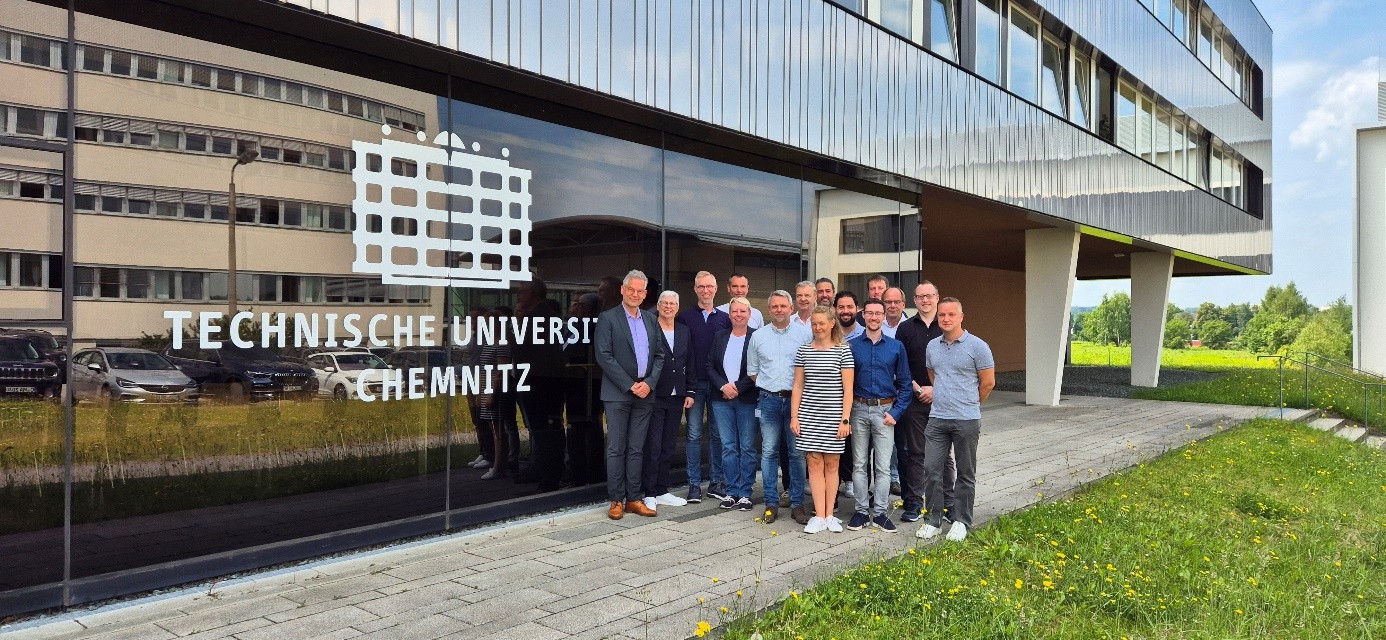
Image: Representatives of the project consortium „SiPro“ at the final meeting on 18 June 2025 at Chemnitz University of Technology; From left to right: Prof Ulrich Prahl (TUBAF), Prof Birgit Awiszus (TUC), Prof Thomas Lampke (TUC), Sebastian Kolb (Mannstaedt GmbH), Dr Caroline Binotsch (TUC), Dr Kai Kittner (TUC), Armin Franke (SFZ), Christoph Klameth (Edelstahl Rosswag), Nadine Lehnert (IWU), Dr Ing.Ing. Kai Kittner (TUC), Armin Franke (SFZ), Christoph Klameth (Edelstahl Rosswag), Nadine Lehnert (IWU), Dr-Ing. Riadh Omri (GMH), Tim Bergelt (TUC), Peter Hilbig (PTJ), Frank Hoffmann (TUBAF), Sebastian Koldorf (MAGMA), Dr.-Ing. Tim Lehnert (IWU) (Photo: private/WOT)
15.7.2025 – Projects of the professorship ( tim.bergelt@mb… )